- The June 1 debt-market signal is worth publishing because it is not another generic “AI spending is expensive” story.
- Amazon provides the clearest hard number.
- Alphabet makes the pattern broader.
- Section
- Markets
- Read time
- 6 min read
- Data included
- Why AI financing now matters to global credit markets
Why AI financing now matters to global credit markets
The new signal is not just more borrowing. It is hyperscalers using multiple currency markets as part of the infrastructure funding stack.
June 1 credit signals
| Market layer | Why the AI buildout now shows up there |
|---|---|
| Euro credit | AI capex is large enough to support record-sized overseas issuance. |
| Cross-currency funding | Hyperscalers are diversifying investor bases and matching global assets with broader financing pools. |
| Fixed-income risk transfer | Bond investors outside the U.S. are becoming part of the funding base behind long-duration AI infrastructure. |
Sources: Reuters June 1, 2026 analysis; Amazon March 16, 2026 8-K; Alphabet March 31, 2026 10-Q.
The June 1 debt-market signal is worth publishing because it is not another generic “AI spending is expensive” story. Reuters reports that hyperscaler debt issues outside the United States are becoming part of an early funding-diversification push as Big Tech prepares to finance years of AI infrastructure investment, especially data centers. That turns global bond markets into part of the AI buildout itself.
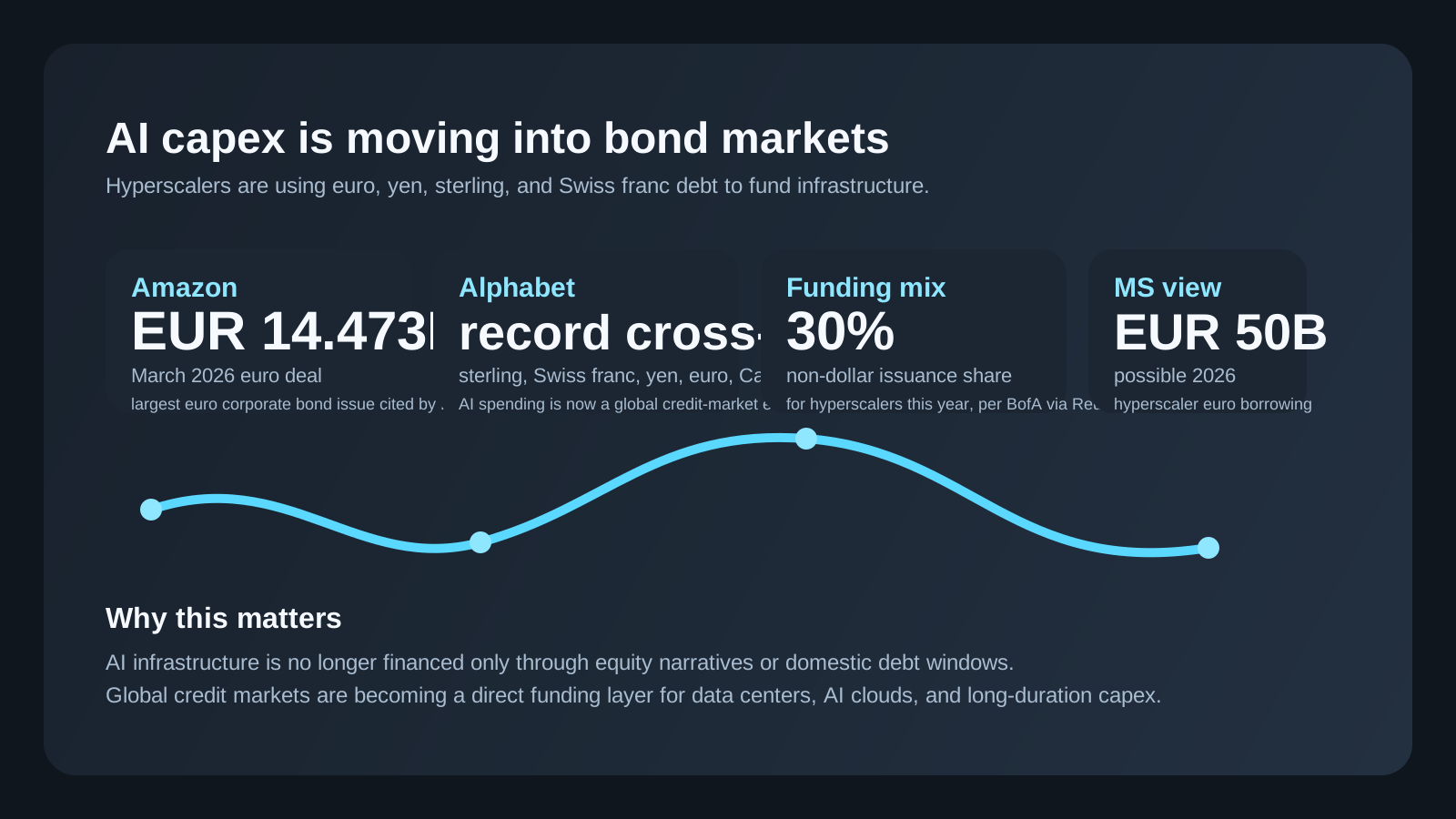
Amazon provides the clearest hard number. In a March 16 filing, the company disclosed that it closed the sale of euro-denominated notes with an aggregate public offering price of EUR 14.473 billion. Reuters says that deal was the largest ever in the euro corporate bond market. That is not a side detail. It is a sign that AI-era infrastructure funding is now large enough to matter to overseas fixed-income markets, not just to U.S. equity narratives.
The AI buildout is no longer just an equity-market story. It is becoming a structural demand story for global bond markets too.
Alphabet makes the pattern broader. Reuters says the company has already become one of the largest outstanding borrowers in sterling and Swiss franc corporate bond markets, and that its deals in yen, Canadian dollars, Swiss francs, and sterling each set borrowing records in those currencies. The useful read is not only that Alphabet borrowed. It is that AI-related capex is large enough to be staged across multiple currency pools and investor bases.
The original Grid Report angle is that hyperscaler capex is becoming a bond-market story. That matters because the AI trade is usually discussed through stocks, earnings, and chip demand. Debt markets tell a different story: how much financing depth exists, how aggressively companies want to diversify funding sources, what currencies they prefer, and how global investors are pricing long-duration AI infrastructure risk.
Reuters says hyperscalers’ non-dollar issuance has risen to 30% of their total bond funding this year, citing Bank of America, and that Morgan Stanley expects around EUR 50 billion of euro borrowing from hyperscalers this year. If that continues, AI spending stops being a niche technology capital-markets theme and becomes a structural demand driver for European and other non-dollar credit markets.
For operators, this is a financing signal. The AI cloud and data-center race is no longer funded only through retained cash or U.S. domestic debt windows. If the biggest buyers of power, servers, campuses, and cloud infrastructure are tapping overseas debt markets more aggressively, then the cost and availability of global credit become part of the operating environment behind AI expansion.
For investors, the implication is that AI risk is spreading across another asset class. That can be constructive when demand is strong and hyperscalers are perceived as elite credits. It also means bond investors in Europe, Japan, Switzerland, and Canada are becoming more exposed to the durability of AI capex, data-center economics, and the question of whether hyperscaler spending keeps compounding at the expected pace.
This differs from the site’s CoreWeave credit story, which focused on GPU-backed contracts becoming a public credit asset. The hyperscaler debt story sits one level higher. It is about Amazon and Alphabet turning sovereign and corporate bond markets abroad into a funding layer for the physical AI buildout.
The reason to publish this now is that Reuters’ June 1 analysis provides a fresh and specific market hook, while Amazon’s March filing gives the hard financing evidence. The AI buildout is no longer just moving stocks. It is starting to reshape where global corporate debt gets issued and who ends up funding the infrastructure race.
Sources
Reuters, “AI debt sales reshape global corporate bond markets,” June 1, 2026: https://www.investing.com/news/economy-news/analysisai-debt-sales-reshape-global-corporate-bond-markets-4718020
Amazon.com, Inc. Form 8-K, March 16, 2026: https://www.sec.gov/Archives/edgar/data/1018724/000110465926028556/tm266670d9_8k.htm
Alphabet Inc. Form 10-Q for quarter ended March 31, 2026: https://www.sec.gov/Archives/edgar/data/1652044/000165204426000048/goog-20260331.htm
By Nawaz Lalani
The Grid Report is written by Nawaz Lalani and focuses on source-backed coverage of AI infrastructure, grid power demand, automation systems, and market signals.
Follow the signal, not just the headline.
Get the daily Grid brief for source-backed coverage on AI power demand, infrastructure timing, automation, and market signals.