- Nextpower’s May 28 agreement to acquire Prevalon Energy is worth publishing because the core signal is stronger than a plain battery-storage expansion story.
- The May 28 release states that Prevalon brings more than 6 gigawatt-hours of deployed BESS systems and 1.3 gigawatts of firm supply contracts supporting AI and hyperscaler data center infrastructure deployments.
- The original Grid Report angle is that battery storage is becoming a power-conditioning trade for AI, not only an energy-arbitrage trade for utilities.
- Section
- Markets
- Read time
- 6 min read
- Why this page exists
- The Grid Report publishes operator-grade coverage on AI, power, infrastructure, automation, and markets.
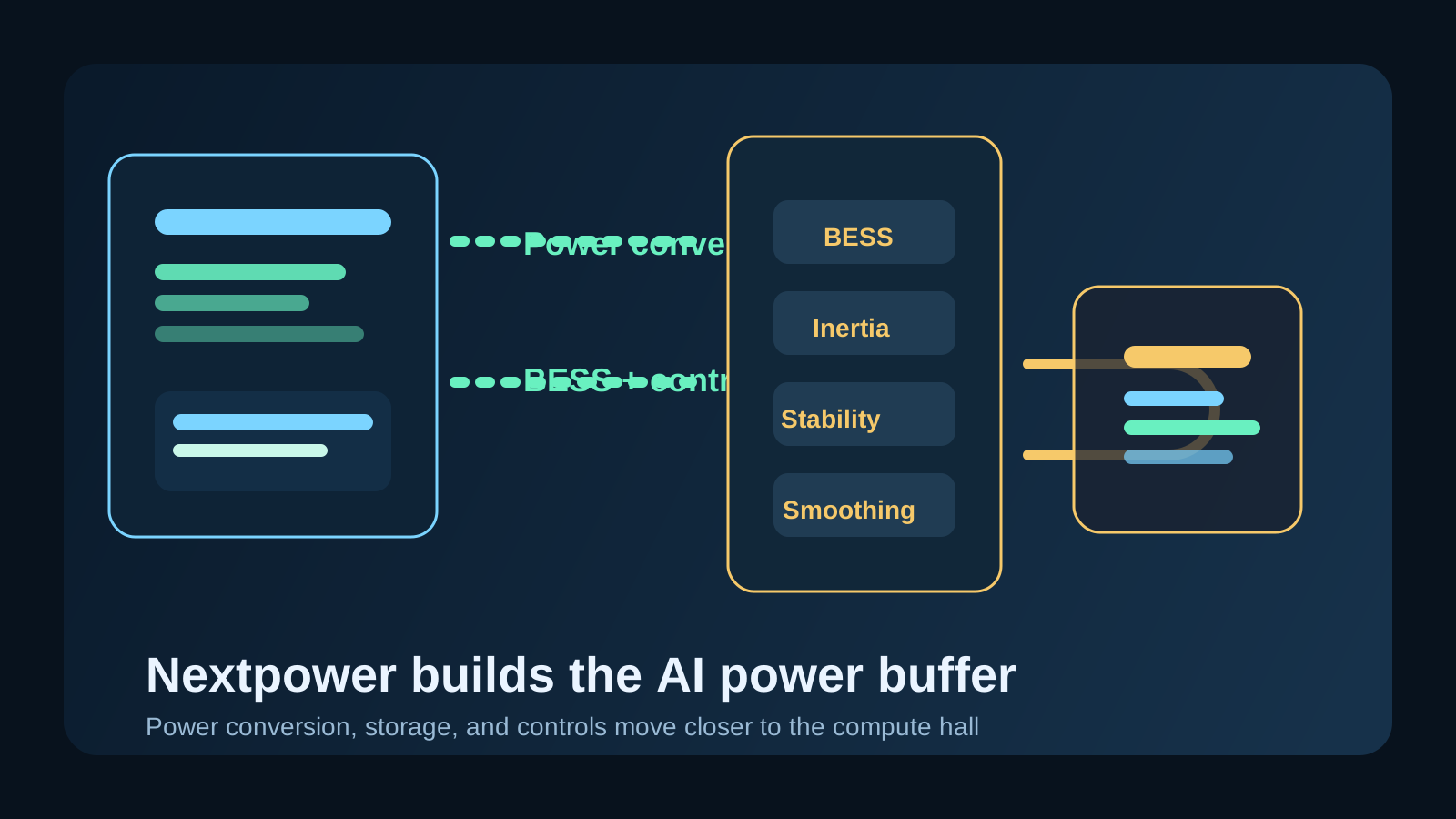
Nextpower’s May 28 agreement to acquire Prevalon Energy is worth publishing because the core signal is stronger than a plain battery-storage expansion story. The company is building a stack around a more specific problem: AI campuses need power systems that do more than supply energy. They need systems that can stabilize rapid load changes, manage contingency events, smooth GPU-intensive demand swings, and help operators work around grid-quality constraints.
The May 28 release states that Prevalon brings more than 6 gigawatt-hours of deployed BESS systems and 1.3 gigawatts of firm supply contracts supporting AI and hyperscaler data center infrastructure deployments. It also says Prevalon’s platform is already engaged with large hyperscalers and can support self-powered AI data centers, private grids, and utility-connected applications. Those are the details that make this publishable. This is not a generic “energy transition” acquisition. It is storage moving directly into the AI campus operating stack.
The emerging AI power product is not only generation. It is the battery-and-controls layer that makes a difficult grid connection usable for high-value compute.
The original Grid Report angle is that battery storage is becoming a power-conditioning trade for AI, not only an energy-arbitrage trade for utilities. Nextpower quotes use cases including inertia support, grid stabilization, contingency management, and GPU AI workload smoothing. That language matters because it describes batteries and controls as operating infrastructure that helps an AI facility behave better electrically, connect more credibly, and preserve uptime under imperfect grid conditions.
The sequence of transactions makes the point sharper. On May 12, Nextpower announced a separate acquisition of advanced power-conversion assets from Zigor and Apex Power, saying the technology would support entry into battery storage and data center markets. Two weeks later, the company layered in Prevalon’s BESS hardware, software, and service capabilities. In practical terms, the company is assembling inverters, storage blocks, and controls into a more complete power-electronics platform aimed at large, complex loads.
That is what clears the duplicate block against the site’s recent energy and infrastructure stories. This is not the same thesis as the EIA gas-forecast piece, which was about the future fuel stack for data-center demand. It is not the same as the DOE oscillation-monitoring article, which focused on reliability measurement of computational loads. And it is not the same as the AI storage article, which dealt with rack-level density and facility power. This story is about the campus-side electrical buffer layer between the grid and the compute hall.
For investors, the raised fiscal 2027 outlook is important, but it is secondary to the category signal. Nextpower is telling the market that storage and power conversion attached to AI infrastructure are not side-adjacencies. They are large enough to move revenue and EBITDA guidance. Once that happens, battery integration for AI stops looking like an experimental edge case and starts looking like a durable capital-allocation lane.
For operators, the implication is straightforward. If grid access arrives with more curtailment risk, power-quality challenges, or contingency requirements, the ability to deploy batteries and controls as part of the campus power architecture becomes a commercial advantage. That can shorten time to useful power, improve resilience, and make difficult sites more workable.
The reason to publish this now is that it is specific, current, and more useful than a broad “AI needs more storage” rewrite. Nextpower’s acquisition language gives a cleaner answer to a more important question: what kind of electrical systems are becoming valuable as AI campuses scale? The answer is increasingly the layer that conditions power quality, not just the layer that generates megawatts.
Sources
Nextpower press release, “Nextpower Announces Entry into Battery Energy Storage and AI Data Center Markets with Definitive Agreement to Acquire Prevalon Energy,” published May 28, 2026: https://nextpower.com/post/press-release/nextpower-enters-battery-energy-storage-bess-market-with-definitive-agreement-to-acquire-prevalon-energy
Nextpower press release, “Nextpower Announces Agreement to Acquire Advanced Power Conversion Product Portfolio,” published May 12, 2026: https://nextpower.com/post/press-release/nextpower-announces-agreement-to-acquire-power-conversion-portfolio
Nawaz Lalani
Nawaz Lalani is the creator of The Grid Report and writes about AI infrastructure, grid power demand, automation systems, and the market signals shaping the physical AI economy. His focus is translating technical and industrial shifts into practical coverage for operators, investors, builders, and teams making real deployment decisions.
B.S. in Geology from UT Arlington. Covers AI infrastructure, energy systems, grid constraints, automation workflows, and market signals.
Stories are built from primary sources, utility and infrastructure signals, company disclosures, filings, and operator-grade context. The goal is to explain what changed, why it matters now, and what it means for builders, investors, utilities, and teams making real deployment decisions.
Follow the lane, not just the headline.
The strongest value in The Grid Report comes from following how AI, infrastructure, power, automation, and markets connect over time.