- IREN’s June 1 financing is worth publishing because the useful signal is not merely that another AI infrastructure company raised a large pool of debt.
- IREN says it closed a $3.65 billion investment-grade GPU financing facility to support delivery of its AI cloud contract with Microsoft.
- That is the original Grid Report angle.
- Section
- Markets
- Read time
- 6 min read
IREN’s June 1 financing is worth publishing because the useful signal is not merely that another AI infrastructure company raised a large pool of debt. The stronger signal is that lenders are starting to treat contracted GPU fleets as financeable infrastructure assets when the revenue counterparty, collateral package, and facility ownership are strong enough. That is a more specific and more durable development than generic enthusiasm around AI capex.
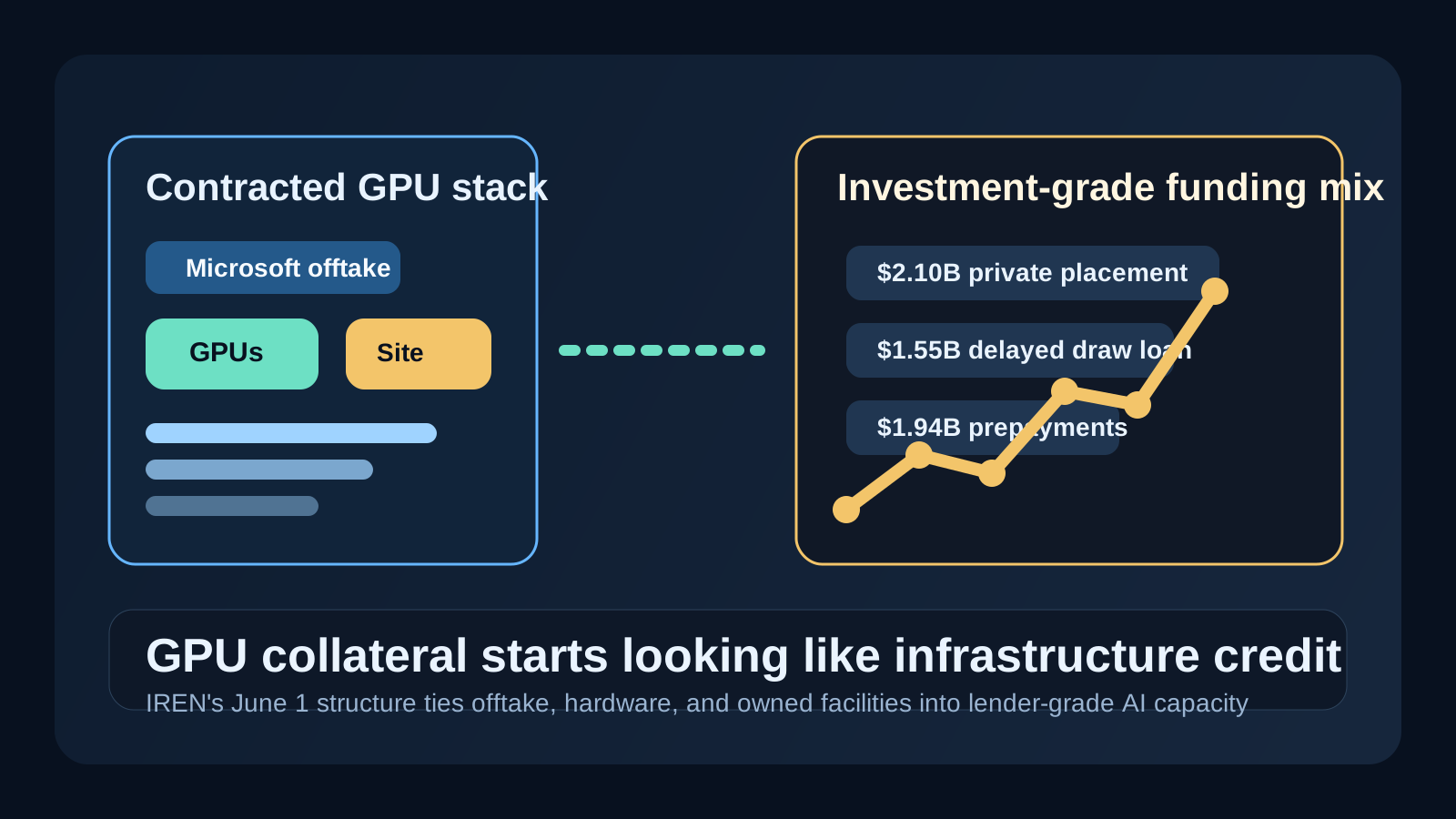
IREN says it closed a $3.65 billion investment-grade GPU financing facility to support delivery of its AI cloud contract with Microsoft. The structure includes a $2.10 billion U.S. private placement at a fixed rate equivalent to SOFR plus 2.13% and a $1.55 billion delayed draw term loan at SOFR plus 2.25%, with interest-rate hedges in place. Fitch and DBRS assigned A and A(low) ratings, and the company says the package funds 96% of its $5.81 billion GPU capex for the Microsoft contract when customer prepayments are included.
The June 1 IREN financing matters because it treats GPUs less like speculative hardware inventory and more like contracted infrastructure collateral.
That is the original Grid Report angle. The market has spent months asking whether GPU clusters should be valued like hot hardware, hyperscaler demand proxies, or speculative compute inventory. IREN is effectively arguing for a fourth bucket: contracted infrastructure credit. Once the debt is secured against the GPUs and the associated contracted cash flows, and once the borrower also owns the data center infrastructure that hosts those systems, the financing conversation starts to look more like project-style underwriting than ordinary growth capital.
That matters because cost of capital is starting to decide who can actually scale AI capacity on time. IREN says the blended debt cost is 6.00%, and that the average financing cost falls to 3.31% when customer prepayments are treated as a zero-cost funding source. In practical terms, that means the company is not just buying hardware. It is turning an offtake contract into a cheaper capital stack. For operators, that is the difference between announcing megawatts and commissioning them without crushing equity dilution.
This clears the duplicate block because it is materially different from the recent CoreWeave loan article and the broader AI debt-sales piece already on the site. Those stories were about public credit appetite and hyperscaler capex pressure in general. This one is narrower and more useful: it shows the financing template by which GPUs, contracted revenue, and owned facility infrastructure can be bundled into an investment-grade collateral story. That is a different thesis and a different search query.
The May 26 IREN release makes the June 1 financing more credible. In that earlier announcement, the company said it had entered into a roughly $1.6 billion purchase agreement with Dell for air-cooled Blackwell systems to support a previously announced five-year, $3.4 billion AI cloud contract at its Childress, Texas campus, with commissioning targeted for early 2027. Read together, the two releases show a pipeline logic: secure the hardware, secure the contract, then secure the credit structure that turns deployment timing into a balance-sheet advantage.
For investors, the implication is that the next valuation spread in AI infrastructure may run through financeability rather than only through installed capacity. Two operators can both claim access to land, power, and GPUs, but the one that can get institutional lenders and insurance capital comfortable with the revenue stream can scale more cheaply and more repeatably. That compresses the advantage of weaker sponsors and raises the premium on counterparties, contract quality, and infrastructure control.
For search performance, the story is strong because it answers a specific live question: what does investment-grade GPU financing actually mean, and why does Microsoft-backed capacity matter? Readers looking for IREN, Microsoft AI cloud financing, GPU private placements, or asset-backed AI infrastructure credit get a clear operator and investor thesis instead of a recycled funding announcement.
Sources
IREN, “IREN Closes $3.65bn Investment-Grade GPU Financing,” published June 1, 2026: https://www.globenewswire.com/news-release/2026/06/01/3304211/0/en/IREN-Closes-3-65bn-Investment-Grade-GPU-Financing.html
IREN, “IREN Targets $4.4bn in ARR with Blackwell Deployment at Childress,” published May 26, 2026: https://www.globenewswire.com/news-release/2026/05/26/3301524/0/en/IREN-Targets-4-4bn-in-ARR-with-Blackwell-Deployment-at-Childress.html
By Nawaz Lalani
The Grid Report is written by Nawaz Lalani and focuses on source-backed coverage of AI infrastructure, grid power demand, automation systems, and market signals.
Follow the signal, not just the headline.
Get the daily Grid brief for source-backed coverage on AI power demand, infrastructure timing, automation, and market signals.