- NVIDIA's June 6 U.K.
- The official facts are unusually specific.
- The release also named the offtake structure.
- Section
- Infrastructure
- Read time
- 5 min read
- Why this page exists
- The Grid Report publishes operator-grade coverage on AI, power, infrastructure, automation, and markets.
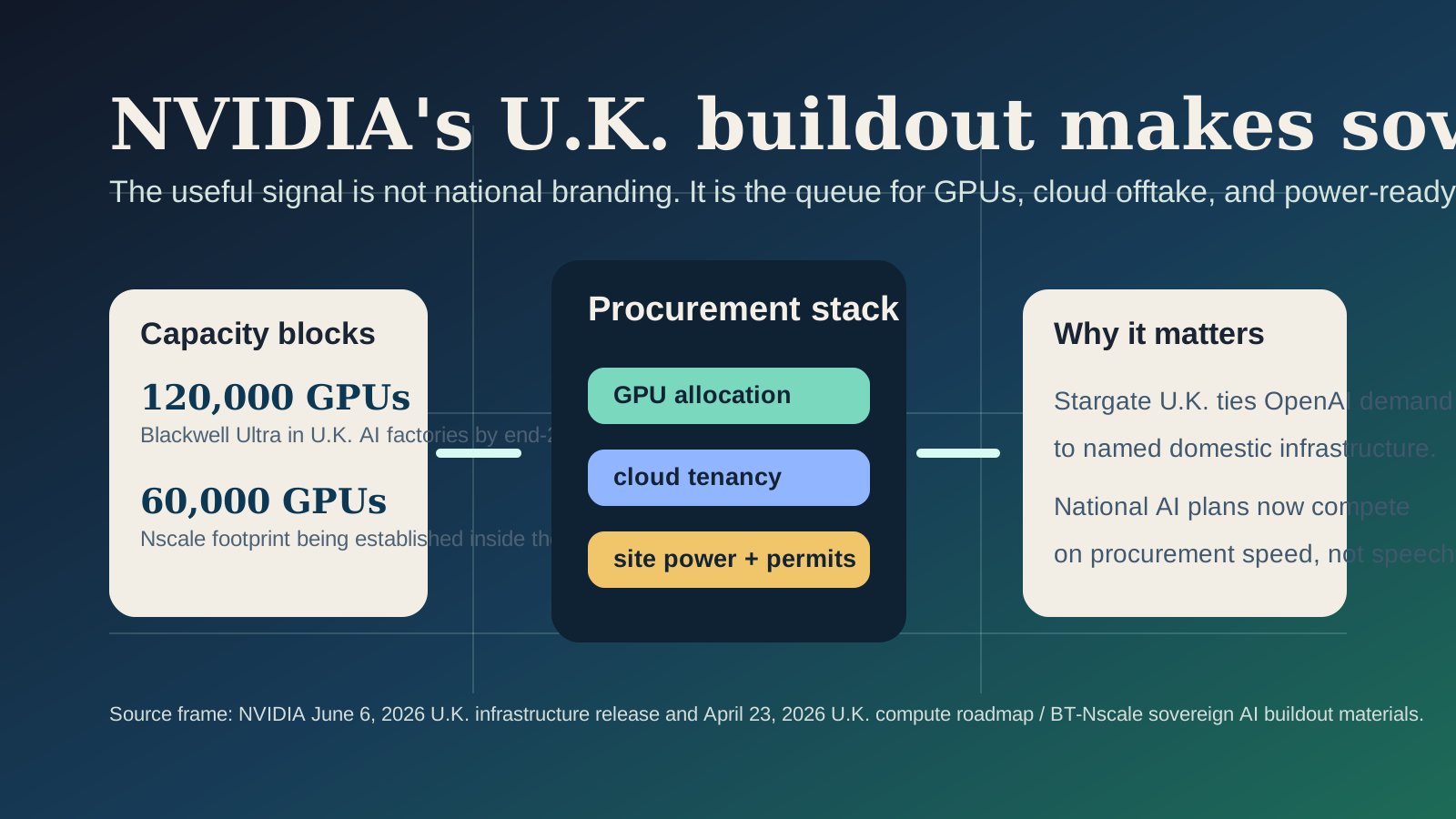
NVIDIA's June 6 U.K. release is worth publishing because the useful signal is not that another country says it wants to lead in AI. The stronger signal is that sovereign AI is hardening into a procurement contest over real capacity. Once a national buildout is expressed as GPU counts, specific cloud offtake, named campuses, and domestic tenancy, the story stops being branding and becomes infrastructure execution.
The official facts are unusually specific. NVIDIA said partners including Nscale, CoreWeave, and Microsoft will build and operate U.K. AI factories by the end of 2026, scaling to up to 120,000 NVIDIA Blackwell Ultra GPUs and up to GBP11 billion for local data centers. It also said Nscale is scaling to 300,000 Grace Blackwell GPUs worldwide, with 60,000 GPUs now being established in the U.K., and that OpenAI is expected to use this infrastructure through Stargate U.K.
The useful U.K. signal is that sovereign AI is no longer a strategy-deck concept. It is a procurement race over GPUs, domestic cloud tenancy, and power-ready campus capacity.
The release also named the offtake structure. NVIDIA said Nscale, OpenAI, and NVIDIA are establishing Stargate U.K. with Blackwell Ultra systems in Nscale's U.K. data centers by 2026, while Nscale and Microsoft plan to build what they describe as the country's most powerful supercomputer in Loughton with more than 24,000 Grace Blackwell Ultra GPUs for Azure services. CoreWeave separately said it will establish an advanced data center in Scotland using Grace Blackwell Ultra GPUs powered by renewable energy.
That level of specificity matters because it changes how to read sovereign AI claims. The binding constraint is not whether a government releases an AI strategy document. It is whether someone has already locked the GPU supply, the cloud customer, the domestic site path, and enough utility-ready capacity to turn a national ambition into usable inference and training throughput. Procurement sequence is becoming the real national-AI moat.
This also clears the duplicate block against the site's recent infrastructure coverage because the thesis is different. The Michigan, Taiwan, and France pieces were about local campus buildout, manufacturing throughput, or prefab deployment speed. This story is about sovereign AI as a procurement stack: GPU reservation, domestic tenancy, and state-aligned siting all moving together around a named OpenAI demand anchor.
The U.K. policy context reinforces that reading. The government's April 23 Compute Roadmap said the country needs large-scale AI infrastructure and warned that without urgent action the U.K. risks over-reliance on foreign infrastructure. NVIDIA's June 6 package is effectively one answer to that problem, but it does so by leaning on foreign suppliers anyway, which means sovereignty here looks less like self-sufficiency and more like secured domestic access to externally controlled hardware and model ecosystems.
For operators and investors, the implication is that sovereign AI will increasingly be won by whoever can combine power, permitting, cloud distribution, and reserved accelerators into one package before capacity tightens again. The national winners may not be the places with the loudest AI rhetoric. They may be the places that convert global vendor relationships into domestically usable compute the fastest.
The Grid Report view is that this clears the search bar because it answers a specific and timely question: what does a serious sovereign AI buildout actually look like on the ground? In the U.K., it now looks like named GPU blocks, specified campuses, explicit OpenAI offtake, and a race to turn political intent into physical compute before the queue gets longer.
Sources
NVIDIA Newsroom PDF, “NVIDIA and United Kingdom Build Nation’s AI Infrastructure and Ecosystem to Fuel Innovation, Economic Growth and Jobs,” published June 6, 2026: https://nvidianews.nvidia.com/_gallery/download_pdf/68c9d80d3d633237c22c9afc/
GOV.UK, “UK Compute Roadmap,” updated April 23, 2026: https://www.gov.uk/government/publications/uk-compute-roadmap/uk-compute-roadmap
Nscale, “BT to work with Nscale to accelerate UK sovereign AI capability, powered by NVIDIA,” published April 23, 2026: https://www.nscale.com/press-releases/nscale-and-bt
Nawaz Lalani
Nawaz Lalani is the creator of The Grid Report and writes about AI infrastructure, grid power demand, automation systems, and the market signals shaping the physical AI economy. His focus is translating technical and industrial shifts into practical coverage for operators, investors, builders, and teams making real deployment decisions.
B.S. in Geology from UT Arlington. Covers AI infrastructure, energy systems, grid constraints, automation workflows, and market signals.
Stories are built from primary sources, utility and infrastructure signals, company disclosures, filings, and operator-grade context. The goal is to explain what changed, why it matters now, and what it means for builders, investors, utilities, and teams making real deployment decisions.
Follow the lane, not just the headline.
The strongest value in The Grid Report comes from following how AI, infrastructure, power, automation, and markets connect over time.