- OpenAI’s June 1 Michigan announcement is worth publishing because it does more than say another AI campus is getting built.
- OpenAI says it broke ground on The Barn, a 1GW data center campus in Saline, Michigan, alongside Oracle, Related Digital, Walbridge, Governor Gretchen Whitmer, and local labor leaders.
- That is the original Grid Report angle.
- Section
- Infrastructure
- Read time
- 6 min read
- Data included
- What OpenAI is promising Michigan
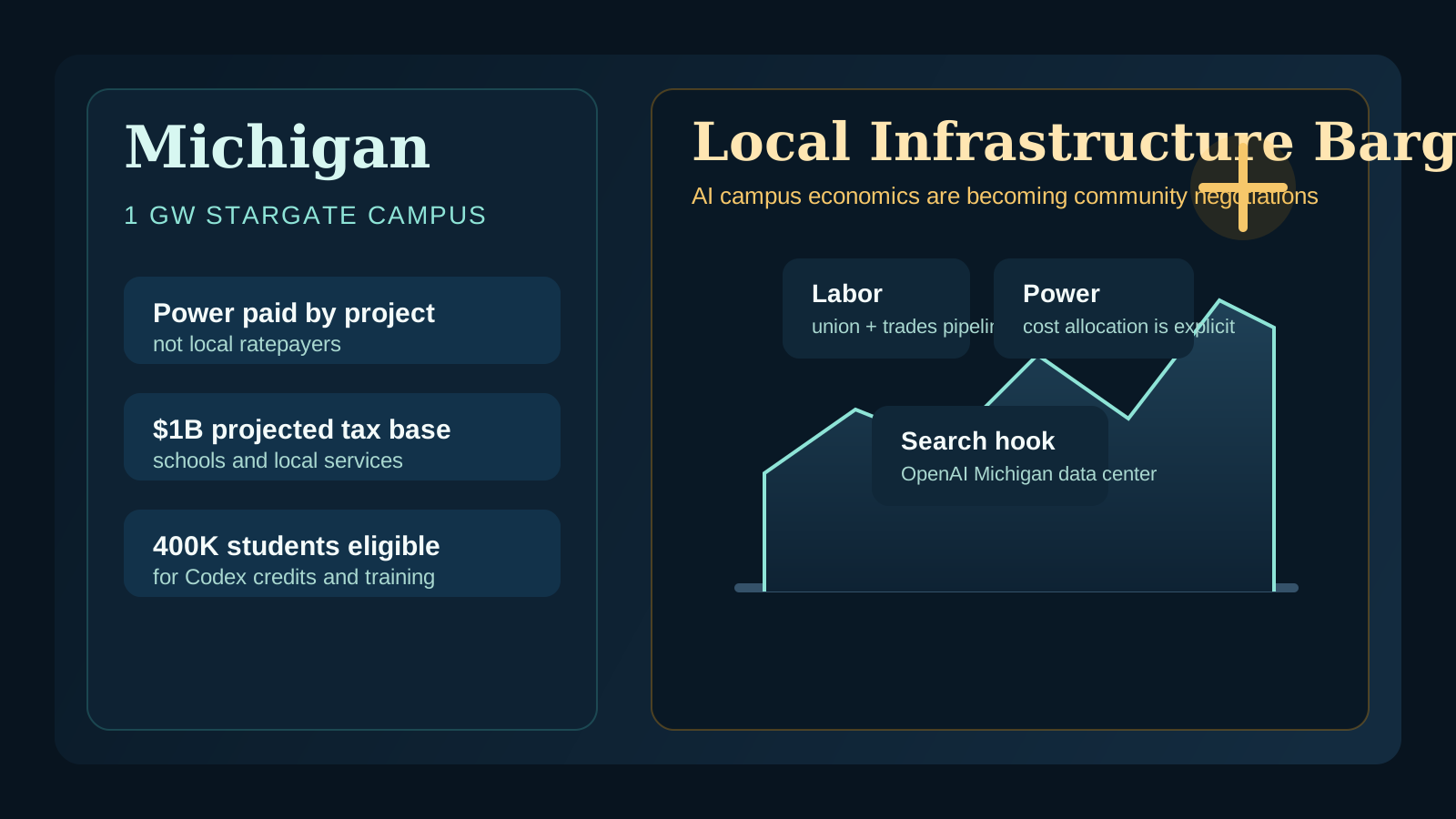
What OpenAI is promising Michigan
The useful thing about the announcement is that it names the local bargain in public rather than hiding behind a generic jobs-and-growth script.
| Commitment | What OpenAI says | Why it matters |
|---|---|---|
| Power and infrastructure cost | Project infrastructure and energy costs will not be passed on to local ratepayers | This is the cleanest answer to the most politically sensitive large-load question. |
| Local public upside | The campus is projected to generate $1 billion in tax revenue over the lease term | Tax contribution is being used to justify the project as a durable local asset rather than a private enclave. |
| Workforce and skills | Up to $45 million in Codex credits for more than 400,000 eligible students plus workforce training partnerships | The campus is being tied to a regional talent pipeline, not only a construction phase. |
| Labor coalition | Groundbreaking included local labor leaders and follows OpenAI’s broader NABTU partnership | Developers increasingly need labor legitimacy alongside land and power readiness. |
Sources: OpenAI June 1, 2026 Michigan announcement and Oracle’s public Michigan campus materials.
OpenAI’s June 1 Michigan announcement is worth publishing because it does more than say another AI campus is getting built. The useful signal is that the company is now packaging AI infrastructure as a local political and economic bargain. In Saline, the headline is not simply 1 gigawatt of future compute. It is a project being sold around explicit commitments on who pays for power infrastructure, who benefits locally, and how the campus ties into labor and workforce pipelines.
OpenAI says it broke ground on The Barn, a 1GW data center campus in Saline, Michigan, alongside Oracle, Related Digital, Walbridge, Governor Gretchen Whitmer, and local labor leaders. The most search-worthy line in the post is the simplest one: local residents will not bear the cost of the infrastructure and energy required to support the project. OpenAI also says the campus is projected to generate $1 billion in tax revenue over the lease term, including support for local schools and services.
The new AI campus question is no longer just how many megawatts a project wants. It is what bargain the developer is offering the community asked to host it.
That is the original Grid Report angle. The next AI campus story is not just power access or construction speed. It is whether developers can show a credible local bargain before backlash hardens. Once data centers become large enough to shape transmission planning, tax politics, and workforce expectations, the winning projects may be the ones that arrive with a cleaner answer to three questions: who pays, who works, and who benefits.
This makes the Michigan update materially different from the site’s earlier OpenAI 10GW story. That article was about national timing pressure around power, land, permitting, cooling, and energization. Michigan is narrower and more operationally useful. It shows what a site sponsor now feels compelled to promise in public when an AI campus enters a real community: no ratepayer cost pass-through, visible tax contribution, labor alignment, and an education or training hook big enough to broaden the coalition behind the buildout.
OpenAI is also pairing the physical campus with a software-and-skills offer. The company says it will make up to $45 million in Codex credits available to more than 400,000 eligible Michigan college, community-college, and trade-school students during the 2026 to 2027 academic year, while also working with the state labor department and participating schools on AI literacy and workforce training. That matters because the project is being framed not only as a compute facility, but as part of a regional talent strategy.
For operators and infrastructure developers, the implication is practical. Large AI campuses are increasingly negotiated as multi-part local packages rather than pure real-estate and utility transactions. It is no longer enough to line up land, interconnection, and equipment. Sponsors may also need a visible answer on customer cost allocation, job quality, training pathways, and tax benefits before local resistance, regulatory scrutiny, or reputational drag starts slowing the project down.
For policymakers, Michigan is a test case for a more disciplined version of AI industrial policy. OpenAI is effectively saying the project should not socialize its energy costs onto residents while still creating public value through taxes and training. That is exactly the kind of structure other states will look for as they decide whether to welcome or resist the next wave of large-load AI campuses.
The reason to publish this now is that the story is specific, timely, and distinct from the site inventory. Readers searching for the OpenAI Michigan data center, Saline campus, or what the company actually promised the community get a clearer answer than a generic groundbreaking recap. The useful thesis is that AI infrastructure is maturing into a negotiated civic bargain, not just a private compute buildout.
Sources
OpenAI, “Building the infrastructure for the Intelligence Age in Michigan,” published June 1, 2026: https://openai.com/index/stargate-michigan-data-center/
Oracle, “Oracle is Set to Power on New Data Center in Michigan,” published December 18, 2025: https://www.oracle.com/news/announcement/blog/oracle-is-set-to-power-on-new-data-center-in-michigan-2025-1018/
Oracle Data Centers, “Saline Township, Michigan Data Center,” accessed June 1, 2026: https://www.oracle.com/data-centers/saline-township/
By Nawaz Lalani
The Grid Report is written by Nawaz Lalani and focuses on source-backed coverage of AI infrastructure, grid power demand, automation systems, and market signals.
Follow the signal, not just the headline.
Get the daily Grid brief for source-backed coverage on AI power demand, infrastructure timing, automation, and market signals.