- NVIDIA’s June 1 AI cloud ecosystem announcement is worth publishing because it adds a distinct layer to the site’s existing Taiwan manufacturing story.
- NVIDIA says its AI cloud ecosystem now reaches six continents following the addition of Cassava in Africa and Claro in South America.
- The original Grid Report angle is that token demand is becoming a regional infrastructure story.
- Section
- Infrastructure
- Read time
- 6 min read
- Data included
- What June 1 adds to the NVIDIA infrastructure map
What June 1 adds to the NVIDIA infrastructure map
The fresh signal is not another chip launch. It is that NVIDIA now has a clearer regional distribution layer for where AI token supply can actually land.
Regional capacity signals
| Infrastructure layer | Why it matters now |
|---|---|
| Regional placement | Capacity close to users, data, and national compliance regimes becomes a commercial advantage. |
| Sovereign control | Governments and regulated industries increasingly want local operating control, not only remote hyperscale access. |
| Power-constrained optimization | More token output per watt can decide which regional clouds bring sellable capacity online first. |
Sources: NVIDIA AI Cloud ecosystem update, NVIDIA DSX announcement, and NVIDIA cloud partner materials accessed June 1, 2026.
NVIDIA’s June 1 AI cloud ecosystem announcement is worth publishing because it adds a distinct layer to the site’s existing Taiwan manufacturing story. Taiwan was about how fast the industrial base can assemble racks. This update is about where those racks, tokens, and inference services get positioned once they exist. The next AI bottleneck is not only manufacturing throughput. It is regional capacity distribution.
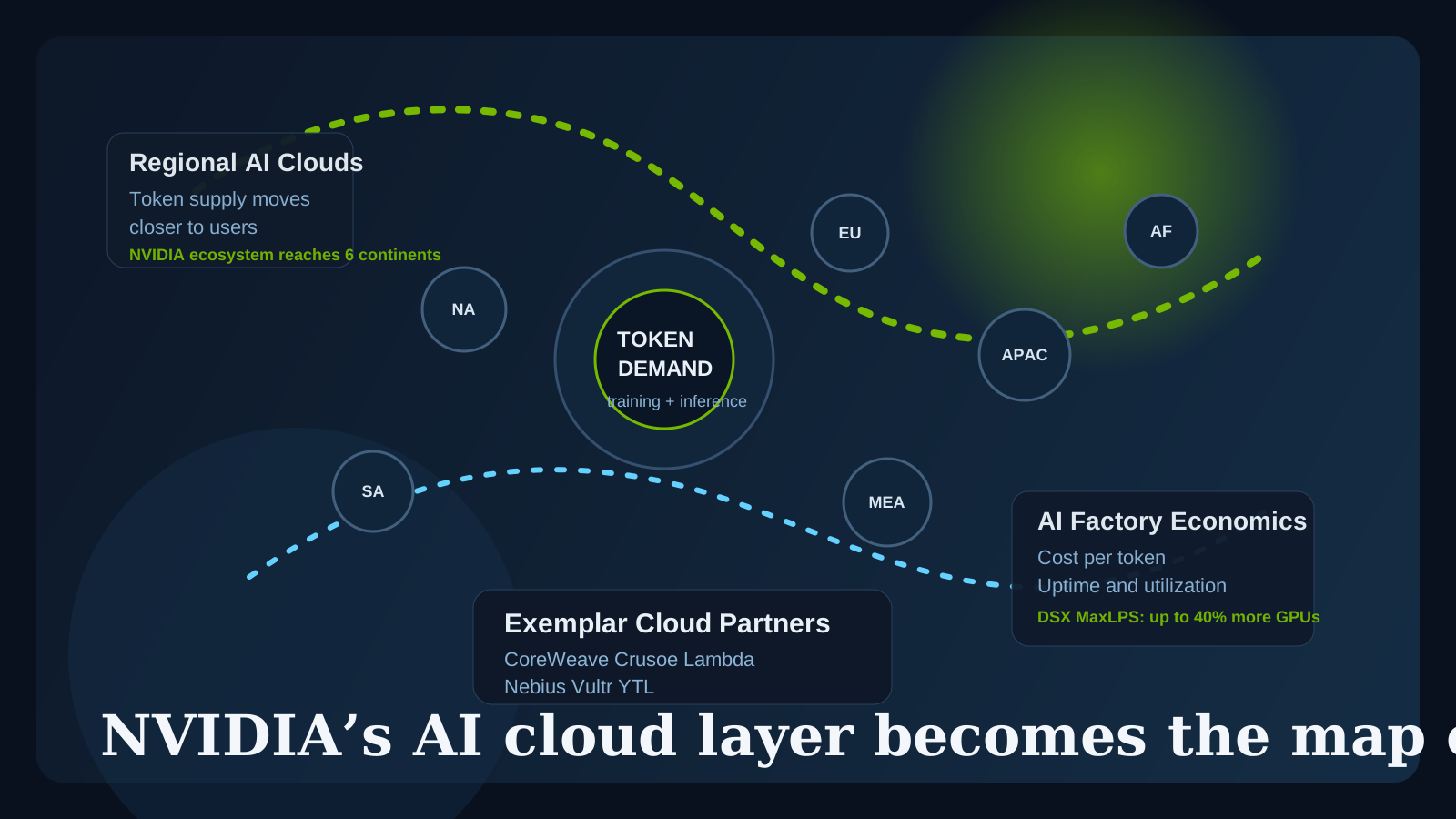
NVIDIA says its AI cloud ecosystem now reaches six continents following the addition of Cassava in Africa and Claro in South America. That matters because the useful unit is no longer just a giant centralized cluster. It is the ability to place AI factory capacity close to data, compliance rules, latency-sensitive users, national programs, and industries that do not want to depend entirely on one remote hyperscale region.
The next AI bottleneck is not only who can build capacity. It is who can place token supply in the right region, under the right economics, fast enough to matter.
The original Grid Report angle is that token demand is becoming a regional infrastructure story. NVIDIA describes these clouds as purpose-built capacity for enterprises, startups, nations, AI labs, and developers scaling agentic AI applications. Once the demand base widens that far, the problem changes from Who can buy GPUs? to Who can deliver usable inference and training capacity in the right geography, under the right governance structure, with the right operating economics?
The sovereign angle is especially important. NVIDIA explicitly frames regional AI clouds as useful for governments and regulated industries that need local control and compliance. That shifts the AI cloud story away from pure hyperscaler centralization and toward a more distributed map of national and regional capacity pools. In practice, that means AI infrastructure is starting to resemble telecom and energy infrastructure: still global in technology, but increasingly local in operating control and political importance.
The partner details support that read. Firmus is expanding across Australia and Southeast Asia with modular, liquid-cooled AI factories. CoreWeave is extending its platform for frontier models, physical AI, and robotics-heavy workloads. Nebius is positioning its Token Factory inference layer and Physical AI Workbench as composable infrastructure for developers and autonomous-systems teams. These are not generic resellers. They are regional capacity operators trying to match local demand with a validated NVIDIA stack.
The more strategic signal is NVIDIA’s emphasis on AI factory economics. The company says the measure of infrastructure is shifting toward token output, utilization, uptime, asset life, and cost per token. That is a more operational metric set than the market usually gets from AI announcements. It implies that the winning cloud partner is not only the one with hardware on paper. It is the one that can turn power, cooling, network design, and workload orchestration into lower-cost token supply near actual customers.
That is where DSX matters. NVIDIA says DSX gives cloud providers validated designs, simulation tools, grid-aware workload flexibility, and operations software. Most notably, DSX MaxLPS is presented as enabling up to 40% more GPUs inside a fixed power budget. If accurate in production conditions, that is not a minor optimization. It means regional cloud builders can squeeze more sellable compute out of constrained power envelopes, which directly affects both site economics and time-to-capacity.
For operators, the read-through is that AI-cloud vendor selection is becoming more geographic and infrastructure-specific. The question is not only which model or GPU is best. It is which provider can deliver reliable token output in the right jurisdiction, with acceptable data locality, and with enough power efficiency that the economics hold up at production scale.
For investors, this is a distribution-layer story. The site has already covered financing, power readiness, and manufacturing throughput. NVIDIA’s June 1 update adds another investable layer: regional AI clouds as the channel through which frontier-model demand gets converted into sellable infrastructure services. That broadens the field of potential winners beyond hyperscalers and chip designers to include cloud operators, telecom-linked builders, and sovereign-capacity platforms.
The reason to publish this now is that it clears the duplicate block and has real search value. Readers looking for the NVIDIA AI Cloud ecosystem, Exemplar Cloud status, DSX platform implications, or sovereign AI infrastructure get a specific June 1 hook and a more useful thesis than a generic cloud-partner recap.
Sources
NVIDIA Blog, “NVIDIA AI Cloud Ecosystem Expands Worldwide to Meet Global AI Compute Demand,” June 1, 2026: https://blogs.nvidia.com/blog/ai-cloud-ecosystem/
NVIDIA Newsroom, “NVIDIA Launches DSX Cloud Platform to Design, Simulate and Operate AI Factories,” accessed June 1, 2026: https://nvidianews.nvidia.com/news/dsx-infrastructure-ai-factory
NVIDIA GPU Cloud Partners page, accessed June 1, 2026: https://www.nvidia.com/en-us/data-center/gpu-cloud-computing/partners/
By Nawaz Lalani
The Grid Report is written by Nawaz Lalani and focuses on source-backed coverage of AI infrastructure, grid power demand, automation systems, and market signals.
Follow the signal, not just the headline.
Get the daily Grid brief for source-backed coverage on AI power demand, infrastructure timing, automation, and market signals.