- NVIDIA’s June 7 SK hynix announcement is worth publishing because the useful signal is not that a leading GPU company and a leading memory company want to work together more closely.
- The official release is specific enough to justify that reading.
- The second signal is manufacturing depth.
- Section
- Infrastructure
- Read time
- 5 min read
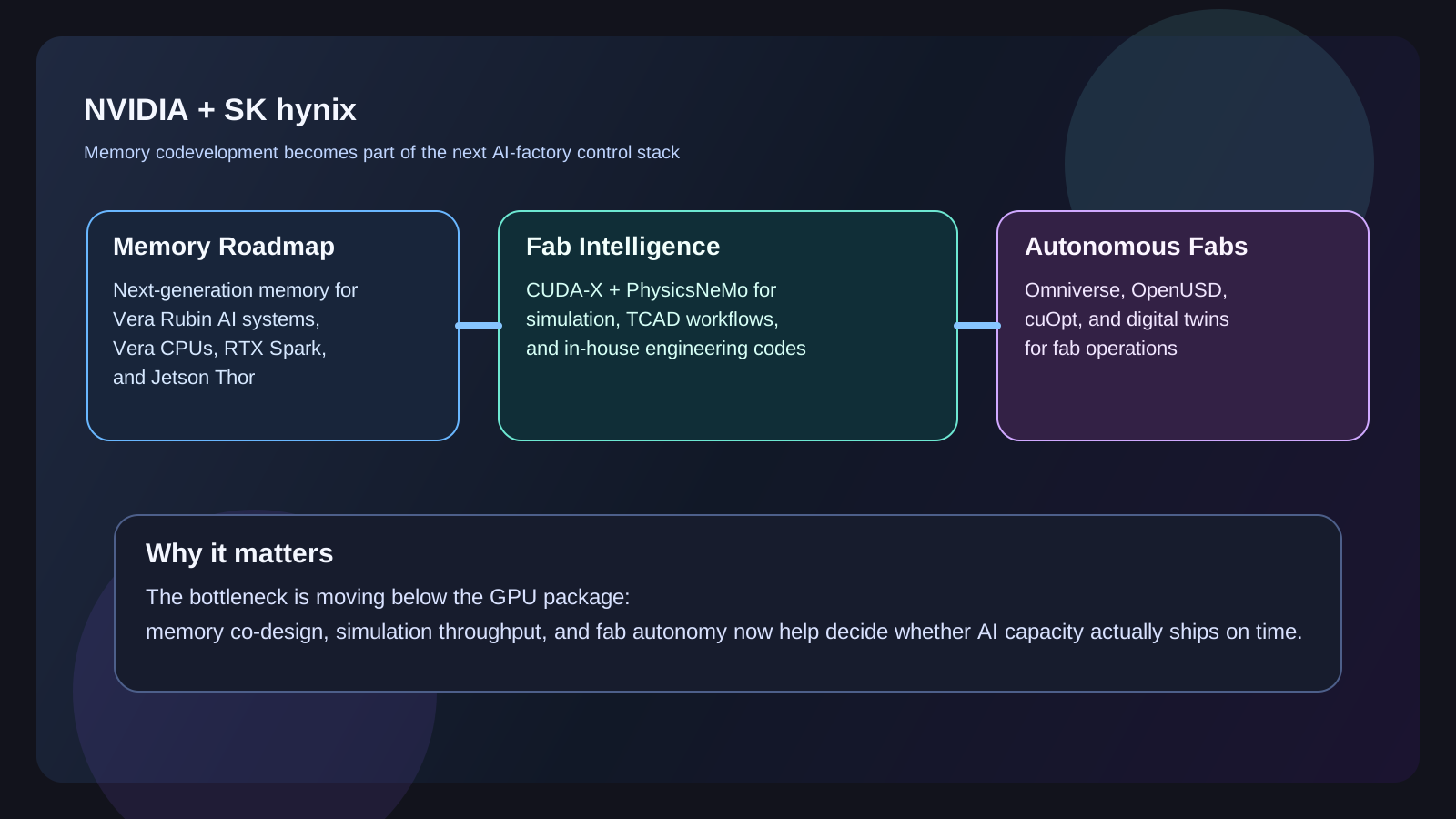
NVIDIA’s June 7 SK hynix announcement is worth publishing because the useful signal is not that a leading GPU company and a leading memory company want to work together more closely. The stronger signal is that the AI-factory bottleneck is moving below the accelerator package. Memory codevelopment, fab simulation throughput, and autonomous manufacturing are starting to matter as much as finished server assembly in deciding whether the next AI-capacity wave actually arrives on time.
The official release is specific enough to justify that reading. NVIDIA and SK hynix say the multiyear partnership covers next-generation memory aligned to NVIDIA’s infrastructure roadmap, with codevelopment support for Vera Rubin AI supercomputers, Vera CPUs, RTX Spark-powered PCs, and Jetson Thor robotic platforms. That matters because advanced memory is no longer a commodity add-on to the AI stack. It is a roadmap-coupled dependency across training systems, inference endpoints, personal AI devices, and physical-AI hardware.
The useful NVIDIA and SK hynix signal is that the next AI-factory bottleneck may sit in memory codevelopment and fab autonomy, not only in GPUs or racks.
The second signal is manufacturing depth. The companies say they will apply NVIDIA CUDA-X libraries and PhysicsNeMo to semiconductor simulation, including technology computer-aided design workflows and in-house engineering codes. That is not a marketing side note. It suggests AI demand is now feeding back into the upstream design-and-process layer of memory production itself, where faster simulation cycles can influence yield, tool qualification, and time-to-volume.
The third signal is operational. SK hynix says it will advance fab digital twins with NVIDIA Omniverse, OpenUSD scene optimization, and cuOpt to support autonomous fab operations. Once digital twins, robot routing, and decision-optimization engines enter the memory-fab discussion, the supply-chain question stops being only how many wafers can be processed. It becomes how intelligently a plant can be modeled, scheduled, and adapted as product complexity rises.
That makes this more than a sequel to the site’s recent TSMC or NVIDIA ecosystem coverage. The TSMC piece was about AI improving yield and cycle time inside a foundry. The Taiwan ecosystem piece was about rack and manufacturing throughput. The Doosan piece was about industrial-stack breadth across robotics, power, and materials. This SK hynix story is different. It pulls memory roadmap control, semiconductor simulation, and autonomous fabs into one supply-assurance thesis.
For operators buying AI infrastructure, the implication is that future delivery risk sits deeper in the bill of materials than most public announcements suggest. For investors, the useful signal is that memory vendors with close roadmap alignment and advanced manufacturing automation may capture a more strategic role in the AI capex cycle than simple component-supplier framing implies. For infrastructure builders, the message is clear: the next capacity crunch may be won by whoever can compress design-to-volume timelines in the memory layer, not only by whoever can source more GPUs.
There is also a broader platform implication. By spanning Vera Rubin systems, Vera CPUs, RTX Spark devices, and Jetson Thor robotics, the agreement suggests NVIDIA wants its memory partners aligned across nearly every compute form factor it is pushing into market. That makes the relationship look less like ordinary procurement and more like an attempt to synchronize one critical bottleneck across multiple product generations at once.
The Grid Report view is that this clears the search bar because it answers a more useful question than “who announced a partnership?” The better question is where the AI-factory bottleneck is moving next. This week’s answer is deeper into memory codevelopment, simulation infrastructure, and fab autonomy.
Sources
NVIDIA Newsroom, “NVIDIA and SK hynix Announce Multiyear Technology Partnership to Advance Memory for AI Factories,” published June 7, 2026: https://nvidianews.nvidia.com/news/nvidia-and-sk-hynix-announce-multiyear-technology-partnership-to-advance-memory-for-ai-factories
NVIDIA Newsroom archive page for June 7, 2026 partnership announcements in South Korea, accessed June 8, 2026: https://nvidianews.nvidia.com/news
By Nawaz Lalani
The Grid Report is written by Nawaz Lalani and focuses on source-backed coverage of AI infrastructure, grid power demand, automation systems, and market signals.
Follow the signal, not just the headline.
Get the daily Grid brief for source-backed coverage on AI power demand, infrastructure timing, automation, and market signals.