- The European Commission’s June 3 Cloud and AI Development Act is worth publishing because the useful signal is not another sovereignty slogan.
- The Commission’s own framing is unusually explicit.
- The most useful infrastructure angle is that Brussels is not only trying to add more capacity.
- Section
- Infrastructure
- Read time
- 5 min read
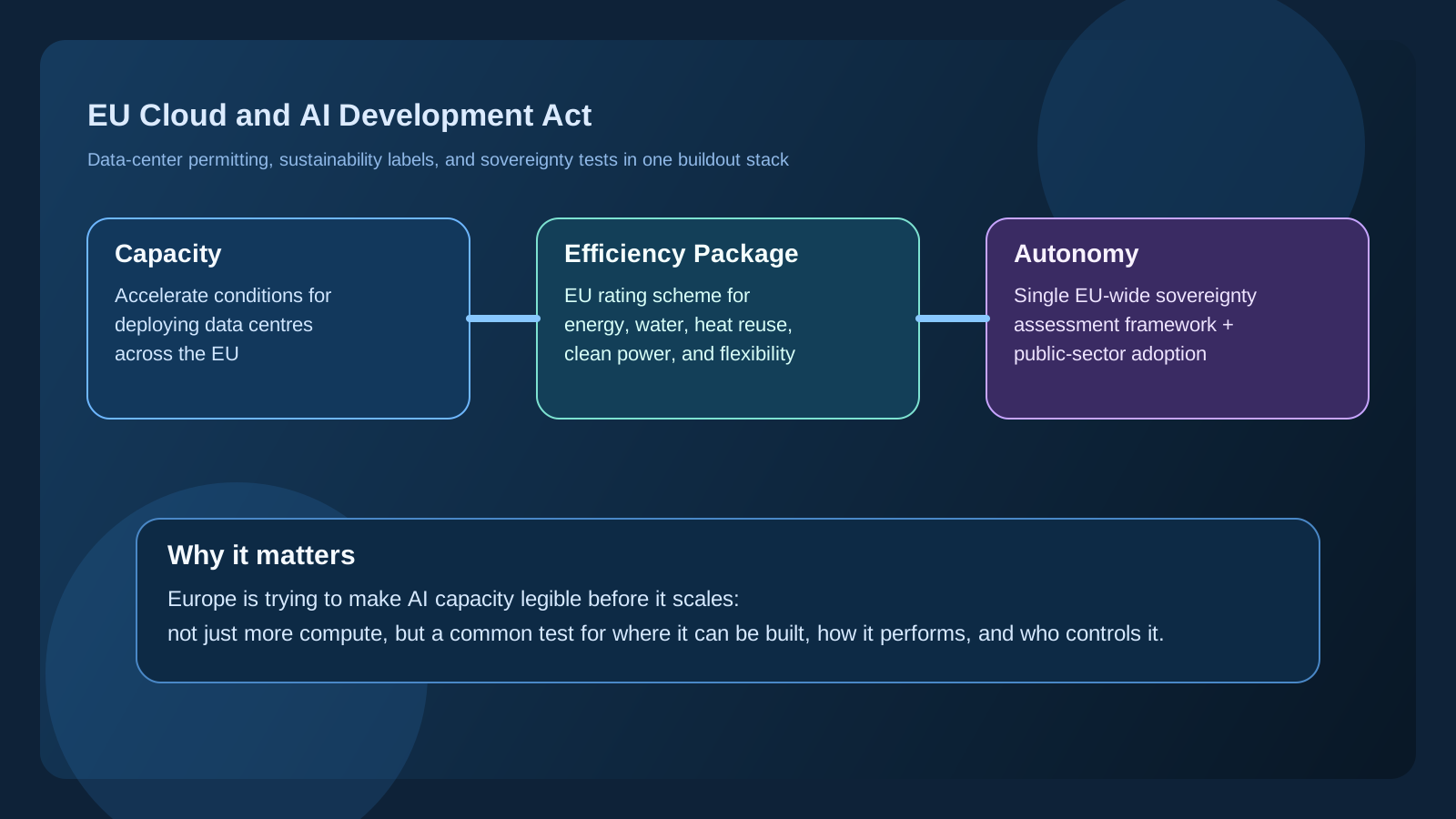
The European Commission’s June 3 Cloud and AI Development Act is worth publishing because the useful signal is not another sovereignty slogan. The stronger signal is that Europe is trying to make AI infrastructure legible before it scales. CADA ties three things together that are too often discussed separately: how quickly data centers can be deployed, how their environmental performance will be judged, and how cloud-and-AI sovereignty will be assessed across the bloc.
The Commission’s own framing is unusually explicit. The proposal says the ongoing deployment of AI factories and AI gigafactories needs broader cloud and data-center capacity behind it, and that the act will reinforce energy-efficient data-center capacity while accelerating the conditions for deployment across the EU. That matters because it shifts the debate from abstract industrial policy into the mechanics of actual capacity formation.
CADA matters because Europe is trying to standardize not just who gets AI capacity, but how that capacity is sited, rated, and judged fit for sovereign use.
The most useful infrastructure angle is that Brussels is not only trying to add more capacity. It is trying to standardize the terms under which that capacity becomes politically and operationally acceptable. CADA proposes a single EU-wide assessment framework for cloud and AI sovereignty, paired with a public-sector adoption mechanism. In practice, that means future European AI buildouts may be evaluated less on generic “Europe needs compute” rhetoric and more on whether facilities, providers, and operating models satisfy a common sovereignty test.
The energy-system layer is even more important. In its related strategic roadmap, the Commission says it plans a model tripartite agreement linking data-center operators, public authorities, and electricity-system operators, with specific attention to flexible connection agreements, waste-heat recovery, clean-energy sourcing, and demand flexibility. That is a strong signal that Europe sees data centers not only as digital infrastructure, but as large electrical loads that need an explicit operating compact with the grid around them.
The proposed sustainability stack sharpens that further. The roadmap says the Commission will adopt a data-center energy-efficiency package, including an EU rating scheme covering energy efficiency, water efficiency, clean-energy use, waste-heat reuse, and flexibility, while also launching the process toward minimum performance standards. Once rating labels and performance floors enter the buildout path, the competitive question changes. It stops being only who can raise capital and secure land. It becomes who can clear a common policy and sustainability bar without slowing deployment.
That is why this clears the duplicate block against the site’s recent France, U.K., and New York coverage. The France and U.K. pieces were about sovereign AI as localized capacity and procurement races. The New York story was about one state trying to contain hyperscale growth through moratoria, rate classes, and permitting pressure. CADA is different. It is an attempt to build a supranational rule stack for how sovereign AI capacity gets sited, rated, and legitimized across multiple countries at once.
For operators, the implication is that European AI infrastructure strategy may increasingly require paired expertise in policy compliance and power integration, not only campus development. For investors, the signal is that the value of an EU data-center platform may depend as much on regulatory readability and grid-fit as on raw megawatts. For policymakers elsewhere, CADA is also a warning shot: the jurisdictions that define the reporting, rating, and sovereignty tests early may shape where the next wave of AI capacity wants to land.
The Grid Report view is that this clears the search bar because it answers the better question behind the headline: what is Europe actually trying to build? The answer is not merely more compute. It is a governed AI-capacity regime where deployment speed, sustainability labels, and sovereignty screening move together.
Sources
European Commission, “Proposal for the Cloud and AI Development Act (CADA),” published June 3, 2026: https://digital-strategy.ec.europa.eu/en/library/proposal-cloud-and-ai-development-act-cada
European Commission, “Strategic Roadmap for Digitalisation and AI for the Energy Sector,” published June 3, 2026: https://energy.ec.europa.eu/document/download/fbe97b7a-20ff-4361-a8b2-9a4055695f3a_en?filename=COM_2026_501_1_EN_ACT_part1_v9.pdf
By Nawaz Lalani
The Grid Report is written by Nawaz Lalani and focuses on source-backed coverage of AI infrastructure, grid power demand, automation systems, and market signals.
Follow the signal, not just the headline.
Get the daily Grid brief for source-backed coverage on AI power demand, infrastructure timing, automation, and market signals.