- OpenAI’s Deployment Company clears the publish bar because it says something important about where enterprise AI adoption is actually getting stuck.
- The stronger angle is that OpenAI is formalizing deployment as its own operating layer.
- That matters because many AI rollouts still stall between pilot enthusiasm and production reality.
- Section
- AI Automation
- Read time
- 4 min read
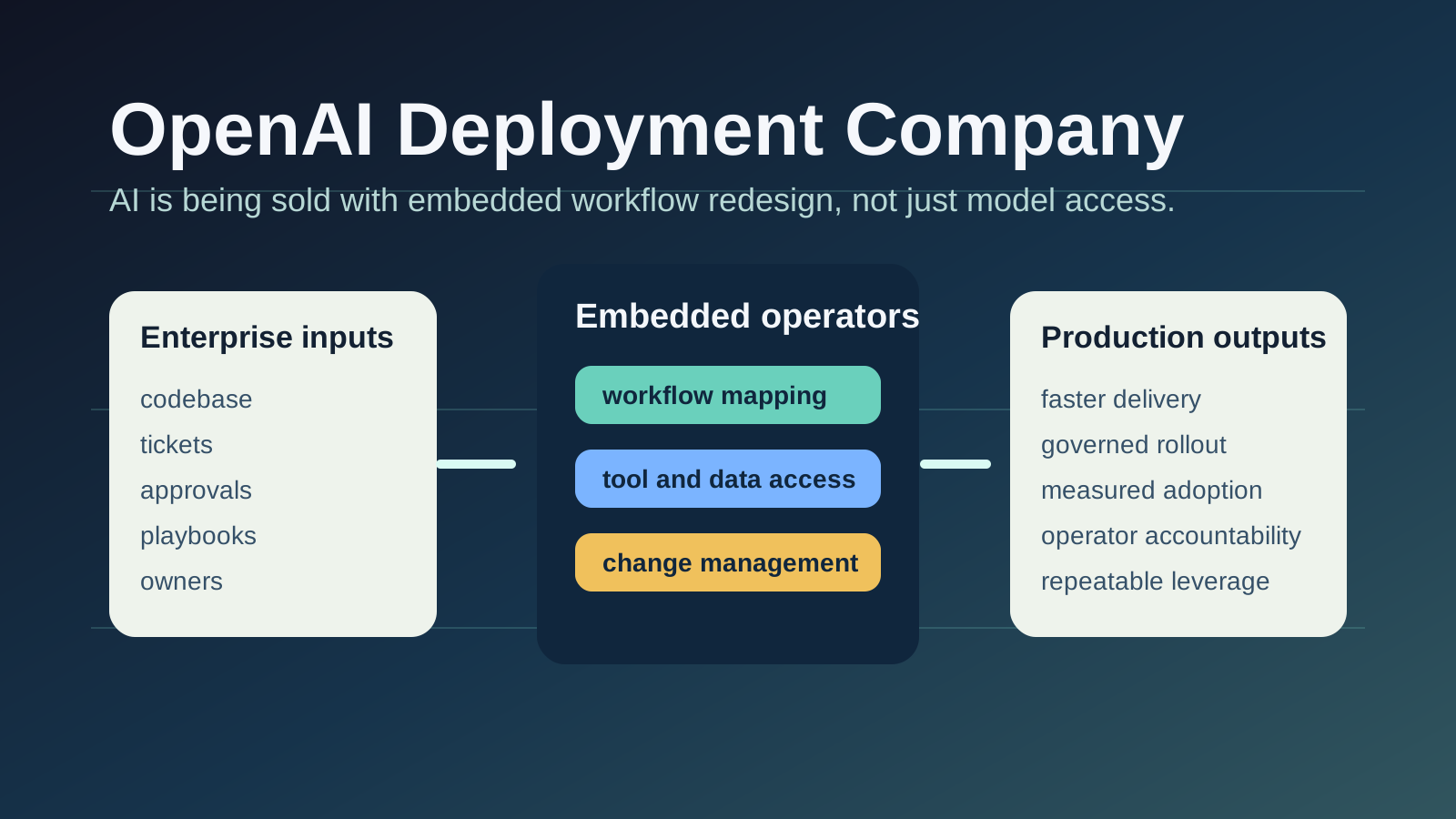
OpenAI’s Deployment Company clears the publish bar because it says something important about where enterprise AI adoption is actually getting stuck. OpenAI said on May 11 that it launched the OpenAI Deployment Company as a standalone business unit, agreed to acquire applied-AI consulting firm Tomoro, and expects roughly 150 Forward Deployed Engineers and deployment specialists from that team to strengthen the motion from day one. That is not just a corporate structure update. It is evidence that model vendors increasingly believe software access alone is not enough to win enterprise deployment.
The stronger angle is that OpenAI is formalizing deployment as its own operating layer. The company said its FDEs will work with business leaders, technology teams, operators, and frontline staff to identify high-value workflows, then design, test, and deploy systems that connect OpenAI models to customer data, tools, controls, and business processes. Read plainly, that is a statement that enterprise AI is becoming an embedded operations business, not only a SaaS subscription business.
Enterprise AI is becoming a workflow-redesign business with models attached, not a model business with workflows attached.
That matters because many AI rollouts still stall between pilot enthusiasm and production reality. Buying access to a strong model is easy compared with redesigning approvals, integrating systems of record, assigning process owners, and making sure the new workflow actually survives contact with daily operations. OpenAI is effectively acknowledging that the missing layer is often not intelligence itself. It is the engineering and change-management work required to turn intelligence into a dependable production system.
The Tomoro piece sharpens the signal. OpenAI said the acquired team has experience building real-time AI systems in complex environments for customers including Tesco, Virgin Atlantic, and Supercell, where reliability, governance, integration, and measurable business impact matter from the start. That matters because the company is not only selling future possibility. It is buying applied deployment muscle to shorten the path from use-case selection to live operations.
Operators should care because this changes what competitive advantage may look like in enterprise AI. The winner may not simply be the lab with the strongest model. It may be the vendor that can help customers map workflows, access the right systems, govern model behavior, and keep the deployment improving as product capabilities change. OpenAI explicitly framed that future-facing connection as an advantage: the Deployment Company can build around where frontier capabilities are headed rather than only where they are today.
There is also a market signal here. OpenAI said its investment and consulting partners sponsor more than 2,000 businesses and that their broader networks reach many thousands more. That means the services layer around AI is becoming investable infrastructure in its own right. Once vendors, private equity sponsors, and integrators treat AI deployment as a repeatable transformation motion, the category starts to look less like experimental software adoption and more like an industrial distribution channel for workflow change.
There are limits. OpenAI has not disclosed unit economics, customer retention, or whether this model scales cleanly beyond high-touch early engagements. A deployment arm can also create execution complexity and may prove expensive relative to lighter partner-led models. But those caveats do not erase the core signal. They reinforce that frontier AI companies are reorganizing around the hard part of adoption.
The better conclusion is that enterprise AI demand is maturing. The scarce asset is no longer just model access. It is the ability to rewire real work around the model and keep that system usable after the demo ends.
Sources
OpenAI, “OpenAI launches the OpenAI Deployment Company to help businesses build around intelligence,” published May 11, 2026: https://openai.com/index/openai-launches-the-deployment-company/
Bain & Company, “Bain & Company invests in the OpenAI Deployment Company, a new venture launched by OpenAI to help enterprises build around intelligence,” published May 11, 2026: https://www.bain.com/about/media-center/press-releases/2026/bain-company-openai-a-new-venture-to-deploy-ai-at-enterprise-scale/
By Nawaz Lalani
The Grid Report is written by Nawaz Lalani and focuses on source-backed coverage of AI infrastructure, grid power demand, automation systems, and market signals.
Follow the signal, not just the headline.
Get the daily Grid brief for source-backed coverage on AI power demand, infrastructure timing, automation, and market signals.