- MRC is worth publishing because the useful signal is not that hyperscalers have invented another obscure transport acronym.
- That point is clearer when the May 6 NVIDIA post is read alongside Microsoft’s June 2 Build infrastructure update and the Open Compute Project specification.
- That matters because giant GPU clusters do not fail gracefully when the network gets sloppy.
- Section
- Infrastructure
- Read time
- 5 min read
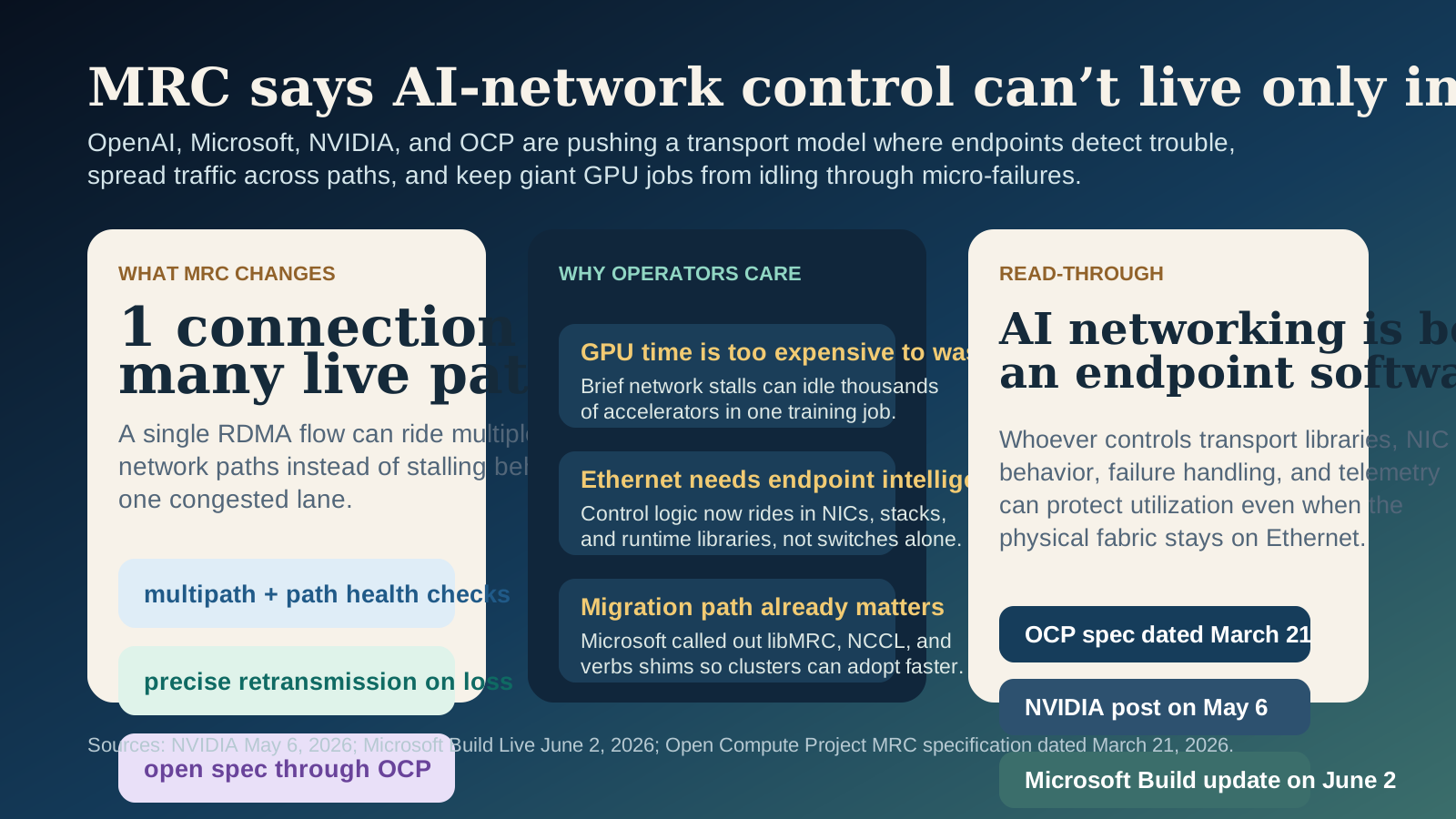
MRC is worth publishing because the useful signal is not that hyperscalers have invented another obscure transport acronym. The stronger signal is architectural. Multipath Reliable Connection is an attempt to move more AI-cluster reliability and traffic intelligence into the endpoints themselves so training jobs do not lose expensive GPU time every time the network hits congestion, imbalance, or a brief path failure.
That point is clearer when the May 6 NVIDIA post is read alongside Microsoft’s June 2 Build infrastructure update and the Open Compute Project specification. NVIDIA says OpenAI, Microsoft, and Oracle are already relying on MRC-class behavior for large AI fabrics, while Microsoft says the protocol shifts intelligence to endpoints so workloads can route around problems without costly stalls or restarts. The OCP spec makes the same idea more explicit: MRC is designed to preserve high goodput, multipath operation, and failure recovery over standard Ethernet in AI and machine-learning clusters.
The useful MRC signal is not one more protocol launch. It is that AI networking control is shifting toward the endpoints so giant GPU fabrics lose less time to congestion and micro-failures.
That matters because giant GPU clusters do not fail gracefully when the network gets sloppy. If thousands of accelerators have to stay synchronized and one part of the fabric slows down, packets back up, jobs idle, and expensive training runs lose effective throughput. MRC is trying to reduce that penalty by letting a single RDMA connection distribute traffic across multiple paths, monitor path health, recover from congestion or loss, and keep ordered delivery semantics where the workload still needs them.
The original Grid Report angle is that this turns networking into an endpoint-control problem, not only a switch-and-cable procurement problem. The site has already covered fiber reservation, networking concentration at Broadcom, and regional cloud-capacity buildout. MRC clears the duplicate block because the thesis is different. The question here is not whether the network layer is strategically scarce. It is where the control logic for a giant AI fabric now lives when standard Ethernet is being pushed toward frontier-training reliability.
For operators, the implication is practical. Once AI clusters reach enough scale, the network can no longer be treated as passive plumbing beneath the GPU fleet. Transport behavior, path selection, retransmission logic, and troubleshooting visibility start to look like first-order utilization levers. That is why Microsoft highlighted libMRC, NCCL integrations, and a verbs shim at Build. The goal is not only a better protocol on paper. It is a migration path that lets existing AI software stacks adopt a new transport without rewriting everything above it.
For investors and infrastructure watchers, the read-through is that Ethernet competition in AI is moving beyond switch speeds and optics alone. The monetization opportunity increasingly sits in whatever combination of NICs, switches, telemetry, software libraries, and transport standards can keep GPU clusters busy under real production stress. If MRC or MRC-like approaches spread, the value accrues to vendors that control both the endpoint behavior and the fabric around it.
The Grid Report view is that this clears the search bar because it answers a more useful question than a generic NVIDIA networking recap: what actually changed with MRC? The useful answer is that AI networking is being re-architected so endpoints, not just the fabric core, participate directly in congestion handling, failover, and utilization control at giant-cluster scale.
Sources
NVIDIA, “NVIDIA Spectrum-X — the Open, AI-Native Ethernet Fabric — Sets the Standard for Gigascale AI, Now With MRC,” published May 6, 2026: https://blogs.nvidia.com/blog/spectrum-x-ethernet-mrc/
Microsoft, “Microsoft Build Live,” infrastructure updates entry covering MRC, published June 2, 2026: https://news.microsoft.com/build-2026-live-blog/microsoft-build-2026-live/
Open Compute Project, “Multipath Reliable Connection (MRC) Specification,” dated March 21, 2026: https://www.opencompute.org/documents/ocp-mrc-1-0-pdf
By Nawaz Lalani
The Grid Report is written by Nawaz Lalani and focuses on source-backed coverage of AI infrastructure, grid power demand, automation systems, and market signals.
Follow the signal, not just the headline.
Get the daily Grid brief for source-backed coverage on AI power demand, infrastructure timing, automation, and market signals.