- Broadcom’s June 3 earnings release is worth publishing because the useful signal is not merely that AI demand is still strong.
- The official numbers are specific.
- That matters because the revenue mix says something more precise than “AI is still booming.” Broadcom is not the primary merchant-GPU headline most readers associate with AI infrastructure.
- Section
- Markets
- Read time
- 5 min read
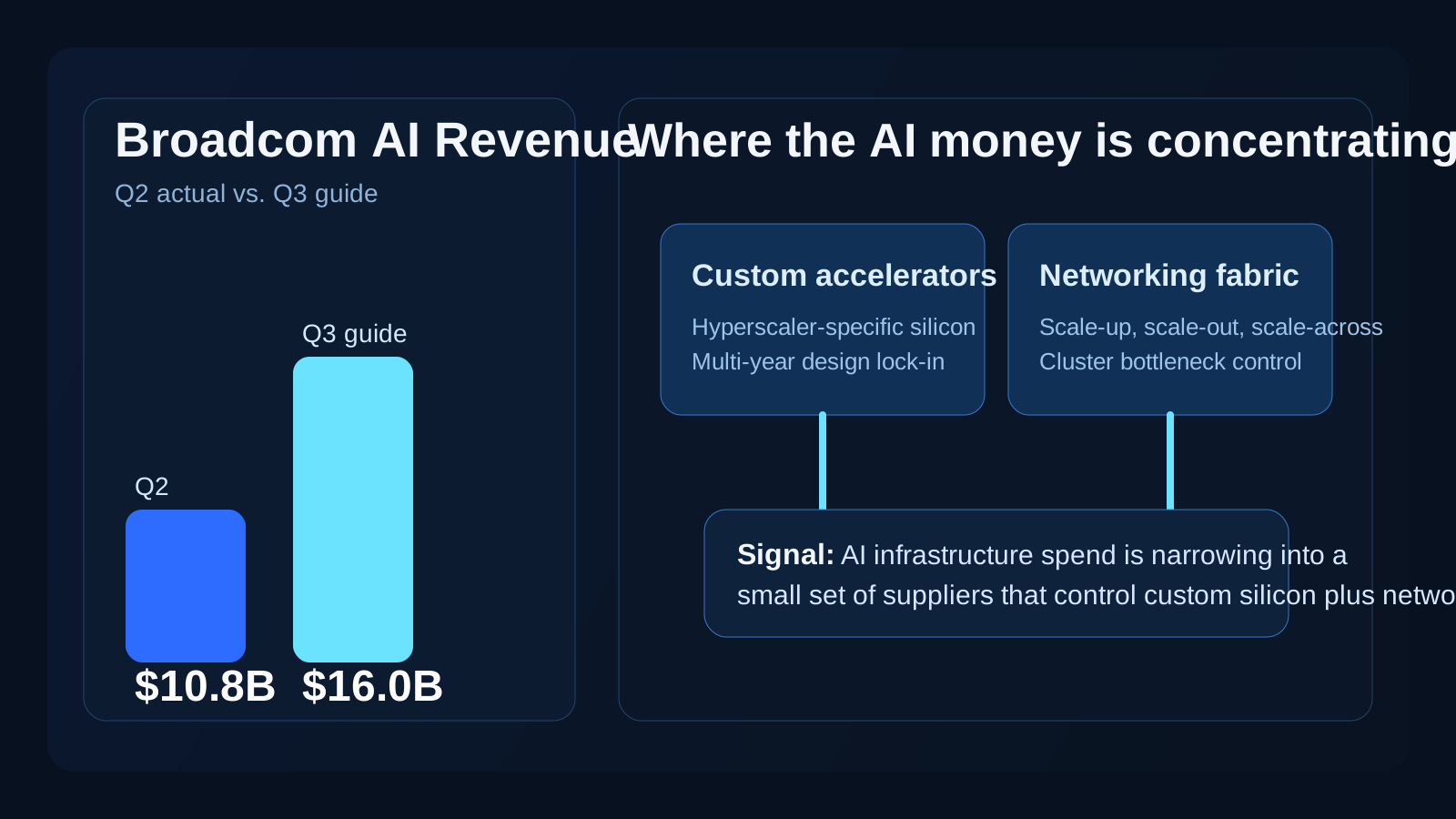
Broadcom’s June 3 earnings release is worth publishing because the useful signal is not merely that AI demand is still strong. The stronger signal is that a growing share of hyperscaler AI spend is concentrating into two layers that sit underneath the usual GPU headlines: custom accelerators and the networking fabric that lets giant clusters scale without choking themselves.
The official numbers are specific. Broadcom said second-quarter fiscal 2026 revenue reached $22.187 billion, with semiconductor solutions revenue of $15.009 billion. It also said AI semiconductor revenue alone reached $10.8 billion in the quarter, up 143% year over year, and that it expects AI semiconductor revenue to reach $16.0 billion in the third quarter, up more than 200% year over year.
Broadcom’s quarter says AI infrastructure money is concentrating into custom accelerators and networking fabrics tied to a small number of hyperscaler buyers.
That matters because the revenue mix says something more precise than “AI is still booming.” Broadcom is not the primary merchant-GPU headline most readers associate with AI infrastructure. Its position is different. It is capturing spend from customers that want custom silicon roadmaps and from the high-bandwidth networking layers those deployments require. Once that revenue line crosses $10 billion in a quarter and management guides it materially higher again, the market is no longer looking at an experimental adjacency. It is looking at one of the main toll roads in the buildout.
The April 14 Broadcom-Meta announcement makes the concentration story easier to read. Broadcom and Meta said they extended their partnership to support multi-gigawatt deployment of Meta’s custom silicon, including a 2-nanometer accelerator roadmap and Broadcom Ethernet technologies for scale-up, scale-out, and scale-across networking. That means Broadcom’s June earnings result is not an isolated beat. It is a public-company readout from a part of the AI stack where a small number of customers are locking in multi-year infrastructure plans.
There is also an important contrast inside the quarter. Broadcom said infrastructure software revenue was $7.178 billion, up 9% year over year, while semiconductor solutions revenue grew 79% year over year. That spread is the real tell. The AI buildout is not lifting every Broadcom segment equally. The money is landing disproportionately in the physical AI-infrastructure layers attached to hyperscaler deployment cycles.
This clears the duplicate block against the site’s recent coverage because the thesis is different. The STMicroelectronics story was about power and control silicon benefiting from AI racks. The Anthropic financing story was about equity converting into supply assurance. This piece is about a public earnings print showing where AI infrastructure revenue is already concentrating at scale and how custom silicon is becoming a bigger part of that answer.
For investors, the practical question is no longer whether Broadcom has AI exposure. It is whether the company is becoming one of the clearest listed proxies for concentrated hyperscaler infrastructure spend outside the pure-GPU trade. For operators, the lesson is that AI cluster economics increasingly depend on networking and custom-accelerator design choices that are being locked in earlier and at larger scale than the market used to assume.
The Grid Report view is that this clears the search bar because it answers a live question better than a generic earnings recap: what did Broadcom’s quarter actually reveal about the shape of AI infrastructure demand? The useful answer is that spending is concentrating into custom silicon programs and networking fabrics tied to a relatively small set of giant buyers, and Broadcom is already monetizing that concentration.
Sources
Broadcom, “Broadcom Inc. Announces Second Quarter Fiscal Year 2026 Financial Results and Quarterly Dividend,” published June 3, 2026: https://investors.broadcom.com/node/64371/pdf
Broadcom and Meta, “Broadcom Announces Extended Partnership with Meta to Deploy Technology to Support Multi-Gigawatts of Meta’s Custom Silicon, MTIA,” published April 14, 2026: https://investors.broadcom.com/news-releases/news-release-details/broadcom-announces-extended-partnership-meta-deploy-technology
Broadcom Investor Center, accessed June 6, 2026: https://investors.broadcom.com/
By Nawaz Lalani
The Grid Report is written by Nawaz Lalani and focuses on source-backed coverage of AI infrastructure, grid power demand, automation systems, and market signals.
Follow the signal, not just the headline.
Get the daily Grid brief for source-backed coverage on AI power demand, infrastructure timing, automation, and market signals.