- Apple’s latest AI disclosures are worth publishing because the useful signal is not the WWDC product layer.
- That is a meaningful change from how Private Cloud Compute was framed when Apple introduced it in June 2024.
- The detail matters because AFM 3 Cloud Pro is not a side model.
- Section
- Infrastructure
- Read time
- 5 min read
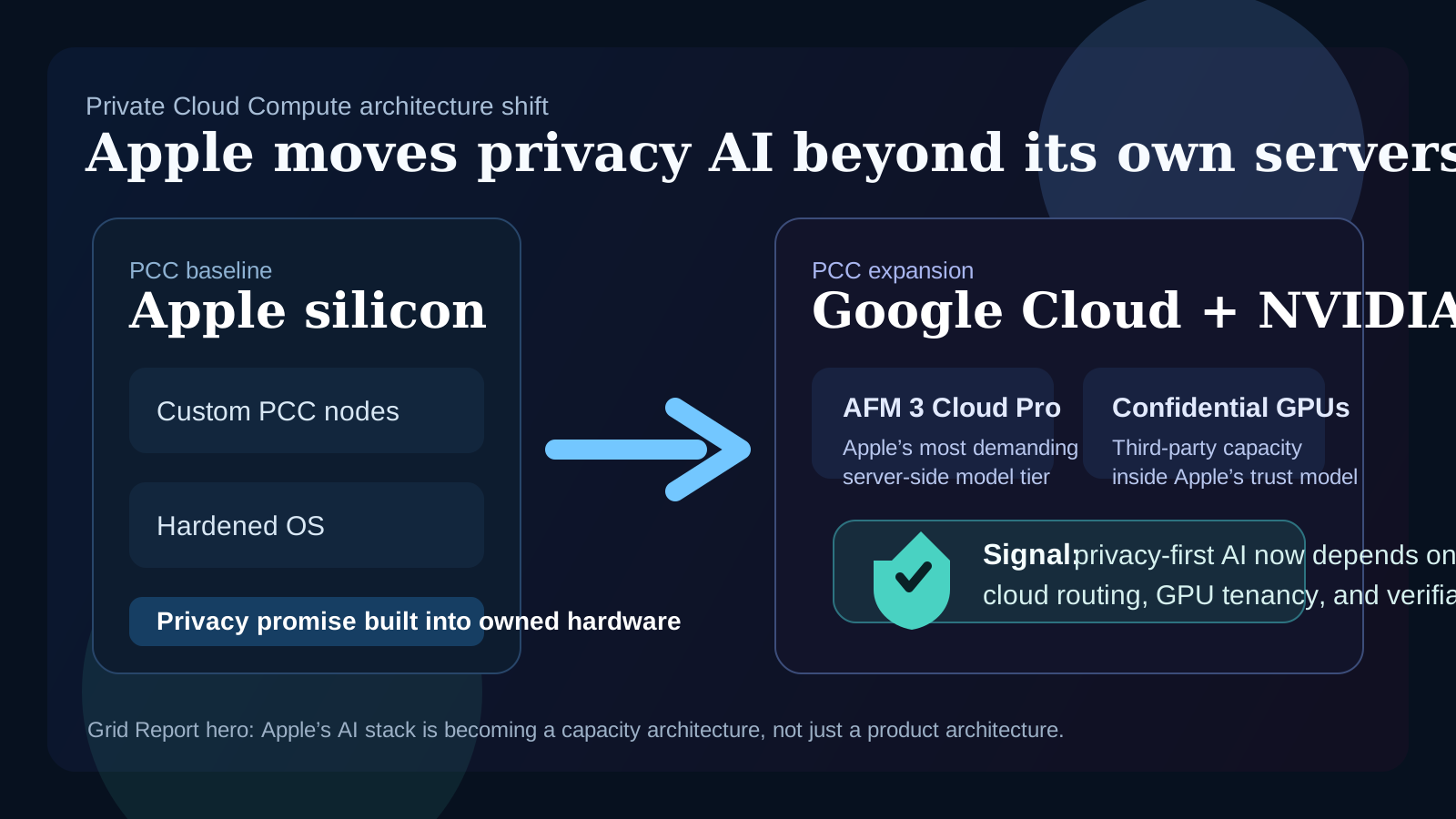
Apple’s latest AI disclosures are worth publishing because the useful signal is not the WWDC product layer. The stronger signal is architectural. Apple has now said that AFM 3 Cloud Pro, its most capable server-side model tier, extends Private Cloud Compute to NVIDIA GPUs in Google Cloud while maintaining the same privacy guarantees Apple has used as the core differentiator for its cloud AI stack.
That is a meaningful change from how Private Cloud Compute was framed when Apple introduced it in June 2024. At that point, Apple described PCC as being built with custom Apple silicon, custom-built server hardware, and a hardened operating system designed to bring iPhone-style security guarantees into the data center. The new Apple machine-learning research page still leans on the same privacy promise, but the infrastructure underneath is now broader. For its highest-end cloud model, Apple is explicitly depending on outside hyperscaler and GPU capacity rather than only Apple-owned server nodes.
The useful Apple signal is not another AI feature launch. It is that privacy-first cloud inference now depends on third-party GPU and hyperscaler capacity while preserving a verifiable trust boundary.
The detail matters because AFM 3 Cloud Pro is not a side model. Apple says it is the company’s most capable server-based model and is used for demanding tasks such as agentic tool use and complex reasoning. In other words, the part of Apple Intelligence that most needs frontier-scale compute is now tied to a third-party supply chain that spans Apple’s software and trust model, Google Cloud’s data-center footprint, and NVIDIA’s confidential-computing hardware path.
That is why this clears the site’s duplicate block against recent Corning fiber, OpenAI Dell locality, and NVIDIA capacity-distribution coverage. Those stories were about network inputs, enterprise deployment control, or regional cloud distribution. This one is different because the angle is trust-boundary design. Apple is effectively saying that privacy-first AI can now be routed through infrastructure it does not fully own, as long as the technical guarantees survive the handoff.
For operators, the practical implication is that privacy architecture is becoming part of capacity strategy. Once a company promises users that cloud inference will not expose data to the platform operator, it cannot scale the service by simply buying generic cloud capacity and hoping policy language closes the gap. It has to prove that the trust boundary, attestation path, and runtime controls still hold when the compute sits on third-party GPU infrastructure.
For investors and infrastructure watchers, the read-through is that premium AI products are converging on a harder stack than normal cloud software. The product experience now depends on secure model routing, scarce accelerator access, and verifiable controls across multiple companies at once. That makes privacy-preserving AI less of a branding exercise and more of a supply-and-systems challenge.
The Grid Report view is that this clears the search bar because it answers a sharper question than a generic Apple recap: what actually changed in Apple’s cloud AI architecture? The useful answer is that Apple’s privacy-first server story is no longer only an Apple-silicon story. For its highest-end cloud model, it is now a third-party GPU and cloud-capacity story as well.
Sources
Apple Machine Learning Research, “Introducing the Third Generation of Apple’s Foundation Models,” accessed June 9, 2026: https://machinelearning.apple.com/research/introducing-third-generation-of-apple-foundation-models
Apple Newsroom, “Apple Intelligence brings powerful AI capabilities into everyday experiences,” published June 8, 2026: https://www.apple.com/newsroom/2026/06/apple-intelligence-brings-powerful-ai-capabilities-into-everyday-experiences/
Apple Security Research, “Private Cloud Compute: A new frontier for AI privacy in the cloud,” published June 10, 2024: https://security.apple.com/blog/private-cloud-compute/
NVIDIA, “NVIDIA Confidential Computing to Help Expand Apple’s Private Cloud Compute,” published June 9, 2026: https://blogs.nvidia.com/blog/nvidia-confidential-computing-apple-private-cloud-compute/
By Nawaz Lalani
The Grid Report is written by Nawaz Lalani and focuses on source-backed coverage of AI infrastructure, grid power demand, automation systems, and market signals.
Follow the signal, not just the headline.
Get the daily Grid brief for source-backed coverage on AI power demand, infrastructure timing, automation, and market signals.