- HPE’s June 1 quarter is worth publishing because the useful signal is not a generic “AI helped earnings” claim.
- The disclosed facts are specific enough to matter.
- The original Grid Report angle is that enterprise AI demand is becoming a server-conversion story.
- Section
- Infrastructure
- Read time
- 6 min read
- Data included
- Why HPE’s quarter is more useful than a generic earnings beat
Why HPE’s quarter is more useful than a generic earnings beat
The publishable signal is not just record revenue. It is that enterprise AI demand appears to be converting from demand language into shipped server revenue and a stronger Cloud and AI mix.
Quarter-over-quarter conversion signals
| Signal | Disclosed fact | Why it matters |
|---|---|---|
| Quarterly scale | $10.7 billion of total revenue, up 40% year over year | The overall print is large enough that Cloud and AI strength is showing up in company-level results. |
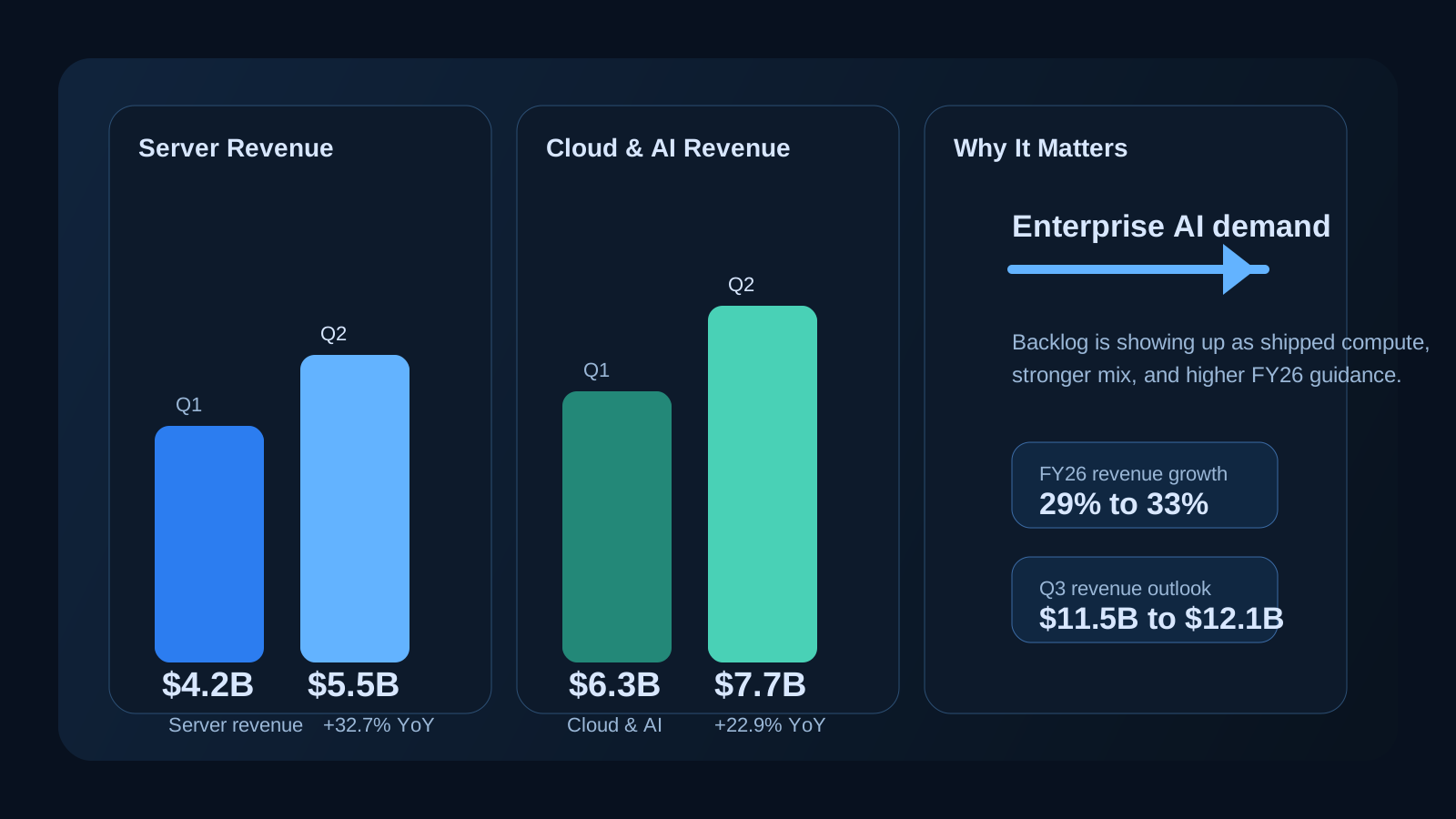
| Server conversion | Server revenue rose from $4.2 billion in Q1 to $5.5 billion in Q2 | This suggests more infrastructure demand is moving from pipeline language into recognized shipments. |
| Segment mix | Cloud and AI revenue reached $7.7 billion with a 12.4% operating profit margin | The segment is not just growing; it is also contributing at healthier profitability. |
| Forward posture | HPE raised FY26 growth guidance and now expects at least $3.5 billion in free cash flow | Management is signaling confidence that current demand is durable enough to support a higher outlook. |
Sources: HPE fiscal 2026 first-quarter and second-quarter results, published March 9 and June 1, 2026.
HPE’s June 1 quarter is worth publishing because the useful signal is not a generic “AI helped earnings” claim. The stronger signal is that enterprise AI demand is increasingly showing up as shipped infrastructure. In HPE’s numbers, that means a step up in server revenue, a stronger Cloud and AI mix, and a raised full-year outlook that now sits ahead of what the company had originally expected to reach by fiscal 2028.
The disclosed facts are specific enough to matter. HPE says second-quarter revenue reached $10.7 billion, up 40% from the prior-year period. Inside Cloud and AI, revenue was $7.7 billion, up 22.9%, while server revenue was $5.5 billion, up 32.7%. HPE also raised its fiscal 2026 revenue growth outlook to 29% to 33% and now expects at least $3.5 billion in free cash flow.
The useful HPE signal is not that AI helped one quarter. It is that enterprise AI demand is starting to show up as shipped server revenue and higher guidance.
The original Grid Report angle is that enterprise AI demand is becoming a server-conversion story. Two months earlier, HPE reported first-quarter Cloud and AI revenue of $6.3 billion and server revenue of $4.2 billion. The second-quarter jump suggests that AI demand is moving beyond broad backlog rhetoric and increasingly appearing in shipped systems and recognized revenue. That does not mean every enterprise AI project is healthy. It does mean more of the demand is becoming physically delivered infrastructure.
That distinction matters because the AI buildout is now splitting into different proof stages. Hyperscaler spending, sovereign buildouts, and startup GPU demand can create strong headlines, but enterprise infrastructure vendors still need to convert orders into assembled, financed, installable systems. HPE’s quarter is useful because it shows one of the cleaner public examples of that conversion happening inside an established enterprise hardware channel.
For operators, the practical takeaway is that enterprise AI is starting to look less like experimental software spend and more like a capital equipment program. When server revenue, networking scale, and Cloud and AI mix all move higher together, the conversation inside customer organizations shifts. The harder questions become how quickly workloads are productionized, how infrastructure is financed, how much capacity is reserved ahead of demand, and whether the organization can absorb the operating complexity that comes with more AI hardware on the floor.
For investors, the read-through is narrower than a broad AI-stock victory lap. HPE is not being rewarded here for model leadership. The useful signal is that infrastructure vendors with credible enterprise distribution and financing posture may benefit as AI demand leaves the proof-of-concept stage and moves into shipped systems. That is a different phase of the AI cycle from chip-roadmap enthusiasm or frontier-model valuation expansion.
This clears the duplicate block against the site’s recent infrastructure coverage. The NVIDIA Taiwan article was about rack-manufacturing throughput across the supply chain. Snowflake’s AWS commitment article was about reserving cloud economics in advance. Modine’s cooling piece was about financed thermal backlog. HPE is different. It is about a major enterprise vendor showing that AI demand is converting into reported server revenue and higher guidance inside a live quarterly print.
There is still a caveat worth stating plainly. HPE does not break out an isolated AI-server revenue number in the June 1 release, so the article should not be read as a pure-play AI-sales benchmark. The interpretation here is an inference from segment growth, server growth, management commentary about customers scaling AI, and the raised outlook. That inference is strong enough to matter, but it is still an inference.
For search performance, the article is strong because it answers a live, specific question: what did HPE’s June 1 quarter actually say about enterprise AI demand, and why do Cloud and AI and server revenue matter beyond a routine earnings beat? Readers searching for HPE Q2 2026 earnings, HPE AI server revenue, or HPE Cloud and AI growth get a direct infrastructure thesis rather than a commodity recap.
Sources
HPE, “HPE reports fiscal 2026 second quarter results,” published June 1, 2026: https://www.hpe.com/us/en/newsroom/press-release/2026/06/hpe-reports-fiscal-2026-second-quarter-results.html
HPE, “HPE reports fiscal 2026 first quarter results,” published March 9, 2026: https://www.hpe.com/us/en/newsroom/press-release/2026/03/hpe-reports-fiscal-2026-first-quarter-results.html
By Nawaz Lalani
The Grid Report is written by Nawaz Lalani and focuses on source-backed coverage of AI infrastructure, grid power demand, automation systems, and market signals.
Follow the signal, not just the headline.
Get the daily Grid brief for source-backed coverage on AI power demand, infrastructure timing, automation, and market signals.