- ASHRAE, NEMA, and Pacific Northwest National Laboratory’s June 10 framework is worth publishing because the useful signal is not that one more consortium issued a dense technical document.
- The official facts are specific enough to matter.
- That breadth is exactly why the story clears the bar.
- Section
- Infrastructure
- Read time
- 4 min read
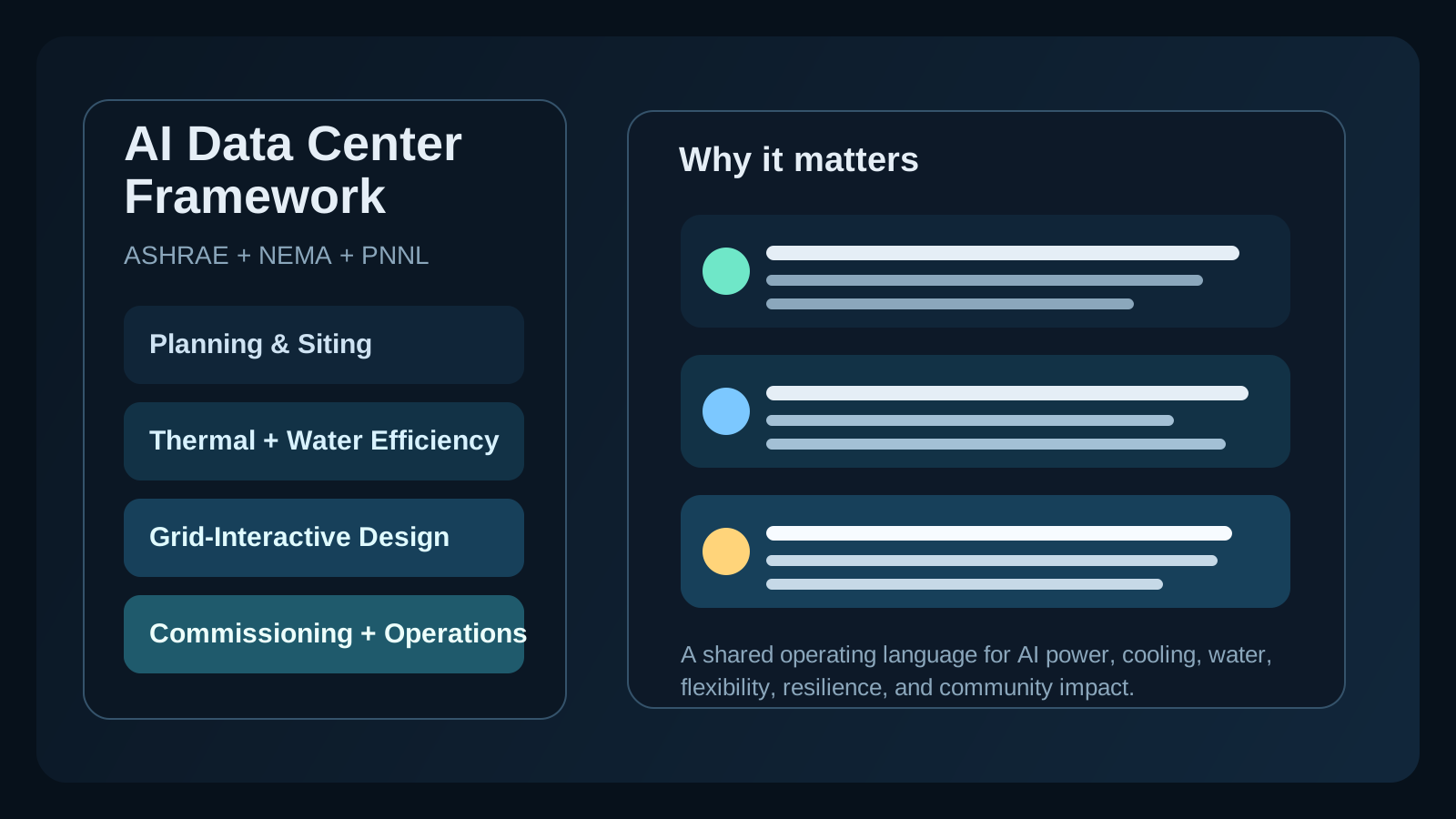
ASHRAE, NEMA, and Pacific Northwest National Laboratory’s June 10 framework is worth publishing because the useful signal is not that one more consortium issued a dense technical document. The stronger signal is that AI data-center buildout is now complicated enough that the industry wants a shared operating language across power, cooling, water, flexibility, resilience, and commissioning before the next wave of campuses gets locked into bad design choices.
The official facts are specific enough to matter. ASHRAE said on June 10 that it released the AI Data Center Energy Performance Framework with NEMA and PNNL, and the framework page says it is meant to guide planning, design, construction, operation, and retrofit of AI data centers. The stated objectives are to support scalable design, improve energy and water efficiency, and promote grid reliability and resilience through load flexibility and grid-interactive operations. The topic list is broad by design: planning and siting, integrated design, energy and thermal efficiency, grid-interactive design, resilient design, commissioning and performance validation, operations and maintenance, retrofit strategy, and supporting tools and standards.
The useful June 10 signal is not one more best-practices PDF. It is that AI data-center scale now requires a shared design language across power, cooling, water, flexibility, resilience, and commissioning.
That breadth is exactly why the story clears the bar. Most AI infrastructure coverage still breaks the stack into separate headlines: interconnection, cooling, backup power, community backlash, or flexible load. This framework does the opposite. It treats the campus as one coupled system. In practice, that means the market is starting to admit that a project cannot really be called “AI-ready” just because it has land, a utility conversation, and a rack-density ambition.
The original Grid Report angle is that AI buildout is becoming a standards-coordination story. ASHRAE’s framework explicitly says it does not create mandatory requirements or override existing codes. That limitation is useful, not disqualifying. It means the document should be read less as a new rulebook and more as a coordination layer that owners, engineers, utilities, and regulators can point to when they argue about what a credible AI campus should prove before energization and before local impacts are pushed onto somebody else.
This clears the duplicate block against the site’s recent ABB, Schneider-Kraken, Modine, and Uptime coverage. Those stories isolated a specific bottleneck: connection strength, grid-facing flexibility, reserved cooling capacity, or failure risk inside the fence. This framework is a different thesis. It is about stitching those bottlenecks into one shared design language so the next round of projects is judged on operating quality rather than on megawatt slogans alone.
For operators and developers, the practical implication is that diligence is moving earlier. If planning and siting are now bundled with energy sourcing, water use, thermal efficiency, grid-interactive behavior, and commissioning validation, then weak projects get easier to spot before capital is fully committed. The buildout question shifts from “Can this campus get built?” toward “Can this campus prove it will behave well enough to deserve grid access, community tolerance, and repeatable financing?”
For utilities, policymakers, and infrastructure investors, the read-through is that soft infrastructure is becoming more valuable. A common framework can reduce friction among design teams, utilities, equipment vendors, community stakeholders, and regulators even when no new law is passed. In a market defined by timing risk, that coordination layer matters because it can shorten argument cycles around what counts as efficient, resilient, flexible, and locally defensible.
The search case is strong because the article answers a more useful query than a generic framework summary: why does a new AI data-center framework matter now? The answer is that the AI campus is maturing from a procurement project into a cross-disciplinary operating system, and the June 10 ASHRAE-NEMA-PNNL release is one of the clearest signs yet that the market knows it.
Sources
ASHRAE, “ASHRAE, NEMA and PNNL Release AI Data Center Energy Performance Framework to Guide Next-Generation Design and Operation,” published June 10, 2026: https://www.ashrae.org/about/news/2026/ashrae-nema-and-pnnl-release-ai-data-center-energy-performance-framework-to-guide-next-generation-design-and-operation
ASHRAE, “PNNL/ASHRAE/NEMA AI Data Center Energy Performance Framework,” accessed June 11, 2026: https://www.ashrae.org/technical-resources/ai-data-center-framework
By Nawaz Lalani
The Grid Report is written by Nawaz Lalani and focuses on source-backed coverage of AI infrastructure, grid power demand, automation systems, and market signals.
Follow the signal, not just the headline.
Get the daily Grid brief for source-backed coverage on AI power demand, infrastructure timing, automation, and market signals.