- Artificial Analysis’ June 12 AA-AgentPerf launch is worth publishing because the useful signal is not that NVIDIA posted another winning chart.
- That clears the originality bar because AA-AgentPerf is built around a different workload pattern than ordinary inference tests.
- The first read-through is operational.
- Section
- Infrastructure
- Read time
- 4 min read
- Data included
- AA-AgentPerf changes the planning unit
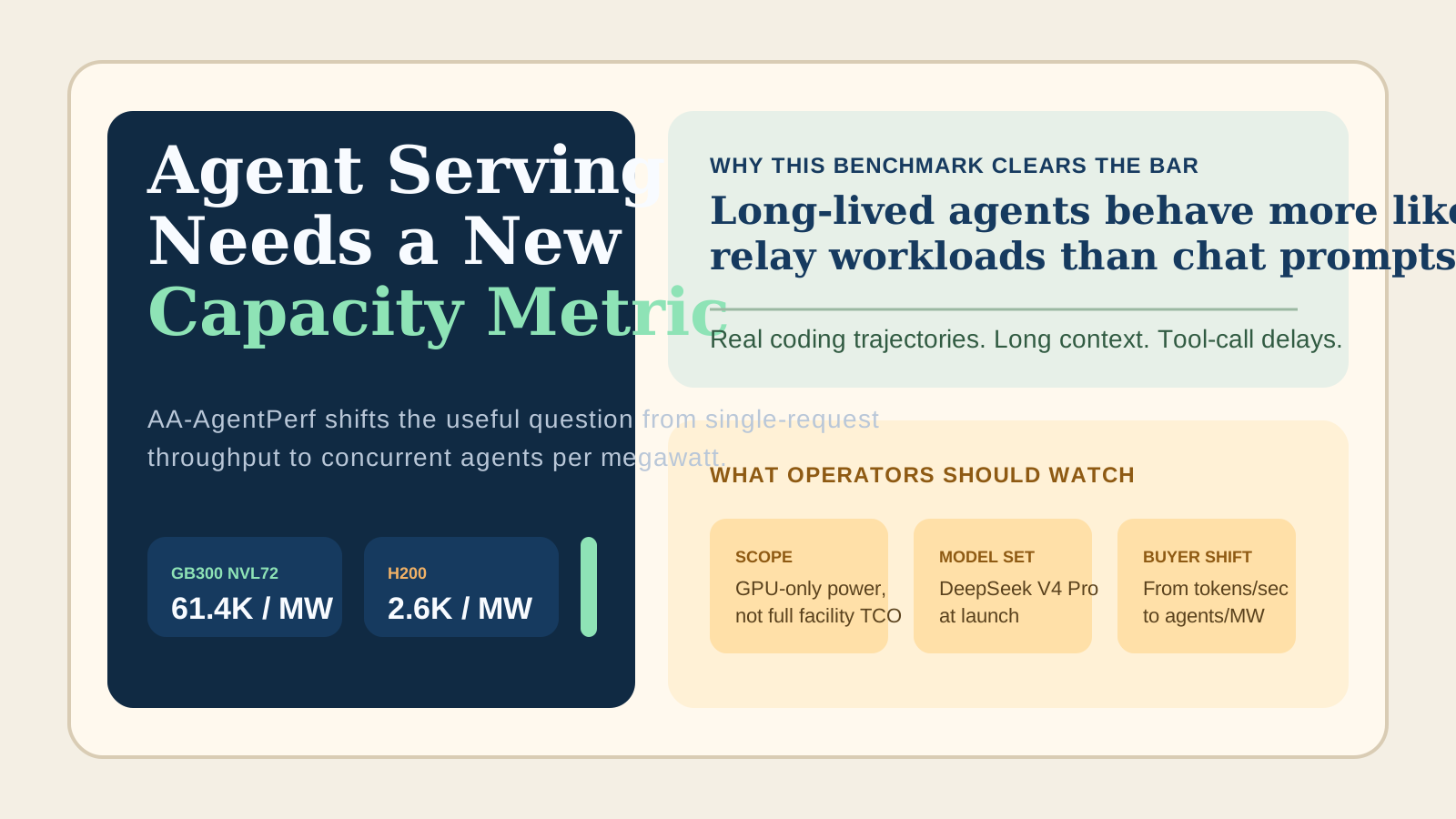
AA-AgentPerf changes the planning unit
The most useful part of the launch is not a brand winner but a new way to think about agent-serving capacity.
| Benchmark layer | What AA-AgentPerf measures | Why it matters |
|---|---|---|
| Workload shape | Real coding-agent trajectories with long context, repeated turns, and tool-call delays | Agent serving stresses infrastructure differently than short single-turn prompts. |
| Capacity unit | Maximum concurrent agents at defined output-speed and time-to-first-token targets | Operators can plan around parallel useful work instead of abstract throughput alone. |
| Power lens | Per-megawatt normalization based on GPU-only power | This improves hardware comparison but is not the same as full facility or cooling-adjusted TCO. |
| Launch scope | DeepSeek V4 Pro at launch, with more model support coming later | Useful benchmark primitive now, broader buyer tool if the model set expands. |
Sources: Artificial Analysis hardware benchmark page and NVIDIA technical blog, both accessed or published June 12, 2026.
Artificial Analysis’ June 12 AA-AgentPerf launch is worth publishing because the useful signal is not that NVIDIA posted another winning chart. The stronger signal is that the benchmark changes the unit of analysis for agent infrastructure. If AI buyers are deploying long-running coding and workflow agents rather than short chat requests, tokens per second is no longer enough. The more useful question becomes how many concurrent agents a system can actually sustain for a given power budget.
That clears the originality bar because AA-AgentPerf is built around a different workload pattern than ordinary inference tests. Artificial Analysis says the benchmark replays real coding-agent trajectories with up to 200 turns and sequence lengths above 100,000 tokens, while allowing production optimizations such as KV-cache reuse, disaggregated prefill and decode, and speculative decoding. In other words, this is trying to measure the relay-race behavior of agents rather than the sprint behavior of a single prompt-response exchange.
The important shift is not one vendor winning a chart. It is that agent infrastructure now needs to be sized in concurrent agents per megawatt, not just tokens per second.
The first read-through is operational. Artificial Analysis says AA-AgentPerf reports maximum concurrent agents at target service levels and normalizes results per megawatt, per accelerator, and per system. NVIDIA’s supporting technical write-up makes the planning impact more concrete: at the launch-day 30-tokens-per-second service tier for DeepSeek V4 Pro, GB300 NVL72 delivered 61,400 concurrent agents per megawatt versus 2,600 for H200. NVIDIA summarizes that as up to 20 times more agents per megawatt than the prior generation. Even if buyers discount vendor framing, the metric itself is the important shift.
The second read-through is that agent infrastructure is becoming a capacity-planning problem, not just a benchmark theater problem. If one model session can involve repeated reasoning, file access, edits, tool calls, and long-lived context, the bottleneck is less about a headline token-speed number and more about how much useful parallel work a rack or cluster can keep alive before latency targets break. That is the right question for operators sizing internal coding fleets, managed inference platforms, and enterprise agent budgets.
The benchmark is also useful because it is not presented as a single-vendor scoreboard. Artificial Analysis says launch results include systems ranging from full-rack GB300 NVL72 down to smaller accelerator configurations, including NVIDIA B300 x8, AMD MI355X x8, and H200 x8. That does not make the benchmark perfect, but it does make it more decision-useful than a one-company demo because buyers can compare architectures on the same workload type.
There is an important caveat, and it is exactly the kind of caveat serious readers need. Artificial Analysis says its per-megawatt normalization is based on measured GPU-only power, including the GPU die and HBM but excluding CPUs, networking, and cooling overhead. It also says the launch model set is limited to DeepSeek V4 Pro, with gpt-oss-120b support coming later. That means AA-AgentPerf is not a full data-center total-cost model yet. It is better understood as a new benchmark primitive that improves hardware comparison for agent workloads while still sitting upstream of full facility economics.
This clears the duplicate block against the site’s recent NVIDIA, Codex, and inference-economics coverage because the thesis is different. The Vera story was about CPU orchestration for agent systems. The Codex and Ona stories were about workflow runtime and persistent execution. The inference-economics piece argued that cost and latency were moving to the center of product design. AA-AgentPerf is different because it introduces a more operator-grade measurement layer for all of those stories: how agentic work should be benchmarked before the buyer even gets to rack design, TCO, or enterprise deployment policy.
The search case is strong because the article answers a live question better than a commodity benchmark rewrite: what is AA-AgentPerf, and why does it matter for AI infrastructure? Readers searching for AA-AgentPerf, agents per megawatt, GB300 NVL72 benchmark results, or agentic AI hardware comparisons get a usable planning frame instead of a generic vendor performance recap.
Sources
Artificial Analysis, “AI Hardware Benchmarking & Performance Analysis,” accessed June 12, 2026: https://artificialanalysis.ai/benchmarks/hardware
Artificial Analysis Changelog entry for “First results from AA-AgentPerf: the hardware benchmark for the agent era,” published June 12, 2026: https://artificialanalysis.ai/changelog
NVIDIA Blog, “NVIDIA Blackwell Leads on First Agentic AI Infrastructure Benchmark,” published June 12, 2026: https://blogs.nvidia.com/blog/nvidia-blackwell-agentperf-artificial-analysis/
NVIDIA Technical Blog, “NVIDIA Achieves Leading Agentic Coding Performance on First Agentic AI Benchmark,” published June 12, 2026: https://developer.nvidia.com/blog/nvidia-achieves-leading-agentic-coding-performance-on-first-agentic-ai-benchmark/
By Nawaz Lalani
The Grid Report is written by Nawaz Lalani and focuses on source-backed coverage of AI infrastructure, grid power demand, automation systems, and market signals.
Follow the signal, not just the headline.
Get the daily Grid brief for source-backed coverage on AI power demand, infrastructure timing, automation, and market signals.