- Pennsylvania’s September 10 utility commission vote clears the publish bar because it moves the state’s data center debate from broad political guardrails into two concrete regulatory workstreams.
- The original angle is the link between service priority and cost responsibility.
- The commission has not yet written that bargain into a rule, and the distinction matters.
- Section
- Policy
- Read time
- 7 min read
- Data included
- Pennsylvania’s two-track large-load rulemaking clock
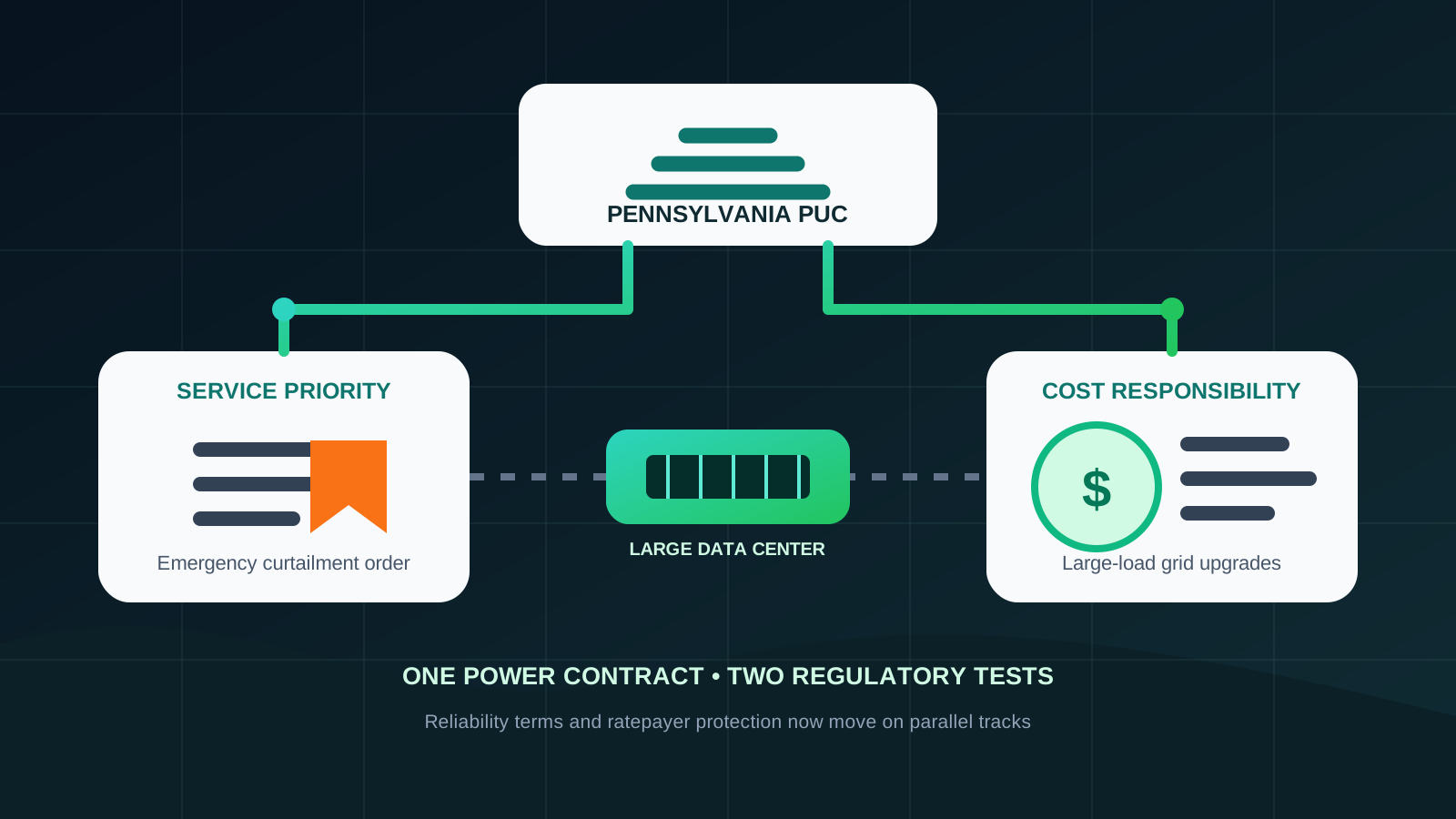
Pennsylvania’s two-track large-load rulemaking clock
The September 10 vote opened regulatory processes rather than imposing final terms. These are the decisions operators and investors should track next.
| Track | Next event | Commercial question |
|---|---|---|
| Emergency load control | Tentative order scheduled for October 1, 2026; final-order target January 28, 2027 after public comment | When can a large data center be curtailed, in what order, and under which criteria? |
| Large-load cost allocation | PUC technical conference planned for fall 2026 | Which interconnection, system, capacity, and reliability costs belong to the new load? |
| Broader ratemaking review | Stakeholder working group forms after the establishing order is published | How should ROE, settlements, and infrastructure returns remain transparent and affordable? |
Source: Pennsylvania Public Utility Commission actions published September 10, 2026. Proposed rules and conference outcomes are not yet final.
Pennsylvania’s September 10 utility commission vote clears the publish bar because it moves the state’s data center debate from broad political guardrails into two concrete regulatory workstreams. By a 5-0 vote, the Pennsylvania Public Utility Commission directed staff to draft updates to emergency electric load-control rules and scheduled a technical conference on how costs caused by large computational loads should be identified and allocated. For data center operators, the combined signal is sharper than another promise that “growth should pay for growth”: the quality and price of power service may increasingly depend on where a campus sits in the curtailment order and which grid costs its tariff makes it carry.
The original angle is the link between service priority and cost responsibility. Those questions are often negotiated separately. Curtailment is treated as an operating issue, while substations, network upgrades, capacity, and other system costs are treated as a tariff issue. Pennsylvania is now examining them on parallel tracks. That creates the possibility that a more interruptible large load could justify a different service product, cost profile, or connection pathway than a campus demanding firm treatment through every emergency.
In a constrained grid, data center power value increasingly depends on both sides of the contract: what the campus must pay and when the utility can tell it to stop consuming.
The commission has not yet written that bargain into a rule, and the distinction matters. Its Law Bureau and Bureau of Technical Utility Services must first prepare a tentative order for the October 1 public meeting. If commissioners approve it, the proposal will go to public comment, with a final-order target of January 28, 2027. The cost-allocation technical conference is also a fact-finding step, not a final tariff. Operators should read the vote as the opening of a decision calendar, not as a completed mandate.
The reliability context explains the urgency. The PUC cited PJM’s July 2026 capacity auction, which identified a 6,831-megawatt system-wide shortfall for the 2028–2029 delivery year. Pennsylvania’s current regulations provide a basic pre-emergency and emergency load-management framework, but the commission says they need clearer direction on the order, criteria, and circumstances under which customers may be curtailed. A large AI campus can no longer assume that ordinary retail-service language fully describes its operating position during a stressed grid event.
That changes data center diligence. Developers should model whether a utility can reduce or interrupt load, how much notice is required, which facilities are curtailed first, whether backup generation or batteries can preserve critical operations, and how nonperformance is measured. Cloud tenants should ask whether the resulting availability risk is carried by the landlord, passed through in the service-level agreement, or priced into reserved capacity. A site with nominally identical megawatts may be worth less if its contract puts it earlier in the emergency stack without a workable continuity plan.
Cost allocation is the second half of the product. The PUC says the fall conference will examine how costs associated with large new loads are identified and allocated, including impacts on customers who did not create the demand. That puts energization studies, substations, transmission and distribution upgrades, capacity exposure, collateral, minimum bills, and stranded-cost protection in the same commercial frame. Investors should not underwrite Pennsylvania projects from an energy-price assumption alone; they need the full contribution, tariff, security, and exit-cost package.
The action is distinct from Pennsylvania’s May GRID Standards and Governor Josh Shapiro’s August executive order. Those policies set a broad state bargain around incremental power, full infrastructure-cost coverage, permitting, local approval, transparency, and environmental commitments. The September PUC vote begins translating two narrower parts of that bargain into commission procedure: an enforceable order of emergency load control and a record on cost responsibility. This is implementation risk, not another policy slogan.
It is also different from The Grid Report’s recent PJM ride-through coverage. Ride-through asks whether data center electrical systems remain connected and recover predictably after voltage or frequency disturbances. Pennsylvania’s new process asks when utilities may deliberately curtail large loads during pre-emergency or emergency conditions and how the cost of serving those loads should be assigned. One is about equipment behavior during faults; the other is about service priority and economic responsibility during scarcity.
The operator opportunity is to design flexibility before regulators price it. A campus that can segment critical and deferrable workloads, coordinate UPS and generation safely, expose reliable telemetry, and accept measurable curtailment may be able to offer the grid something more useful than a promise to cooperate. But flexibility is valuable only when duration, notice, rebound demand, emissions limits, fuel availability, and performance penalties are explicit. A vague right to interrupt is risk; a tested operating product can be an asset.
The commission’s next documents will determine whether that distinction becomes commercially meaningful. Watch the October 1 tentative order for customer classes, sequencing criteria, exemptions, notice requirements, and measurement rules. Watch the technical conference for treatment of shared upgrades, upstream system benefits, minimum-payment terms, security, project cancellation, and costs that would not have been incurred without the load. Those details will decide whether Pennsylvania creates a usable large-load service model or simply adds another layer of uncertainty.
For searchers trying to understand what changed, the answer is specific. Pennsylvania has not banned data centers or finalized a new data center tariff. It has started a dated regulatory process that could turn curtailment priority and cost allocation into core terms of AI infrastructure value. In a power-constrained PJM region, the best site may not be the one with the largest interconnection claim. It may be the one whose operating flexibility, tariff obligations, and emergency-service position can all survive underwriting.
Sources
Pennsylvania Public Utility Commission, “PUC Moves to Address Data Center Impacts on Electric Reliability and Consumer Costs,” published September 10, 2026: https://www.puc.pa.gov/press-release/2026/puc-moves-to-address-data-center-impacts-on-electric-reliability-and-consumer-costs-09102026
Pennsylvania Public Utility Commission, “PUC Launches Review of Utility Ratemaking to Address Affordability, Transparency and Changing Economic Conditions,” published September 10, 2026: https://www.puc.pa.gov/press-release/2026/puc-launches-review-of-utility-ratemaking-to-address-affordability-transparency-and-changing-economic-conditions-09102026
By Nawaz Lalani
The Grid Report is written by Nawaz Lalani and focuses on source-backed coverage of AI infrastructure, grid power demand, automation systems, and market signals.
Follow the signal, not just the headline.
Get the daily Grid brief for source-backed coverage on AI power demand, infrastructure timing, automation, and market signals.