- Oracle’s June 10 results are worth publishing because the useful signal is not just faster cloud growth.
- The original Grid Report angle is that Oracle is becoming a balance-sheet readout on how reserved AI capacity gets financed.
- The same-day OpenAI announcement makes that read-through more useful.
- Section
- Markets
- Read time
- 5 min read
- Data included
- What Oracle’s June 10 numbers actually say
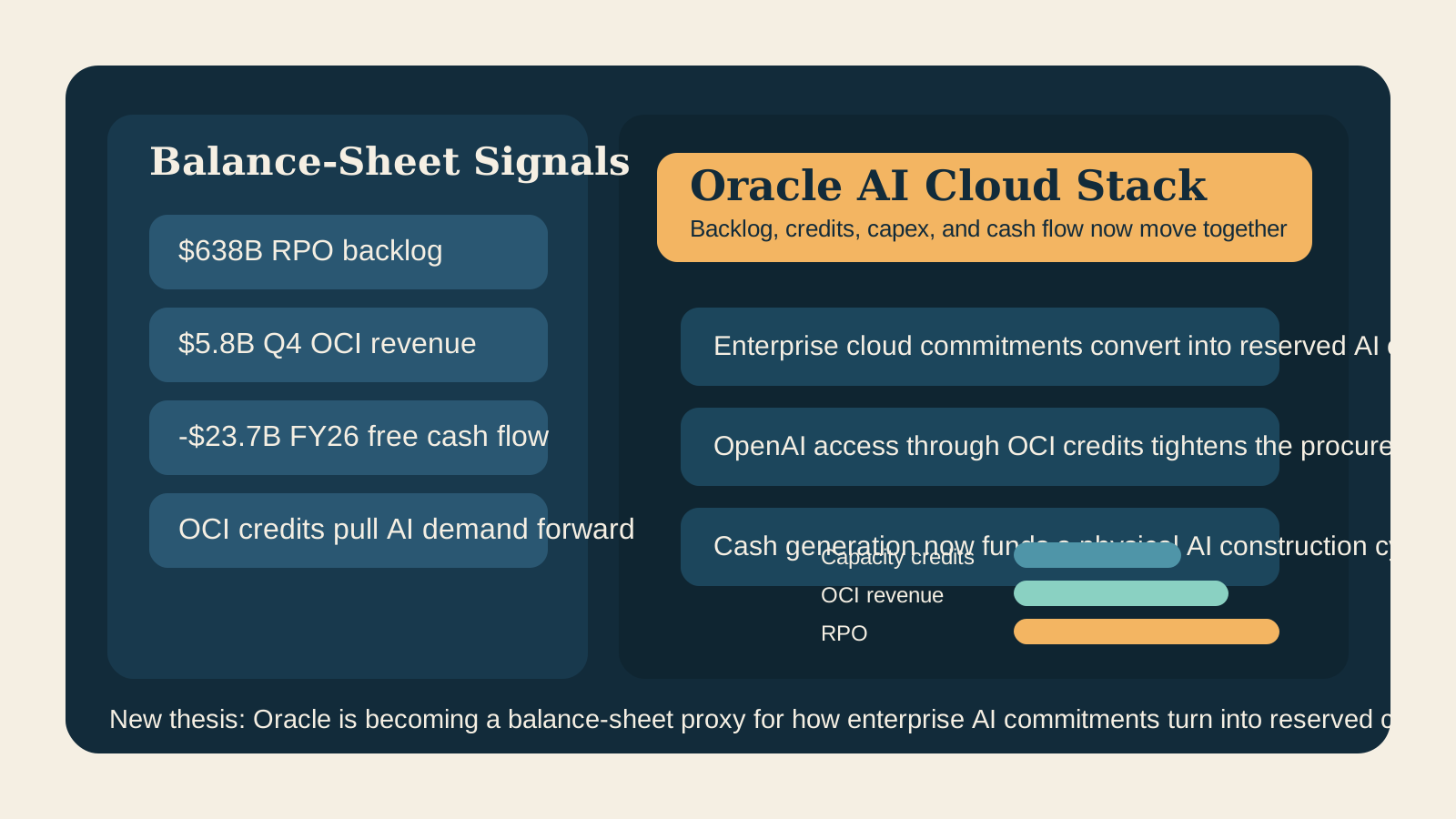
What Oracle’s June 10 numbers actually say
The useful read-through is not a generic AI beat. It is that Oracle’s backlog, cloud revenue, and cash profile now describe the same physical buildout cycle.
Oracle buildout markers
| Signal | Reported level | Why it matters | Grid Report read-through |
|---|---|---|---|
| RPO backlog | $638 billion | Customers are committing to future capacity at unusual scale. | AI demand is being reserved well before all of the physical capacity is online. |
| Q4 OCI revenue growth | $5.8 billion, +93% year over year | The delivery engine is ramping quickly, not just the contract book. | Oracle is already converting part of the backlog into live AI infrastructure revenue. |
| Free cash flow | -$23.7 billion for FY26 | Infrastructure expansion is consuming real cash, not just management narrative. | The AI cloud race is showing up as a construction burden on the balance sheet. |
| OpenAI through OCI credits | Coming weeks | Existing Oracle commitments may become a direct spend path for frontier models and Codex. | Procurement channels are being fused with model access, which can speed enterprise adoption and lock in cloud intermediaries. |
Source context: Oracle’s June 10, 2026 fiscal Q4/FY26 results release and OpenAI’s June 10, 2026 Oracle cloud commitment announcement.
Oracle’s June 10 results are worth publishing because the useful signal is not just faster cloud growth. The stronger signal is that AI demand is now large enough to reshape the balance sheet of a major infrastructure supplier in real time. Oracle reported $638 billion of remaining performance obligations, said Q4 cloud infrastructure revenue reached $5.8 billion with 93% year-over-year growth, and disclosed negative $23.7 billion of free cash flow for fiscal 2026 as it kept investing to support cloud-infrastructure expansion. That is not a normal software-company pattern. It is a construction pattern.
The original Grid Report angle is that Oracle is becoming a balance-sheet readout on how reserved AI capacity gets financed. A backlog that large means customers are committing to future consumption well ahead of delivery. When the same company also shows surging infrastructure revenue and deeply negative free cash flow tied to buildout, the practical message is that enterprise AI demand is being pulled forward through long-dated commitments that then have to be converted into powered data-center capacity fast enough to keep up.
Oracle is not just selling more AI cloud. It is turning enterprise commitments into a physical buildout cycle that now shows up in backlog, procurement credits, capex intensity, and cash flow at the same time.
The same-day OpenAI announcement makes that read-through more useful. OpenAI said on June 10 that, in the coming weeks, Oracle Cloud Infrastructure customers will be able to apply eligible Oracle Cloud Universal Credits toward OpenAI models and Codex through OCI. That matters because it tightens the procurement loop. Instead of asking enterprises to create a new vendor path for frontier AI, Oracle and OpenAI are trying to let existing cloud commitments become a spend channel for advanced models. In effect, backlog, purchasing workflow, and model access are being fused more tightly together.
That is why this story clears the duplicate block against the site’s recent AI distribution and cloud-access coverage. The AWS general-availability piece was about procurement-approved access to OpenAI through a hyperscaler channel. The Dell article was about locality and governed enterprise deployment. This Oracle story is different because the real signal sits in the capital structure. It shows what happens when AI cloud demand becomes large enough that a vendor’s backlog, construction budget, and cash generation all need to be read together.
For operators, the implication is that AI access is increasingly governed by financial plumbing as much as model quality. If existing OCI credits can be redirected into OpenAI model usage, then enterprise teams may not need a new approval process to move from pilot to production. That can speed adoption. But it also means the cloud provider sitting inside the contract path captures more of the control over how AI workloads are budgeted, staged, and prioritized.
For investors and infrastructure watchers, Oracle’s results help separate ordinary software optimism from physically constrained AI demand. A $638 billion RPO figure is only useful if the company can translate contracted demand into available data-center, power, and networking capacity without destroying future returns. The negative free-cash-flow line is therefore not a side note. It is the cost of turning booked AI demand into operating infrastructure.
The search case is strong because the article answers a live, specific question better than a generic earnings recap: what do Oracle’s June 10 numbers actually say about the AI buildout? Readers searching for Oracle Q4 FY2026 results, Oracle RPO, Oracle free cash flow, OCI AI demand, or OpenAI on Oracle cloud get a concrete thesis about procurement, backlog, and physical capacity rather than a commodity beat-and-raise summary.
Sources
Oracle Investor Relations, “Oracle Announces Record Q4 and FY 2026 Results Driven by Cloud Infrastructure & Cloud Applications,” published June 10, 2026: https://investor.oracle.com/investor-news/news-details/2026/Oracle-Announces-Record-Q4-and-FY-2026-Results-Driven-by-Cloud-Infrastructure--Cloud-Applications/default.aspx
OpenAI, “Access OpenAI models and Codex through your Oracle cloud commitment,” published June 10, 2026: https://openai.com/index/openai-on-oracle-cloud/
By Nawaz Lalani
The Grid Report is written by Nawaz Lalani and focuses on source-backed coverage of AI infrastructure, grid power demand, automation systems, and market signals.
Follow the signal, not just the headline.
Get the daily Grid brief for source-backed coverage on AI power demand, infrastructure timing, automation, and market signals.