- Hut 8’s Beacon Point disclosures are worth publishing because the useful signal is not merely that one more company announced a large AI campus.
- The operating facts are specific enough to matter.
- The June 4 filing makes the financing angle even sharper.
- Section
- Markets
- Read time
- 5 min read
- Why this page exists
- The Grid Report publishes operator-grade coverage on AI, power, infrastructure, automation, and markets.
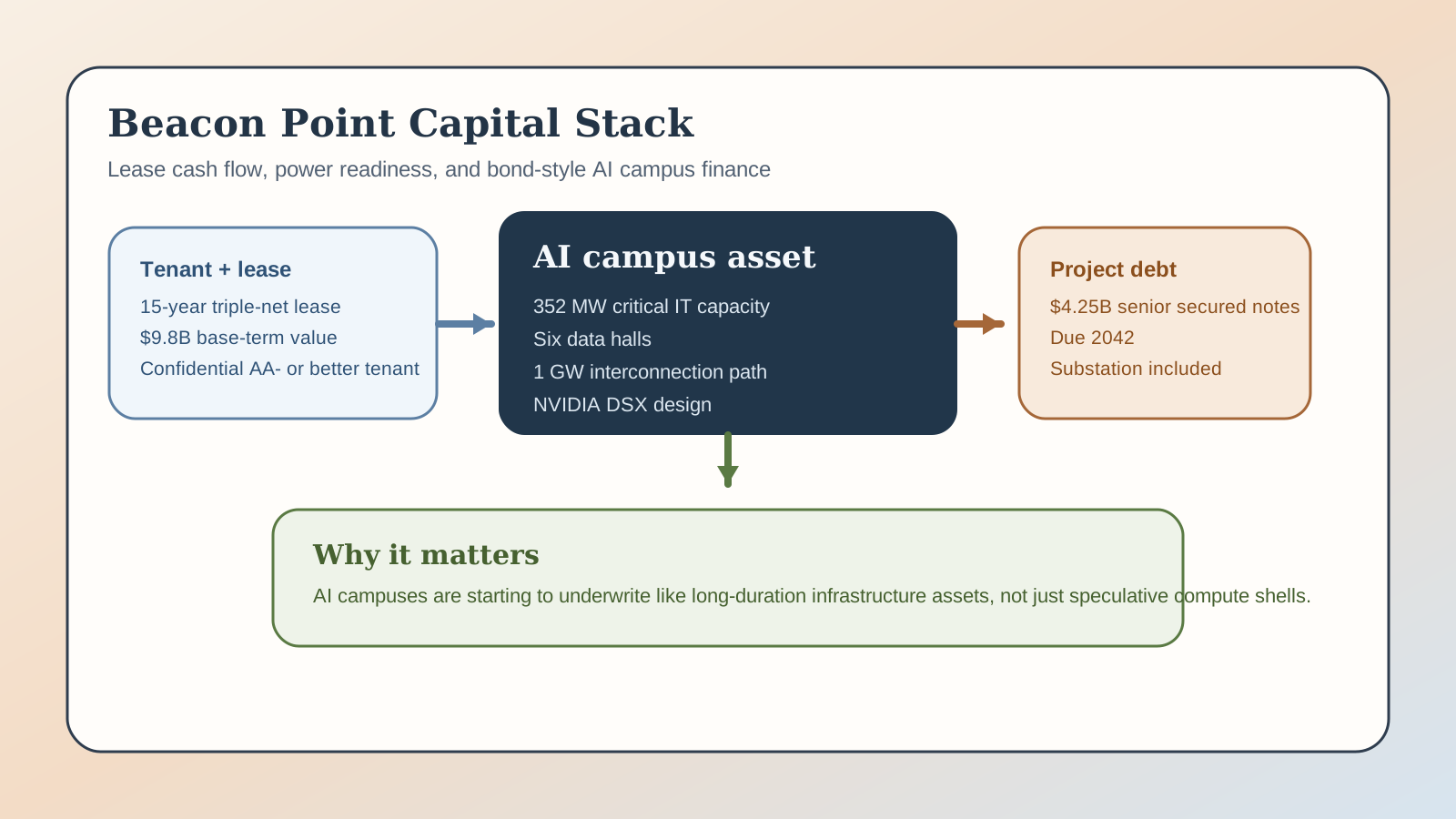
Hut 8’s Beacon Point disclosures are worth publishing because the useful signal is not merely that one more company announced a large AI campus. The stronger signal is that a hyperscale AI project is being assembled with a capital structure that looks increasingly like infrastructure paper rather than a short-cycle compute bet. Lease cash flows, site-controlled power access, substation buildout, and long-dated secured debt are being fused into one financing package.
The operating facts are specific enough to matter. Hut 8 said on May 6 that the first phase of its Beacon Point campus in Nueces County, Texas was commercialized through a 15-year, $9.8 billion lease for 352 megawatts of IT capacity with a confidential high-investment-grade tenant. The company said the campus has a 1,000 megawatt utility interconnection agreement, uses a triple-net lease structure, is designed to NVIDIA’s DSX reference architecture, and is expected to begin initial energization in the first quarter of 2027. That is not ordinary speculative land banking. It is a fully shaped campus product with power, tenancy, architecture, and timeline explicitly bundled together.
Beacon Point matters because AI infrastructure is starting to be financed less like speculative compute and more like long-duration project paper built on lease cash flows, substations, and power certainty.
The June 4 filing makes the financing angle even sharper. Hut 8 disclosed plans for $4.25 billion of senior secured notes due 2042 to finance a turnkey data center comprising six data halls with 352 megawatts of critical IT capacity and the substation located on the property. The same filing says the tenant is rated AA- or higher as of the filing date. That means the market is being asked to underwrite a package built around long-duration lease economics, an investment-grade off-taker profile, and dedicated grid-enabling infrastructure at the site itself.
That is the part that clears the duplicate block. The recent IREN piece was about investment-grade GPU financing tied to a Microsoft AI cloud contract. The CoreWeave piece was about public credit treating GPU capacity as a financial asset. This one is different. Beacon Point pushes the capital stack down a layer, from financed GPUs toward financed campus infrastructure. The collateral logic is no longer just the chips. It is the campus, the lease, the substation, the interconnection pathway, and the durability of the tenant relationship.
The original angle is that AI campuses are starting to look financeable in the same institutional language that infrastructure investors already understand. A 15-year triple-net lease with escalators, site-controlled utility capacity, and project-level secured notes moves the story away from venture-style AI exuberance and closer to toll-road logic: lock in long-lived demand, secure the enabling physical asset, and sell the resulting cash-flow profile to capital that wants duration and structure.
That matters for operators because it changes what “bankable” now means in AI infrastructure. The differentiator is not only whether a developer can raise equity or reserve GPUs. It is whether the site arrives with enough power certainty, contractual clarity, and credit quality to support cheaper long-term capital. For investors, the signal is that AI demand is beginning to migrate into instruments that can be analyzed through project finance, infrastructure debt, and lease-backed underwriting rather than only growth-equity narratives.
It also sharpens the grid angle. Beacon Point’s June 4 filing explicitly includes the substation in the financed project, which is a reminder that the enabling electrical layer is moving inside the asset package rather than sitting offstage as someone else’s problem. In other words, the next generation of AI-campus finance may be won by developers that can present a campus not just as a compute destination, but as an integrated power-and-lease machine.
The Grid Report view is that this clears the search bar because it answers a specific and useful question better than a generic Hut 8 summary: what changed at Beacon Point? The useful answer is that AI-campus finance is starting to resemble long-duration infrastructure paper, where credit quality, substation readiness, lease structure, and power delivery matter as much as headline megawatts.
Sources
Hut 8, “Hut 8 Commercializes First Phase of 1 GW Beacon Point AI Data Center Campus with 15-Year, 352 MW IT Lease with Base-Term Contract Value of $9.8 Billion,” published May 6, 2026: https://www.prnewswire.com/news-releases/hut-8-commercializes-first-phase-of-1-gw-beacon-point-ai-data-center-campus-with-15-year-352-mw-it-lease-with-base-term-contract-value-of-9-8-billion-302763484.html
Hut 8, Form 8-K dated June 4, 2026, regarding Beacon Point senior secured notes: https://www.sec.gov/Archives/edgar/data/1964789/000110465926070393/tm2616869d1_8k.htm
Hut 8, Form 10-Q for quarter ended March 31, 2026: https://www.sec.gov/Archives/edgar/data/1964789/000110465926055891/hut-20260331x10q.htm
Nawaz Lalani
Nawaz Lalani is the creator of The Grid Report and writes about AI infrastructure, grid power demand, automation systems, and the market signals shaping the physical AI economy. His focus is translating technical and industrial shifts into practical coverage for operators, investors, builders, and teams making real deployment decisions.
B.S. in Geology from UT Arlington. Covers AI infrastructure, energy systems, grid constraints, automation workflows, and market signals.
Stories are built from primary sources, utility and infrastructure signals, company disclosures, filings, and operator-grade context. The goal is to explain what changed, why it matters now, and what it means for builders, investors, utilities, and teams making real deployment decisions.
Follow the lane, not just the headline.
The strongest value in The Grid Report comes from following how AI, infrastructure, power, automation, and markets connect over time.