- NVIDIA’s September 9 IBC announcement matters less as another media-AI product release than as evidence that synthetic-video detection is becoming part of the broadcast control plane.
- That changes the operator question.
- The announced integrations show three versions of that system.
- Section
- AI Automation
- Read time
- 6 min read
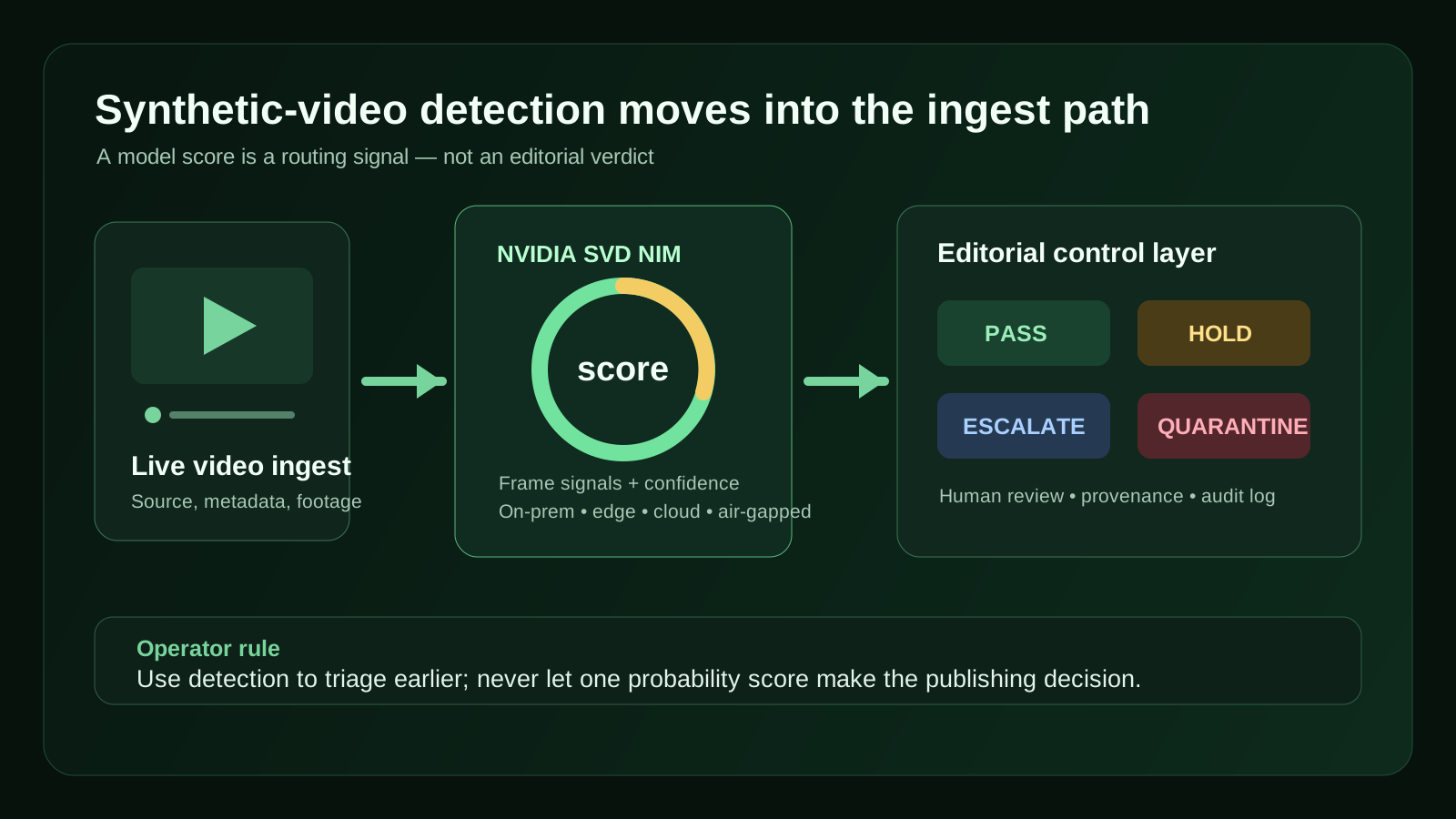
NVIDIA’s September 9 IBC announcement matters less as another media-AI product release than as evidence that synthetic-video detection is becoming part of the broadcast control plane. The company says its Synthetic Video Detector NIM microservice now reaches 99.3% accuracy on text-to-video content and 97.7% on image-to-video content. More consequentially, Dalet, TwelveLabs, and Wowza are putting its scores inside editorial, compliance, and live-stream infrastructure rather than leaving detection in a separate forensic tool.
That changes the operator question. Newsrooms no longer need only to ask whether a detector performs well on a benchmark. They need to decide where the score enters the ingest path, who reviews it, what evidence can override it, how quickly a live workflow can tolerate escalation, and whether sensitive footage may leave the organization’s own environment. Detection becomes useful only when it is attached to a decision system.
Synthetic-media defense is shifting from post-publication forensics to pre-publication operations.
The announced integrations show three versions of that system. Dalet is adding secure, cloud-hosted verification so editorial teams can inspect scores and metadata in an existing interface. TwelveLabs is adding frame-level authenticity signals to regional and custom compliance screening. Wowza plans to analyze live feeds through infrastructure already used across more than 35,000 deployments, with on-premises, edge, cloud, hybrid, and fully air-gapped deployment options.
Those deployment choices are not a secondary feature. Broadcasters, government teams, financial institutions, and critical-infrastructure operators often handle footage whose location, chain of custody, or source identity cannot be exposed to a public service. A detector that can run close to ingest and inside a controlled environment is easier to turn into policy because the organization can retain footage, logs, and review artifacts under its own access rules.
The accuracy numbers should still be treated as model measurements, not verdicts. NVIDIA describes the output as a probability that footage is authentic or AI-generated. Even a strong aggregate result can hide different error rates across generators, edits, compression levels, camera pipelines, languages, or adversarial transformations. A newsroom that automatically rejects or publishes footage at a single threshold would be outsourcing editorial judgment to a probabilistic classifier.
A production workflow therefore needs at least four states: pass, hold, escalate, and quarantine. Low-risk footage with credible provenance may pass with logging. Ambiguous material should be held for a second signal such as source verification, metadata review, reverse search, or another detector. High-impact footage should escalate to a trained reviewer regardless of the score. Suspected manipulation should be quarantined without destroying the original evidence or its audit trail.
Teams also need to measure the system against their own risk mix. False positives can delay legitimate breaking news and unfairly discredit authentic footage. False negatives can put fabricated material on air. The acceptable threshold for a user-generated sports clip is not necessarily the threshold for footage purporting to show a military strike, market-moving announcement, or public-safety emergency. Precision, recall, review latency, and appeal outcomes should be tracked by content class rather than collapsed into one headline accuracy figure.
The operator advantage is not perfect detection. It is earlier triage. Moving the model into ingest gives teams a chance to route suspicious material before it is clipped, translated, syndicated, and amplified across downstream systems. NVIDIA’s broader IBC stack—including live localization, video enhancement, and software-defined media exchange—makes that boundary more important because the same infrastructure can now alter and distribute content at machine speed.
For media software vendors, authenticity is becoming an attachable control surface. Customers will increasingly expect confidence scores, frame-level flags, review queues, retention policies, audit logs, and deployment-location choices to travel with the video workflow. Vendors that expose only a detection score will leave the hard operational work to the buyer; vendors that connect the score to policy and evidence handling can sell a more durable trust product.
The original lesson from IBC is that synthetic-media defense is shifting from post-publication forensics to pre-publication operations. NVIDIA has supplied a stronger detector and a growing distribution layer. Broadcasters still have to build the governance around it: calibrated thresholds, human authority, provenance checks, private deployment, incident logging, and a clear rule for what happens when the model is uncertain.
Sources
NVIDIA, “NVIDIA Brings Real-Time AI to Broadcast, Sports and Global Streaming at IBC,” published September 9, 2026: https://blogs.nvidia.com/blog/ibc-news-2026/
NVIDIA, “At SIGGRAPH, NVIDIA Advances Graphics and Simulation With Agentic and Physical AI,” published July 20, 2026: https://blogs.nvidia.com/blog/siggraph-news-2026/
By Nawaz Lalani
The Grid Report is written by Nawaz Lalani and focuses on source-backed coverage of AI infrastructure, grid power demand, automation systems, and market signals.
Follow the signal, not just the headline.
Get the daily Grid brief for source-backed coverage on AI power demand, infrastructure timing, automation, and market signals.