- 1Password’s September 8 Codex case study clears the publish bar because it offers something most enterprise AI announcements do not: a measured operating result and a specific control design in the same release.
- That is the original angle.
- The cycle-time result is the cleanest operational signal.
- Section
- AI Automation
- Read time
- 5 min read
1Password’s September 8 Codex case study clears the publish bar because it offers something most enterprise AI announcements do not: a measured operating result and a specific control design in the same release. OpenAI says a core cohort of 1Password engineers recorded a 20.9% productivity improvement, while median pull-request cycle time fell 10.9%. Those numbers are useful, but the more important story is how a security company made the deployment measurable and governable enough to expand.
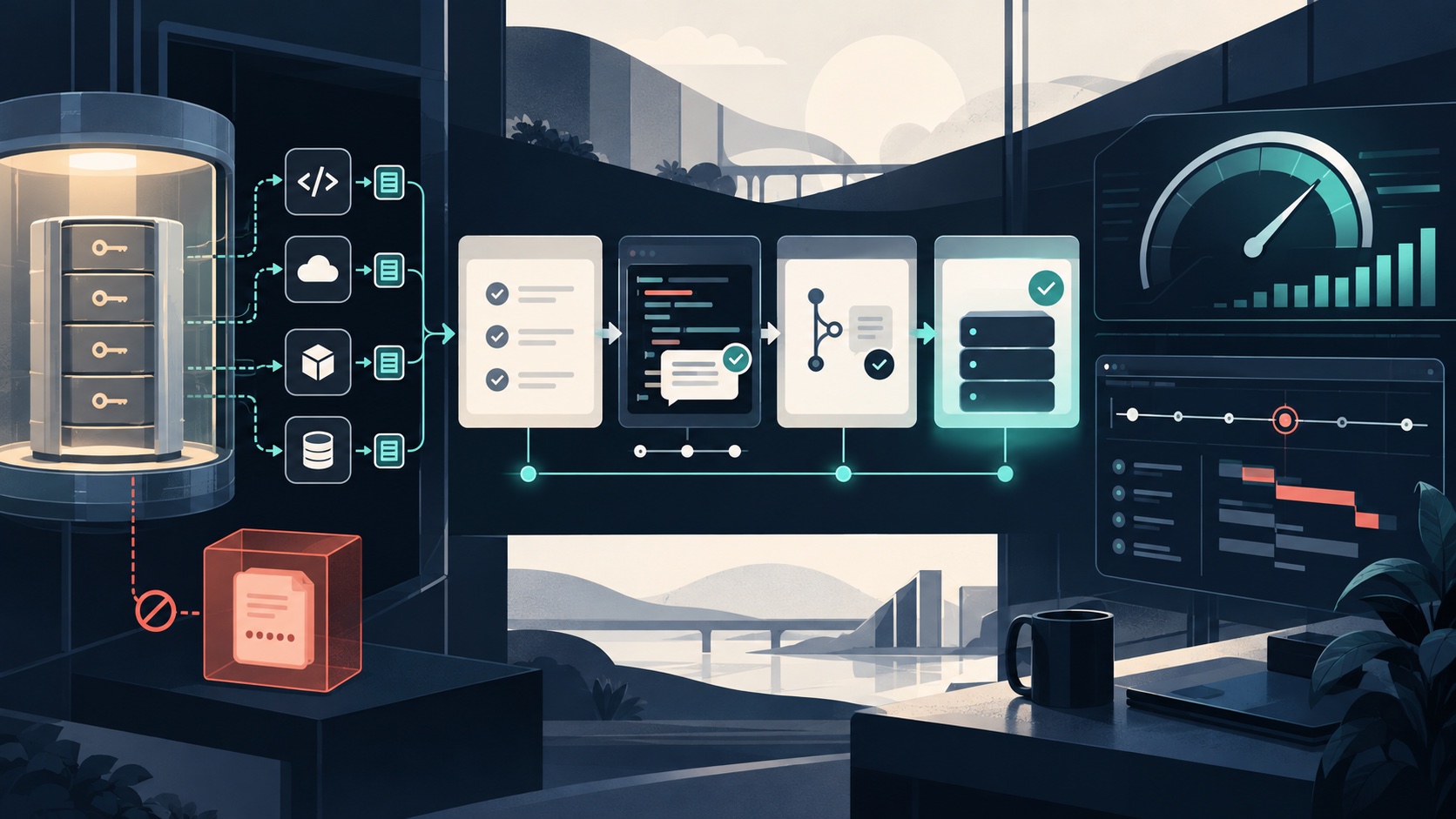
That is the original angle. Enterprise coding agents are often sold as a contest over generated code volume or individual developer speed. 1Password’s evidence points to a more complete system: work is decomposed from user stories, agents operate across planning, implementation, review, testing, and incident investigation, security policy travels with the workflow, and the organization measures whether faster output survives the path to production. The product is not just the model. It is the instrumented delivery loop around it.
AI productivity becomes credible when measurable delivery gains and secret isolation are designed as one operating system.
The cycle-time result is the cleanest operational signal. OpenAI says an engineer working outside a familiar stack reduced a typical three-day merge to one day, while a team facing a fixed beta deadline completed four release-critical tickets instead of the roughly two it expected. Those examples are company-reported and should not be generalized as universal benchmarks. They do show where operators should look for value: elapsed time through a constrained workflow, not the number of prompts sent or lines of code generated.
The incident example adds a different kind of leverage. For a defect spanning more than 10 microservices, 1Password says investigation time fell from roughly two hours to between five and 20 minutes. That matters because production investigation is an information-retrieval and evidence-assembly problem before it is a code-writing problem. An agent that can gather telemetry, source context, paging history, feature flags, and incident data under approved access controls can compress the expensive search phase without being trusted to make every remediation decision alone.
The security architecture is what makes the story more than a productivity case study. 1Password says repositories contain secret references rather than credentials. When Codex calls an approved internal tool, the system resolves and injects the credential at the point of action, so plaintext does not enter model context. The company also says it encoded internal security policies into reusable AppSec skills. Together, those choices create a practical enterprise pattern: give the agent enough authority to complete real work, but move sensitive material and policy enforcement into controlled execution boundaries.
That pattern changes the procurement question. Buyers should not ask only whether a coding agent writes acceptable code. They should ask how credentials are resolved, which tools can be invoked, where policy is enforced, how actions are logged, what requires human approval, and which delivery metrics will prove that added throughput is real. Without those answers, autonomy can increase review debt and access risk faster than it increases useful capacity.
The ROI model is also unusually transparent. OpenAI says 1Password estimated about $783,750 in annual engineering capacity for 50 consistently active developers, using a $250,000 fully loaded annual cost, a 20.9% measured productivity improvement, 40% directional attribution to Codex, and 75% realization of that productive capacity. The result is still modeled, not booked savings. But explicitly discounting attribution and realization is far more useful than multiplying an observed time saving by every engineering salary dollar.
The duplicate screen holds. Recent Grid Report systems coverage examined agent reliability, spend controls, benchmark risk, and workflow redesign in the aggregate. The Australian Payments Plus story focused on simulation and reconciliation speed, while UST focused on hardware-validation loops. 1Password adds a distinct thesis: enterprise coding-agent scale depends on joining measurable software-delivery outcomes to secret isolation and reusable application-security policy.
There are clear limits. The source is a vendor case study published by OpenAI, the measured cohort was 50 consistently active users, the productivity methodology is not independently audited, and the capacity value depends on assumptions about attribution and realization. Those caveats should keep the headline narrow. They do not erase the operator value of the evidence, because the metrics and controls are specific enough for another enterprise to test against its own baseline.
The practical conclusion is that AI productivity becomes credible when it is treated as an operating system rather than a seat-license story. Instrument the path from planning to production. Measure cycle time and incident investigation, not activity. Discount modeled value for attribution and realization. Keep plaintext credentials outside model context. Encode security policy where the agent actually works. That combination is a more durable enterprise adoption template than another claim that developers simply code faster.
Sources
OpenAI, “1Password increases engineering productivity 21% with Codex,” published September 8, 2026: https://openai.com/index/1password/
1Password Developer Documentation, “Use secret references,” accessed September 9, 2026: https://developer.1password.com/docs/cli/secret-references/
By Nawaz Lalani
The Grid Report is written by Nawaz Lalani and focuses on source-backed coverage of AI infrastructure, grid power demand, automation systems, and market signals.
Follow the signal, not just the headline.
Get the daily Grid brief for source-backed coverage on AI power demand, infrastructure timing, automation, and market signals.