- NVIDIA’s July 1 manufacturing post clears the publish bar because it does more than repeat that AI needs more chips.
- The primary-source details are concrete enough to matter.
- That stack is what makes the story worth publishing.
- Section
- Infrastructure
- Read time
- 5 min read
- Why this page exists
- The Grid Report publishes operator-grade coverage on AI, power, infrastructure, automation, and markets.
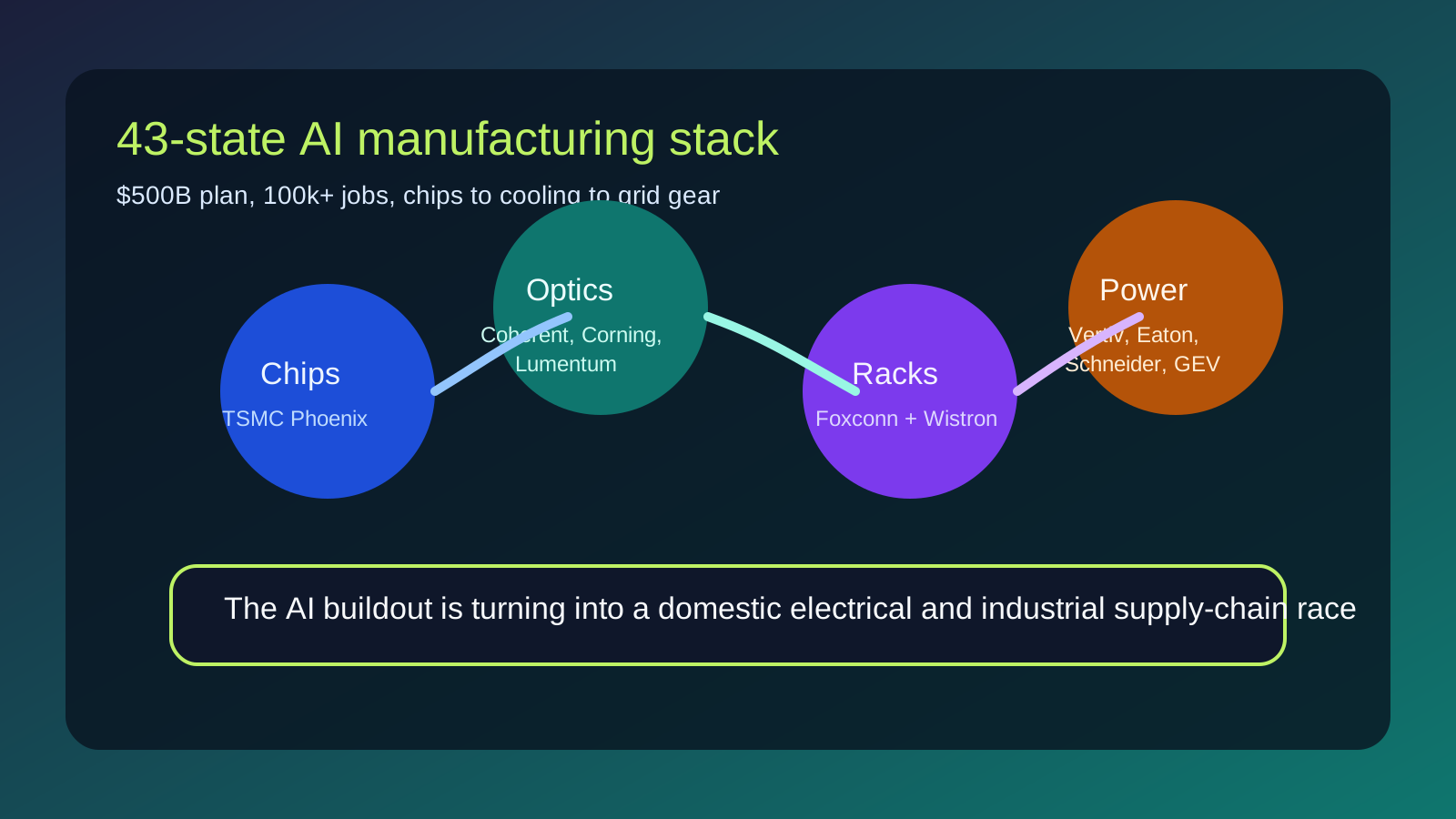
How NVIDIA is framing the domestic AI stack
The interesting part is not only the headline number. It is the spread of dependencies across chips, optics, assembly, and power infrastructure.
| Layer | Primary-source detail | Why it matters |
|---|---|---|
| Semiconductors | NVIDIA says Blackwell wafer production is underway at TSMC’s Phoenix facility | U.S.-based advanced-chip output is becoming part of the AI deployment timeline. |
| System assembly | Foxconn in Houston and Wistron in Fort Worth are building and testing NVIDIA AI systems | Racks and server systems need domestic conversion capacity, not just imported parts. |
| Optical network | NVIDIA highlights Coherent, Corning, and Lumentum across optical and connectivity manufacturing | Interconnect supply is moving into the critical path as AI systems scale. |
| Facility stack | NVIDIA names Vertiv, Schneider Electric, Eaton, Siemens, Trane, and GE Vernova as part of the buildout | Power, cooling, and electrical equipment are now core AI-capacity constraints. |
| Economic footprint | NVIDIA cites a 43-state supplier network, up to $500 billion of planned U.S. AI infrastructure production, and more than 100,000 supported jobs | AI is increasingly behaving like a broad industrial program rather than a narrow software cycle. |
Sources: NVIDIA July 1, 2026 buildout post and linked NVIDIA manufacturing announcements.
NVIDIA’s July 1 manufacturing post clears the publish bar because it does more than repeat that AI needs more chips. NVIDIA says its partner-and-supplier network now spans 43 states and that it plans to produce up to $500 billion of AI infrastructure in the United States with partners including TSMC, Foxconn, Wistron, Corning, Lumentum, Coherent, and Amkor. The stronger Grid Report angle is that AI deployment is starting to look like a nationwide electrical and industrial supply-chain buildout rather than a single semiconductor story.
The primary-source details are concrete enough to matter. NVIDIA says Blackwell wafer production is underway at TSMC’s Phoenix facility, Foxconn is building a Texas factory for NVIDIA AI systems and GB300 tray modules in Houston, and Wistron will assemble and test NVIDIA AI systems at a new advanced manufacturing facility in Fort Worth. The company also highlights Coherent, Corning, and Lumentum on the optical side and points to equipment and infrastructure providers such as Vertiv, Schneider Electric, Eaton, Siemens, Trane Technologies, and GE Vernova.
The real NVIDIA signal is not patriotic branding. It is that AI deployment now depends on a synchronized electrical, optical, cooling, and assembly supply chain spread across the U.S.
That stack is what makes the story worth publishing. Searchers do not need another shallow summary saying NVIDIA wants more domestic production. The more useful answer is that the AI bottleneck is broadening. Once the buildout depends on wafers, packaging, optics, racks, thermal systems, switchgear, backup power, and factory labor all moving together, the scarce asset is not just an accelerator. It is a synchronized industrial chain.
This is why the piece belongs in infrastructure instead of a generic AI or corporate-news lane. NVIDIA is effectively describing three factory layers: semiconductor fabs, electronics-manufacturing facilities, and AI factories themselves. Read through a Grid Report lens, that means more of the deployment constraint is shifting into physical conversion capacity. The next delay may come from optics, power gear, cooling, or assembly throughput as easily as from GPU demand alone.
The employment and economic figures help show the scale of the claim, even if they should be read as company-selected framing. NVIDIA cites analysis from Public First estimating that in 2026 alone NVIDIA-driven AI demand will contribute $485 billion to U.S. GDP and support more than 100,000 jobs. The precise multiplier is less important than the structure of the buildout it implies: AI is now creating work for electricians, pipefitters, HVAC technicians, construction crews, and manufacturing technicians, not only software teams and chip designers.
The operator read-through is that site readiness now depends on supplier readiness across multiple layers. A campus can have demand, capital, and land, yet still stall if optical components, racks, cooling systems, or power equipment do not arrive in sequence. That is why NVIDIA’s supplier list is more useful than the patriotic wrapper around it. It shows which parts of the stack are moving from background inputs into named strategic dependencies.
This also helps separate the story from the site’s recent NVIDIA coverage. The June 21 SK hynix article was about memory roadmaps and fab automation. The June 22 45-degree-cooling piece was about data-center thermal efficiency. The June 23 TOP500 story was about system performance and power efficiency. This July 1 hook is different because it is a map of the domestic manufacturing stack around AI, including optics, assembly, and power equipment that can determine how quickly demand turns into operating capacity.
There are still caveats. NVIDIA is describing its own ecosystem, and the $500 billion figure is a plan, not finished output. Company blog posts also compress a lot of execution risk into one coherent narrative. But even with those limits, the narrower conclusion holds: AI infrastructure is becoming a U.S. industrial buildout with multiple physical bottlenecks that deserve to be tracked explicitly.
That is enough to publish. Searchers looking for NVIDIA’s latest U.S. manufacturing push should get more than a corporate slogan. They should get the harder point: AI scale increasingly depends on whether the electrical, optical, mechanical, and assembly supply chain can industrialize fast enough to keep up.
Sources
NVIDIA, “NVIDIA and Partners Build in America, for America,” published July 1, 2026: https://blogs.nvidia.com/blog/nvidia-and-partners-build-in-america-for-america/
NVIDIA, “NVIDIA and Corning Partner to Expand U.S. AI Manufacturing”: https://nvidianews.nvidia.com/news/nvidia-and-corning-partner-to-expand-u-s-ai-manufacturing
NVIDIA, “NVIDIA to Manufacture American-Made AI Supercomputers in US for the First Time”: https://blogs.nvidia.com/blog/nvidia-manufacture-american-made-ai-supercomputers-us/
Nawaz Lalani
Nawaz Lalani is the creator of The Grid Report and writes about AI infrastructure, grid power demand, automation systems, and the market signals shaping the physical AI economy. His focus is translating technical and industrial shifts into practical coverage for operators, investors, builders, and teams making real deployment decisions.
B.S. in Geology from UT Arlington. Covers AI infrastructure, energy systems, grid constraints, automation workflows, and market signals.
Stories are built from primary sources, utility and infrastructure signals, company disclosures, filings, and operator-grade context. The goal is to explain what changed, why it matters now, and what it means for builders, investors, utilities, and teams making real deployment decisions.
Follow the lane, not just the headline.
The strongest value in The Grid Report comes from following how AI, infrastructure, power, automation, and markets connect over time.