- Tapestry’s first live HyperQ deployment at PJM is worth publishing because the useful signal is not simply that an AI tool processed a large pile of paperwork quickly.
- The facts are concrete enough to clear the bar.
- That matters because site-control review is not a cosmetic step.
- Section
- Energy
- Read time
- 4 min read
- Data included
- What HyperQ handled in PJM Cycle 1
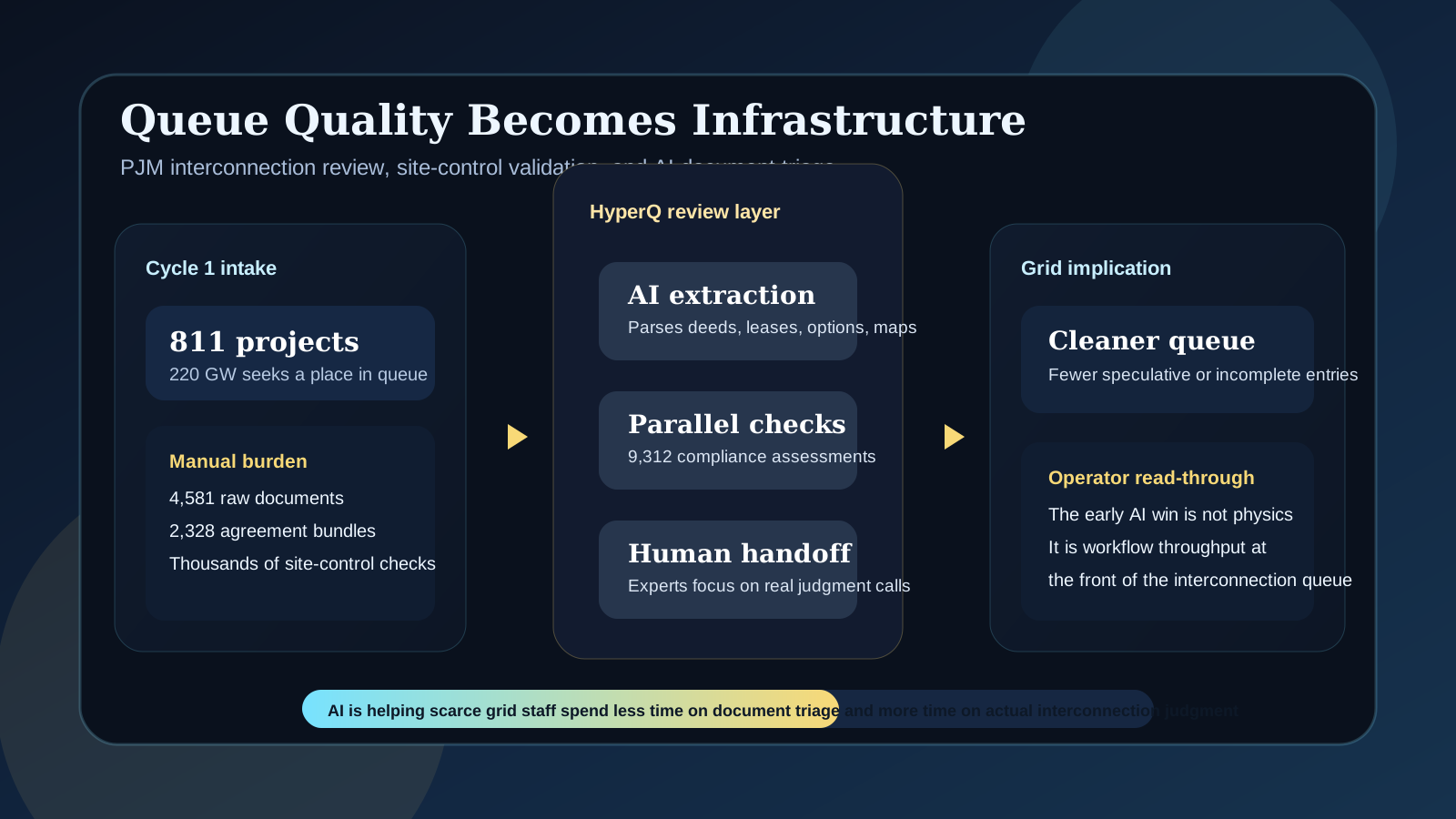
What HyperQ handled in PJM Cycle 1
The useful point is not “AI touched the grid.” It is that AI was applied to a real queue-intake bottleneck with measurable document volume and review workload.
| Cycle 1 intake layer | Reported volume | Why it matters | Operator implication |
|---|---|---|---|
| Applications received | 811 projects / 220 GW | PJM’s first reformed Cycle opened with a large intake that would strain manual review bandwidth. | Queue-quality tools matter more when the volume spike arrives all at once. |
| Raw site-control inputs | 4,581 documents | Land rights, leases, deeds, and related records are where incomplete filings can consume expert time. | Document hygiene becomes part of infrastructure readiness. |
| Agreement bundles | 2,328 bundles | HyperQ had to organize fragmented legal material into reviewable packages. | Better intake structure can keep viable projects moving sooner. |
| Compliance assessments | 9,312 parallel checks | Screening for term, continuity, exclusivity, and acreage is part of first-ready discipline. | AI’s early value is workflow throughput before deeper engineering studies begin. |
Source context: PJM’s April 29, 2026 Cycle 1 announcement and Data Center Dynamics’ June 12, 2026 report on Tapestry’s first HyperQ deployment.
Tapestry’s first live HyperQ deployment at PJM is worth publishing because the useful signal is not simply that an AI tool processed a large pile of paperwork quickly. The stronger signal is that one of the first real AI wins in the power buildout may sit at the front of the queue: sorting incomplete or speculative applications from viable ones before scarce grid experts spend weeks on them.
The facts are concrete enough to clear the bar. On April 29, PJM said 811 new generation projects representing 220 gigawatts had applied in the first Cycle of its reformed interconnection process and that HyperQ was already helping staff review application data more quickly. Then on June 12, Data Center Dynamics reported details from Tapestry’s first deployment: HyperQ handled the initial site-control review for Cycle 1, processed 4,581 raw site-control documents into 2,328 agreement bundles, and ran 9,312 parallel compliance assessments with a median assessment time of 6 minutes and 15 seconds.
The early AI win in interconnection is not solving grid physics. It is keeping weak paperwork from consuming scarce expert time at the front of the queue.
That matters because site-control review is not a cosmetic step. Under PJM’s first-ready, first-served process, developers need to prove they actually control the land they plan to build on before moving deeper into the queue. In a market flooded with AI-driven load growth and developer urgency, the ability to filter land-control claims quickly is part of queue quality. It determines whether the study pipeline is reserved for projects that can plausibly become steel, wire, and operating megawatts.
That is the sharper Grid Report angle. The market often talks about AI and power as if the only bottlenecks are turbines, substations, transformers, and transmission upgrades. Those are real. But PJM’s HyperQ deployment shows another chokepoint: expert review time. If hundreds of applications arrive at once, each with dense legal documents, maps, leases, options, and chain-of-title questions, then the queue can bog down long before the hardest electrical modeling starts. AI is being used here less as a magical planning oracle and more as workflow compression for an overloaded gate.
This is also why the story clears the duplicate block against the site’s recent PJM coverage. The expedited-track article was about a fast lane for state-backed 250-megawatt-plus supply projects. The spring-heat piece was about near-term operating stress. The large-load and governance stories were about market design and cost allocation. HyperQ is different because it focuses on the quality-control layer at the intake stage, where paperwork discipline becomes part of power-delivery timing.
For operators and developers, the practical implication is that queue strategy is becoming more operational. Winning projects will not only need capital, land, and a plausible interconnection thesis. They will need document packages that are machine-readable, internally consistent, and legally clean enough to survive faster screening. That favors developers who treat site control, parcel mapping, acreage requirements, and filing hygiene as core infrastructure work rather than back-office cleanup.
For investors and policy watchers, the read-through is narrower but still important. AI is not yet solving PJM’s entire interconnection problem. It is helping reclaim expert time at a stage where throughput matters. If that pattern holds, the next infrastructure advantage may not just belong to the projects with access to megawatts. It may also belong to the operators, grid institutions, and software layers that can raise queue quality before the engineering queue gets clogged.
The search case is strong because readers looking for Tapestry HyperQ, PJM AI interconnection review, or what happened in PJM’s first Cycle need more than a generic “AI speeds the grid” headline. The more useful answer is that AI is being deployed first as a queue-discipline tool, and that says a lot about where the real administrative bottlenecks now sit in the power buildout.
Sources
PJM Inside Lines, “PJM, Google & Tapestry Join Forces To Apply AI To Enhance Regional Planning, Generation Interconnection,” published April 10, 2025: https://insidelines.pjm.com/pjm-google-tapestry-join-forces-to-apply-ai-to-enhance-regional-planning-generation-interconnection/
PJM Inside Lines, “Over 800 New Generation Projects Seek To Connect Under PJM’s Reformed Process,” published April 29, 2026: https://insidelines.pjm.com/over-800-new-generation-projects-seek-to-connect-under-pjms-reformed-process/
Data Center Dynamics, “Google-backed Tapestry completes first deployment of AI platform for PJM interconnection application process,” published June 12, 2026: https://www.datacenterdynamics.com/en/news/google-backed-tapestry-completes-first-deployment-of-ai-platform-for-pjm-interconnection-application-process/
By Nawaz Lalani
The Grid Report is written by Nawaz Lalani and focuses on source-backed coverage of AI infrastructure, grid power demand, automation systems, and market signals.
Follow the signal, not just the headline.
Get the daily Grid brief for source-backed coverage on AI power demand, infrastructure timing, automation, and market signals.