- SWI Group’s June 15 acquisition of a significant Genesis Digital Assets stake is worth publishing because the useful signal is not simply that another investor wants AI exposure.
- The operating facts are specific enough to clear the bar.
- That is the sharper Grid Report angle.
- Section
- Infrastructure
- Read time
- 4 min read
- Data included
- Why the GDA deal matters to the AI buildout
Why the GDA deal matters to the AI buildout
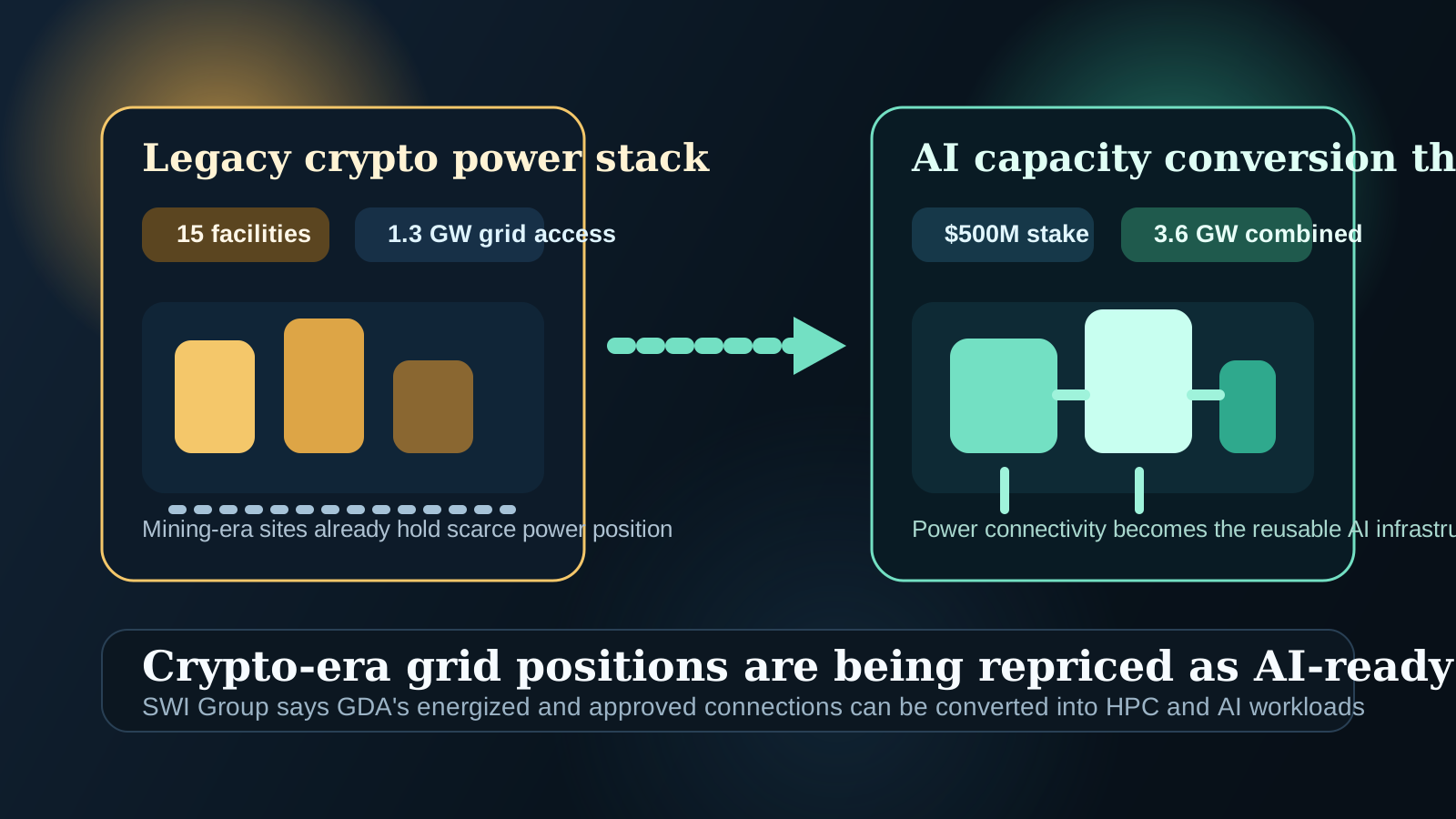
The transaction matters because it treats legacy crypto infrastructure as convertible AI supply built around scarce megawatts.
| Signal | What SWI said | Why it matters | Grid Report read-through |
|---|---|---|---|
| Grid position | GDA has 1.3 GW of energized and approved connections across 15 facilities. | Actual power posture is harder to replace than a campus rendering. | The scarce asset is energizable capacity, not generic land. |
| Use-case shift | SWI plans to reposition mining assets toward HPC and AI workloads. | Older compute sites can be upgraded instead of built from zero. | Crypto infrastructure is becoming a reserve inventory pool for AI demand. |
| Texas concentration | Portfolio includes multiple hyperscaler-grade sites in Texas. | Texas remains one of the most active large-load markets in the US. | The portfolio may offer faster customer conversion if the sites are truly AI-suitable. |
| Platform scale | Combined SWI and AiOnX footprint reaches 3.6 GW. | The company is assembling a transatlantic capacity map, not a one-campus story. | AI infrastructure competition is moving toward multi-site power portfolios. |
Source context: SWI Group announcement of its June 15, 2026 Genesis Digital Assets transaction.
SWI Group’s June 15 acquisition of a significant Genesis Digital Assets stake is worth publishing because the useful signal is not simply that another investor wants AI exposure. The stronger signal is that legacy crypto infrastructure with real grid access is being repriced as AI-ready capacity. In this market, power connectivity is becoming the asset, and older mining platforms already sitting on energized or approved connections can convert into a faster AI buildout path than many greenfield campuses.
The operating facts are specific enough to clear the bar. SWI Group said it is paying $500 million for a significant shareholding in Genesis Digital Assets, a platform with 1.3 gigawatts of energized and approved grid connections across 15 facilities, including multiple hyperscaler-grade sites in Texas. The company said it intends to reposition those assets from digital-asset mining into high-performance computing and AI workloads. It also said the combination with AiOnX’s 2.3 gigawatt European platform would give the group 3.6 gigawatts of combined transatlantic AI-ready digital infrastructure capacity.
The asset being repriced is not the old mining business. It is the power connection underneath it.
That is the sharper Grid Report angle. The market still often talks about AI infrastructure as if the main problem is finding enough land, enough capital, or enough GPUs. Those matter, but the harder-to-replace asset is often the power position underneath the site. If a company already controls facilities with grid access, transmission posture, and a history of operating power-dense loads, the conversion from mining to AI can become a timing trade rather than a pure development gamble.
This clears the overlap filter against the site’s recent infrastructure coverage because the thesis is different. The TeraWulf Kentucky piece was about brownfield transmission posture as a site-selection shortcut. The Hut 8 Beacon Point story was about AI campuses being financed like long-duration infrastructure paper. This SWI-GDA deal sits one step earlier in the chain. It is about the market repricing crypto-era power access itself as convertible AI inventory.
The Texas detail matters in particular. SWI says GDA includes multiple hyperscaler-grade sites in Texas, which implies the company is not just buying old mining sheds. It is buying a portfolio with power characteristics and scale that can matter to serious AI and HPC demand. That does not guarantee smooth conversion, but it changes the starting point. The commercial question shifts from whether the site can ever become AI-capable to how quickly the owner can refit the platform, secure customers, and align the operating model with higher-value workloads.
There is also a broader read-through for developers and utilities. The AI buildout is starting to absorb infrastructure created for adjacent compute markets, especially where those markets already solved the difficult early problems around land control, interconnection, and on-site electrical operations. That makes legacy crypto infrastructure less of a side story and more of a reserve inventory pool for AI capacity expansion.
For investors, the most important sentence in the release may be the plainest one: power connectivity is the most valuable commodity in digital infrastructure today. That is promotional language, but it is directionally correct. The next wave of AI winners may not be the firms with the loudest campus renderings. They may be the ones that already control scarce, energizable megawatts and can convert them into production AI supply faster than new entrants can permit and build.
The search case is strong because readers looking for the GDA transaction need more than a crypto-to-AI pivot headline. The more useful answer is that legacy mining infrastructure is being repriced as a shortcut to AI-ready capacity, and that tells you what the market now thinks is truly scarce.
Sources
SWI Group, “SWI Group Expands Transatlantic Digital Infrastructure Platform with closing of $500 Million USD Acquisition of significant shareholding in a 1.3 GW USA portfolio,” published June 15, 2026: https://www.prnewswire.co.uk/news-releases/swi-group-expands-transatlantic-digital-infrastructure-platform-with-closing-of-500-million-usd-acquisition-of-significant-shareholding-in-a-1-3-gw-usa-portfolio-302799777.html
TradingView/EQS version of the June 15, 2026 SWI Group announcement, accessed June 15, 2026: https://www.tradingview.com/news/eqs%3A38c0a0aac094b%3A0-swi-group-expands-transatlantic-digital-infrastructure-platform-with-closing-of-500-million-usd-acquisition-of-significant-shareholding-in-a-1-3-gw-usa-portfolio/
Data Center Dynamics, “AiOnX completes $500m Genesis Digital Assets deal, will pivot crypto data centers to AI,” published June 15, 2026: https://www.datacenterdynamics.com/en/news/aionx-completes-500m-genesis-digital-assets-deal-will-pivot-crypto-data-centers-to-ai/
By Nawaz Lalani
The Grid Report is written by Nawaz Lalani and focuses on source-backed coverage of AI infrastructure, grid power demand, automation systems, and market signals.
Follow the signal, not just the headline.
Get the daily Grid brief for source-backed coverage on AI power demand, infrastructure timing, automation, and market signals.