- One of the stronger infrastructure stories this week is Schneider Electric saying it is progressing phased delivery of more than $290 million of AI infrastructure solutions at TeraWulf’s Google-backed Lake Mariner campus.
- Schneider’s May 26 release says TeraWulf’s 750-megawatt Lake Mariner campus is using Schneider and Motivair infrastructure and services to support long-term growth for Core42 and Fluidstack.
- The original Grid Report angle is that AI capacity increasingly depends on execution stacks rather than isolated hardware orders.
- Section
- Infrastructure
- Read time
- 5 min read
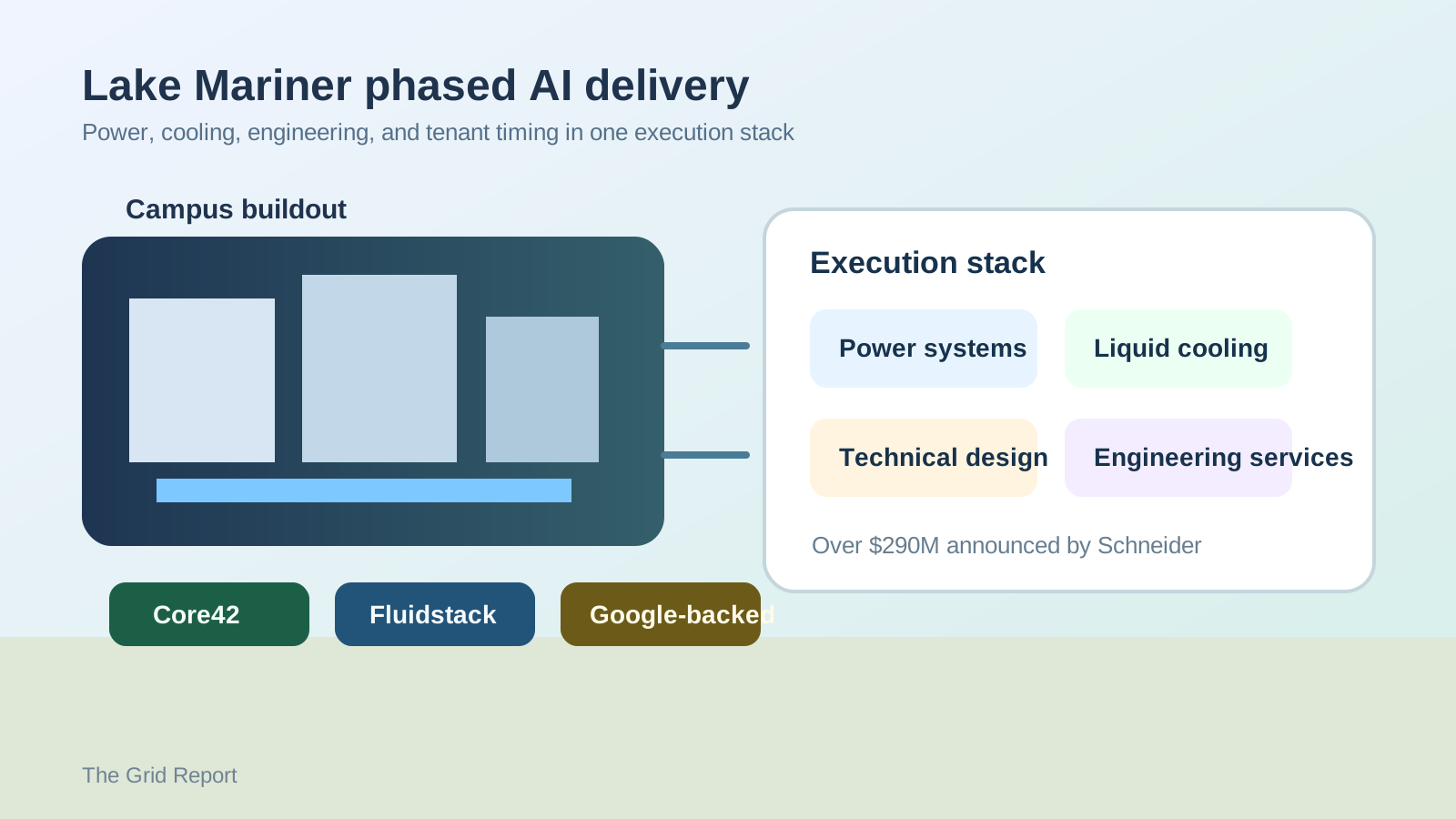
One of the stronger infrastructure stories this week is Schneider Electric saying it is progressing phased delivery of more than $290 million of AI infrastructure solutions at TeraWulf’s Google-backed Lake Mariner campus. The article clears the bar because the useful signal is not simply another vendor attaching itself to AI demand. It is that one of the better-known high-performance-compute campuses is being assembled through a coordinated delivery stack that includes power infrastructure, liquid cooling, technical design, and engineering services around anchor tenants already tied to the site.
Schneider’s May 26 release says TeraWulf’s 750-megawatt Lake Mariner campus is using Schneider and Motivair infrastructure and services to support long-term growth for Core42 and Fluidstack. TeraWulf’s own May 8 first-quarter release adds the operational context: 60 megawatts of critical IT capacity for Core42 were live as of March 31, CB-3 was nearing completion with energization aligned to customer hardware deployment, and the company was coordinating infrastructure delivery with Fluidstack and Google. That combination is what makes the story publishable. It links supplier language to a real campus build schedule and contracted tenant sequence.
The scarce asset at big AI campuses is increasingly not one component. It is the coordinated execution stack that turns announced megawatts into live tenant capacity.
The original Grid Report angle is that AI capacity increasingly depends on execution stacks rather than isolated hardware orders. A large campus only becomes usable when switchgear, cooling, design services, energization timing, and customer hardware delivery all line up. The industry often talks as if capacity appears once land and megawatts are announced. Lake Mariner is a better example of the real work: a phased sequence where infrastructure vendors, tenant commitments, and site readiness have to be synchronized tightly enough that rent and compute can begin on schedule.
This clears the site’s duplicate block. The Grid Report has already covered Modine’s reserved cooling capacity, NVIDIA and IREN’s power-readiness push, and general competition on energization timing. This article is materially different because it focuses on campus execution as a stack product. The thesis is not just that cooling or power matters. It is that supplier coordination and delivery sequencing are becoming part of the scarce asset.
For operators and developers, the implication is straightforward. AI-campus execution risk should be judged less by headline megawatt counts and more by whether the enabling stack is already in motion: cooling vendor alignment, engineering depth, utility timing, phased building turnover, and the quality of the tenant schedule behind the site. If any one of those breaks, the capacity may exist on paper but not in service.
For investors, the signal is that more of the AI buildout value may accrue to companies that sit inside delivery-critical layers rather than only the obvious compute names. Once the market starts rewarding firms that help convert announced campuses into revenue-producing infrastructure, execution vendors and campus operators can become more legible parts of the AI stack.
The Grid Report view is that this article is publishable because it has a same-day company hook, a specific and distinct thesis, and strong search value around Lake Mariner, Schneider Electric, TeraWulf, and AI campus delivery. The important shift is not just a $290 million contract. It is AI capacity being built as an execution stack.
Sources
Schneider Electric, “Schneider Electric progresses phased-delivery of over $290M in AI Infrastructure Solutions, including Motivair technologies, at TeraWulf’s Google-Backed Lake Mariner Campus,” May 26, 2026: https://www.prnewswire.com/news-releases/schneider-electric-progresses-phased-delivery-of-over-290m-in-ai-infrastructure-solutions-including-motivair-technologies-at-terawulfs-google-backed-lake-mariner-campus-302781489.html
TeraWulf, “TeraWulf Reports First Quarter 2026 Results,” May 8, 2026: https://investors.terawulf.com/news-events/press-releases/detail/140/terawulf-reports-first-quarter-2026-results
By Nawaz Lalani
The Grid Report is written by Nawaz Lalani and focuses on source-backed coverage of AI infrastructure, grid power demand, automation systems, and market signals.
Follow the signal, not just the headline.
Get the daily Grid brief for source-backed coverage on AI power demand, infrastructure timing, automation, and market signals.