- Rocket Lab stock keeps attracting attention because it gives public-market investors something rare: a real operating space company with meaningful launch history, a widening systems business, and a product roadmap that reaches beyond one rocket.
- What Rocket Lab actually does is broader than many casual investors realize.
- That business mix is the reason Rocket Lab matters.
- Section
- Markets
- Read time
- 7 min read
Rocket Lab stock keeps attracting attention because it gives public-market investors something rare: a real operating space company with meaningful launch history, a widening systems business, and a product roadmap that reaches beyond one rocket. That is why treating Rocket Lab as just a “small SpaceX” misses the substance of the story. The company is not only selling launches. It is trying to build an end-to-end space stack with launch, spacecraft, payloads, software, and satellite components under one roof.
What Rocket Lab actually does is broader than many casual investors realize. Officially, Rocket Lab says it provides launch services, spacecraft, payloads, and satellite components serving commercial, government, and national security markets. Electron is its established small launch vehicle. HASTE is a suborbital variant aimed at hypersonic test missions. Neutron is the next step up: a reusable medium-lift rocket intended for constellation deployment, national security work, and exploration missions. Outside launch, Rocket Lab also builds spacecraft and supplies components that already support more than 1,700 missions globally.
The real Rocket Lab question is not whether it is “the next SpaceX.” It is whether RKLB is becoming one of the few public ways to own real space infrastructure growth.
That business mix is the reason Rocket Lab matters. Ticker-wise, the stock is Nasdaq: RKLB. Strategically, the more important point is that Rocket Lab is not trying to be only a rocket company. It is trying to be a vertically integrated space company with multiple revenue paths. That matters because launch can be cyclical and operationally unforgiving, while spacecraft, payloads, and components can create a broader and potentially more durable revenue base.
The promising part of the Rocket Lab story is that some of this is already showing up in the numbers. In its February 26, 2026 release covering fourth quarter and full-year 2025 results, Rocket Lab reported record quarterly revenue of $180 million, record annual revenue of $602 million, and backlog growth to $1.85 billion. The company also said it flew 21 Electron and HASTE missions in 2025 with 100% mission success, won an $816 million Space Development Agency contract to build 18 satellites, and continued expanding its vertically integrated space-systems footprint through acquisitions and new component products. That is a more serious operating profile than the usual speculative-space narrative.
The SpaceX connection is real, but it needs to be stated carefully. Rocket Lab is not SpaceX in scale, cadence, or launch economics today. Electron operates in small launch, where dedicated access and schedule control can matter more than brute lift capacity. The more important overlap is Neutron. In practical market terms, Neutron is Rocket Lab’s route into a lane that today is largely defined by Falcon 9-style missions: constellation deployment, national security payloads, and larger commercial spacecraft. That is an analytical inference from Rocket Lab’s stated Neutron positioning and payload class, not a claim that Rocket Lab has already matched SpaceX operationally.
Investors should also be honest about the risks. Rocket Lab’s own February 2026 update said Neutron’s first launch target moved to Q4 2026 following a stage 1 tank test failure. That does not kill the thesis, but it does underline the hard part of the story. Climbing from a successful small-launch business into a reusable medium-lift vehicle is difficult, capital intensive, and execution sensitive. Space is not a software market where roadmap delays are cosmetic. Hardware delays, qualification issues, and launch slip-ups can materially change sentiment and cash needs.
So the bullish case for Rocket Lab stock is not simply “space is cool” or “maybe this becomes another SpaceX.” The stronger case is narrower and more defensible: Rocket Lab has already proven it can launch repeatedly, it has expanded into higher-value spacecraft and component work, it has meaningful government and national-security exposure, and if Neutron works, it could move the company into a much larger part of the space economy. For search-driven investors and general readers alike, that is the real Rocket Lab question. Not whether RKLB is a meme on the back of space enthusiasm, but whether it is becoming one of the few public companies with credible leverage to real space infrastructure demand.
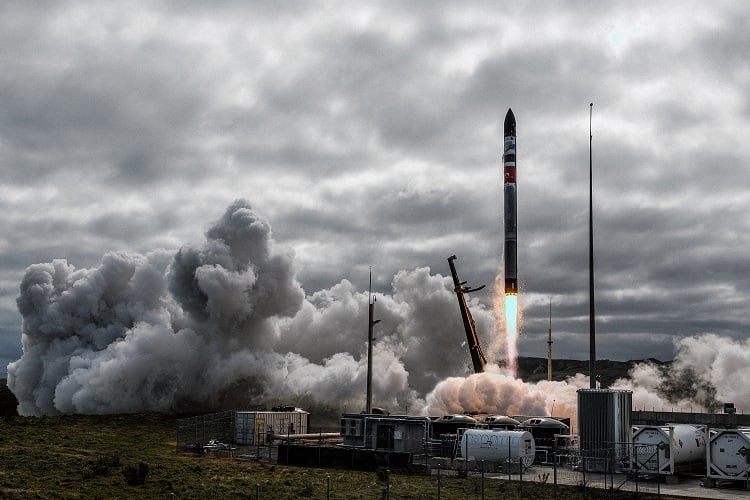
Image credit: Rocket Lab. Hero image source: Rocket Lab, “Rocket Lab Launches 40th Electron Mission, Successfully Flies Reused Engine,” August 24, 2023.
Sources
Rocket Lab About Us: https://rocketlabcorp.com/about/about-us/
Rocket Lab Electron: https://rocketlabcorp.com/electron/
Rocket Lab Neutron: https://rocketlabcorp.com/launch/neutron/
Rocket Lab Q4 and Full Year 2025 Financial Results, February 26, 2026: https://investors.rocketlabcorp.com/news-releases/news-release-details/rocket-lab-announces-fourth-quarter-and-full-year-2025-financial
Rocket Lab Date of First Quarter 2026 Financial Results, April 16, 2026: https://investors.rocketlabcorp.com/news-releases/news-release-details/rocket-lab-announces-date-first-quarter-2026-financial-results
Nasdaq press release on public listing and ticker RKLB, August 25, 2021: https://www.nasdaq.com/press-release/rocket-lab-completes-merger-with-vector-acquisition-corporation-to-become-publicly
By Nawaz Lalani
The Grid Report is written by Nawaz Lalani and focuses on source-backed coverage of AI infrastructure, grid power demand, automation systems, and market signals.
Follow the signal, not just the headline.
Get the daily Grid brief for source-backed coverage on AI power demand, infrastructure timing, automation, and market signals.