- OpenAI’s June 22 Daybreak expansion clears the publish bar because it sharpens the real operating question in AI security.
- OpenAI says that is exactly what Daybreak is being built to address.
- The strongest signal is not the benchmark table.
- Section
- AI
- Read time
- 5 min read
- Why this page exists
- The Grid Report publishes operator-grade coverage on AI, power, infrastructure, automation, and markets.
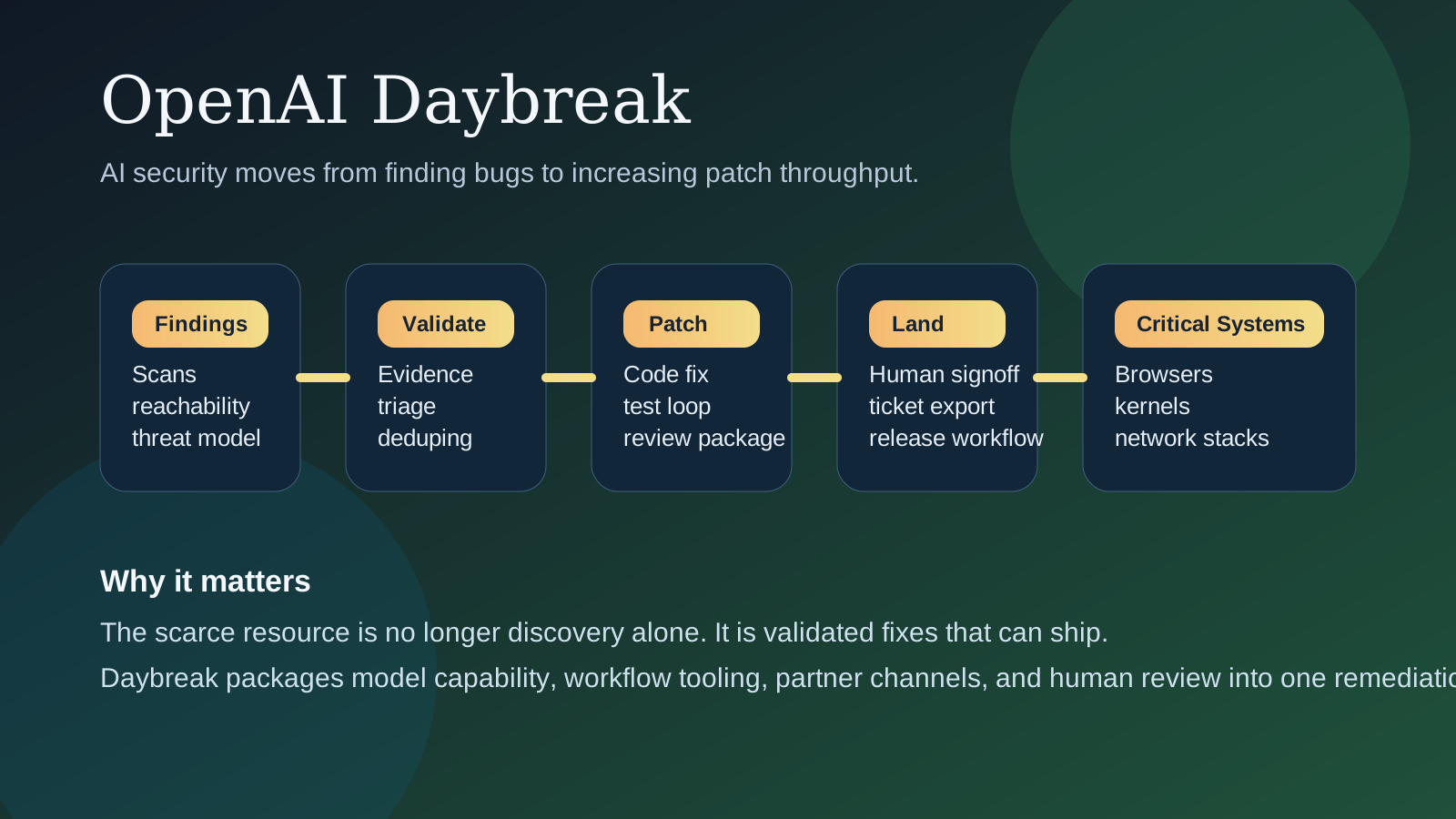
OpenAI’s June 22 Daybreak expansion clears the publish bar because it sharpens the real operating question in AI security. The useful story is not simply that models can find more vulnerabilities. It is that the bottleneck has shifted to validating issues, generating workable fixes, coordinating review, and actually landing patches before attackers or backlogs outrun defenders.
OpenAI says that is exactly what Daybreak is being built to address. The company framed the current moment as a transition from vulnerability discovery to end-to-end patch automation, and paired that framing with concrete workflow updates: a broader Codex Security plugin release, the full version of GPT-5.5-Cyber for trusted defenders, a new Daybreak Cyber Partner Program, and Patch the Planet to help open-source maintainers move from findings to fixes.
In cyber AI, the scarce resource is no longer only finding flaws. It is landing validated fixes fast enough to reduce real risk.
The strongest signal is not the benchmark table. It is the workflow claim. OpenAI said Codex Security has already scanned more than 30 million commits across more than 30,000 codebases, with more than 70,000 findings manually marked fixed and over 500,000 findings automatically determined to be fixed. Those numbers matter because they point to the scale of the remediation problem. If cyber AI is useful, it has to fit the throughput requirements of real codebases rather than only impress in isolated demos.
That is why the stronger angle is patch throughput. OpenAI says Codex Security can now scan code, generate threat models, determine whether vulnerable code is reachable, produce validation evidence, develop targeted patches, and verify the result before export into existing workflows. In other words, the company is trying to turn defensive AI into a systems layer for remediation, not just a smarter alert generator.
GPT-5.5-Cyber adds another part of that stack. OpenAI said the updated model reached 85.6% on CyberGym versus 81.8% for GPT-5.5, 39.5% versus 25.95% on ExploitGym, and 69.8% versus 63.1% on SEC-bench Pro. The more durable read-through is not “the benchmark went up.” It is that OpenAI is explicitly optimizing for long-horizon security work across large codebases: tracing reachability, validating hypotheses in controlled environments, and preparing patches with evidence for human review.
There is also a channel strategy embedded in the release. OpenAI launched a Daybreak Cyber Partner Program that lets participating security vendors and services firms use GPT-5.5 with Trusted Access for Cyber inside customer-facing products and services. That matters because cyber adoption rarely scales through direct model access alone. It scales through managed platforms, existing security teams, and toolchains companies already trust.
Patch the Planet is the clearest policy and infrastructure signal in the package. OpenAI said more than 30 open-source projects have committed to participate, including cURL, Go, Python, Sigstore, and pyca/cryptography. The company also cited research showing that 94 percent of widely used projects in the Linux Foundation and Harvard study had fewer than ten developers responsible for more than 90 percent of code added in a year. That makes the story more concrete: the internet’s software base has a maintainer-capacity problem, and AI only helps if it reduces maintainer burden instead of flooding projects with low-quality reports.
This is where the release becomes more than a product post. OpenAI said it is also working with governments and institutions to support critical infrastructure and sensitive systems, and that in the past month it established Trusted Access for Cyber partnerships with Australia, Canada, France, Germany, Japan, the Republic of Korea, and EU institutions including ENISA. That positions Daybreak as both a product and a policy-facing defensive capability stack.
The article clears the search bar because broad AI-security coverage still tends to stop at “models found more bugs.” The stronger query class is operational: how do defenders actually increase patching capacity, what tools are being built for that workflow, and how does AI fit into critical software maintenance without overwhelming human operators?
That is enough to publish. The useful conclusion is not that AI is making cyber easy. It is that defensive AI is becoming valuable only when it helps organizations convert findings into validated fixes that can move through existing engineering and security systems fast enough to matter.
Sources
OpenAI, “Daybreak: Tools for securing every organization in the world,” published June 22, 2026: https://openai.com/index/daybreak-securing-the-world/
OpenAI, “Patch the Planet: a Daybreak initiative to support open source maintainers,” published June 22, 2026: https://openai.com/index/patch-the-planet/
Nawaz Lalani
Nawaz Lalani is the creator of The Grid Report and writes about AI infrastructure, grid power demand, automation systems, and the market signals shaping the physical AI economy. His focus is translating technical and industrial shifts into practical coverage for operators, investors, builders, and teams making real deployment decisions.
B.S. in Geology from UT Arlington. Covers AI infrastructure, energy systems, grid constraints, automation workflows, and market signals.
Stories are built from primary sources, utility and infrastructure signals, company disclosures, filings, and operator-grade context. The goal is to explain what changed, why it matters now, and what it means for builders, investors, utilities, and teams making real deployment decisions.
Follow the lane, not just the headline.
The strongest value in The Grid Report comes from following how AI, infrastructure, power, automation, and markets connect over time.