- NVIDIA’s June 23 AWS update clears the publish bar because it exposes a more useful infrastructure shift than the average partnership headline.
- The release ties together three separate pieces.
- That is why this belongs in the infrastructure lane.
- Section
- Infrastructure
- Read time
- 4 min read
- Why this page exists
- The Grid Report publishes operator-grade coverage on AI, power, infrastructure, automation, and markets.
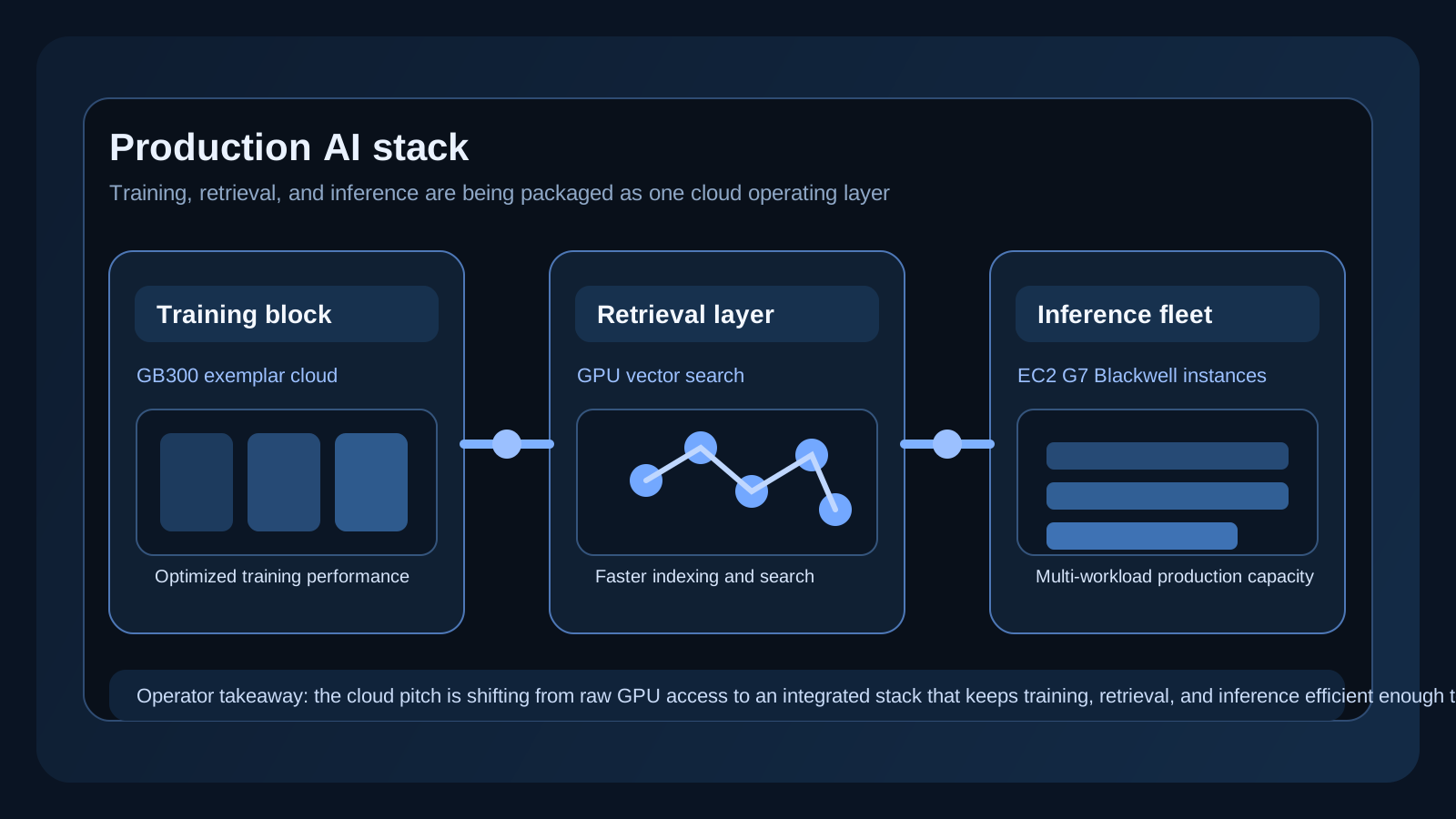
NVIDIA’s June 23 AWS update clears the publish bar because it exposes a more useful infrastructure shift than the average partnership headline. The story is not simply that NVIDIA and AWS still work together. It is that production AI is being packaged as a three-layer system: validated training performance, faster retrieval, and more practical inference capacity.
The release ties together three separate pieces. NVIDIA said AWS has achieved Exemplar Cloud status for GB300 training workloads, that Amazon OpenSearch Serverless is using the NVIDIA cuVS library to accelerate vector indexing and search, and that Amazon EC2 G7 instances built on NVIDIA RTX PRO 4500 Blackwell Server Edition GPUs are expanding the compute layer for inference, graphics, analytics, and video workloads. Taken together, that is a more complete operating story than a single new instance family or benchmark claim.
The production AI fight is moving from raw GPU access toward a stack contest around retrieval speed, inference efficiency, and trusted training performance.
That is why this belongs in the infrastructure lane. Much of the AI market still talks as if the main question is who can access GPUs. For operators actually trying to ship products, the better question is whether the surrounding stack is fast enough and cheap enough to keep an application useful in production. Retrieval latency, indexing throughput, and inference price-performance increasingly matter as much as training glamour because those are the layers customers touch every day.
The G7 launch is a useful signal on its own. AWS said on June 18 that it is the first major cloud provider to support the RTX PRO 4500 Blackwell Server Edition GPU and that G7 delivers up to 4.6 times AI inference performance and up to 2.1 times graphics performance compared with G6 instances. That matters because it suggests the Blackwell cycle is not only about giant frontier clusters. It is also being pushed into a broader class of production workloads that need lower operational overhead than a hyperscale training fleet.
The retrieval layer is what makes the story more original. NVIDIA said OpenSearch Serverless is making GPU-powered vector indexing the default through cuVS. That is the buried operating detail inside the headline. As more enterprise AI products rely on retrieval, search, and memory layers to stay grounded in real data, vector performance becomes part of application economics. A slower retrieval path does not just hurt elegance. It raises costs by keeping expensive downstream inference waiting longer.
There is also a market-structure read-through here. Exemplar Cloud status means AWS is being presented as meeting NVIDIA’s reference-performance thresholds for GB300 training. Whether or not a typical enterprise buyer cares about the label itself, the commercial function is obvious: cloud providers increasingly need public proof that their AI infrastructure is not merely available, but tuned closely enough to vendor reference designs that buyers can trust expected performance.
This does not mean AWS has solved production AI. Pricing, software portability, model quality, and power availability still matter, and vendor-led announcements naturally compress the messy parts of real deployment. But the narrower conclusion is still strong: AI cloud competition is moving beyond a one-dimensional race for more accelerators and into a stack contest around training assurance, retrieval speed, and inference efficiency.
That is enough to publish. Search demand on AI infrastructure still overweights megawatt headlines and giant cluster announcements. The more durable query class is now operational: which cloud stacks are actually reducing the friction between training, retrieval, and production inference for teams trying to ship AI systems at scale?
Sources
NVIDIA, “NVIDIA and AWS Collaborate to Bring AI to Production at Scale,” published June 23, 2026: https://blogs.nvidia.com/blog/nvidia-aws-ai-production-scale/
AWS News Blog, “Announcing Amazon EC2 G7 instances accelerated by NVIDIA RTX PRO 4500 Blackwell Server Edition GPUs,” published June 18, 2026: https://aws.amazon.com/blogs/aws/announcing-amazon-ec2-g7-instances-accelerated-by-nvidia-rtx-pro-4500-blackwell-server-edition-gpus/
AWS, “Amazon EC2 G7 instances are now generally available,” published June 18, 2026: https://aws.amazon.com/about-aws/whats-new/2026/06/amazon-ec2-g7-generally-available/
Nawaz Lalani
Nawaz Lalani is the creator of The Grid Report and writes about AI infrastructure, grid power demand, automation systems, and the market signals shaping the physical AI economy. His focus is translating technical and industrial shifts into practical coverage for operators, investors, builders, and teams making real deployment decisions.
B.S. in Geology from UT Arlington. Covers AI infrastructure, energy systems, grid constraints, automation workflows, and market signals.
Stories are built from primary sources, utility and infrastructure signals, company disclosures, filings, and operator-grade context. The goal is to explain what changed, why it matters now, and what it means for builders, investors, utilities, and teams making real deployment decisions.
Follow the lane, not just the headline.
The strongest value in The Grid Report comes from following how AI, infrastructure, power, automation, and markets connect over time.