- NERC’s late-June reliability push clears the publish bar because it is no longer just another warning that data centers use a lot of power.
- That is the stronger angle because it changes the status of the AI-power story.
- The registration details are specific enough to matter.
- Section
- Policy
- Read time
- 5 min read
- Why this page exists
- The Grid Report publishes operator-grade coverage on AI, power, infrastructure, automation, and markets.
How NERC is drawing the first line around computational loads
The useful change is that NERC is moving from warning language toward a named entity type and a standards-development track.
| Layer | Primary-source detail | Why it matters |
|---|---|---|
| State-of-reliability signal | NERC’s June 24 release says the BPS performed reliably in 2025, but emerging risks are reducing the margin for error | AI load is being folded into a broader reliability picture rather than treated as a side issue. |
| New entity concept | NERC says it proposes a new functional entity type called a Computational Load Entity | Large AI campuses are moving closer to direct reliability governance, not just utility-side oversight. |
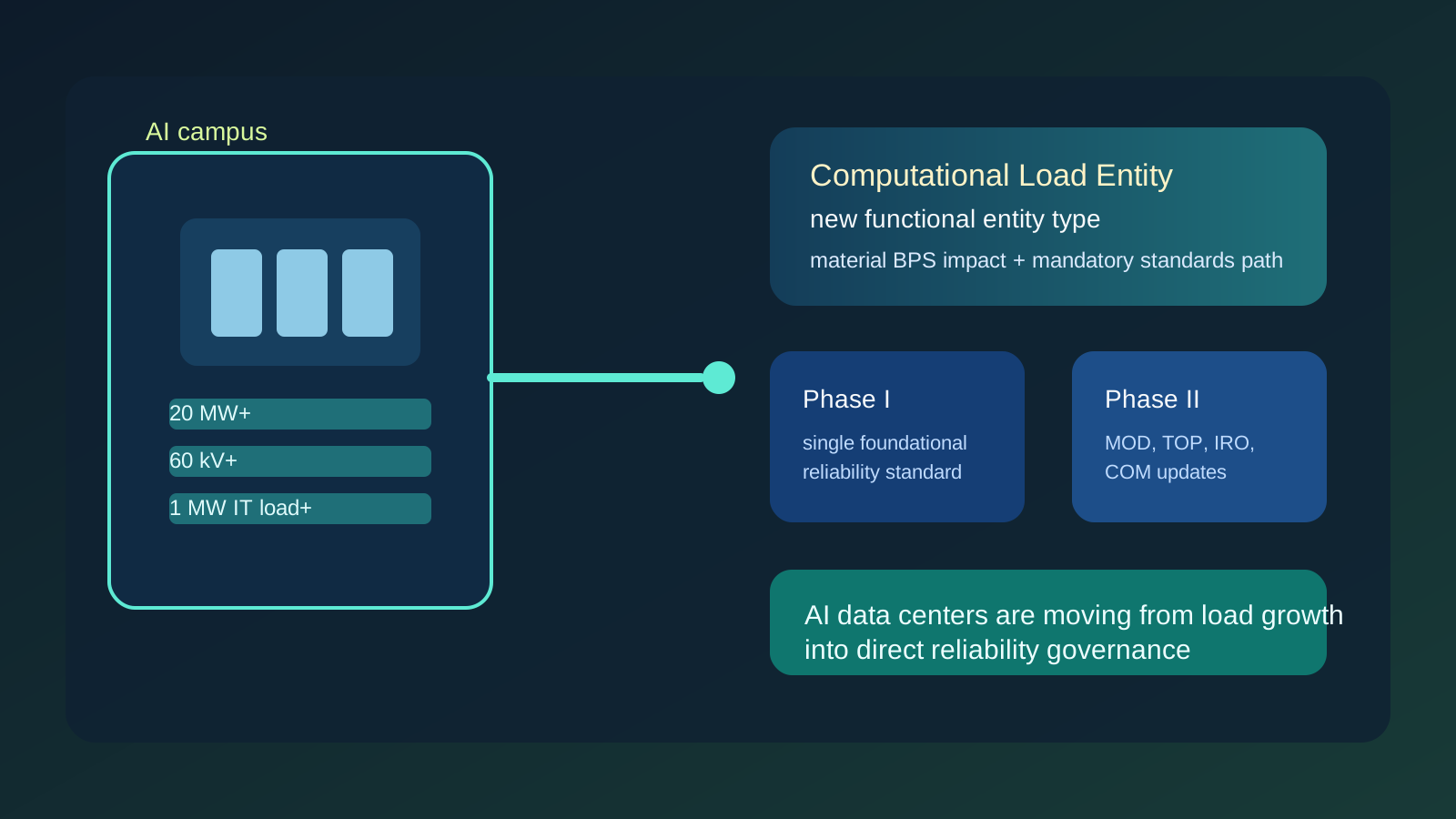
| Registration threshold | Proposed criteria include 20 MW or greater connected load capability, 60 kV or higher interconnection, and 1 MW or more of computational load | Only a subset of very large facilities are in scope, but the line is now concrete enough to model against. |
| Phase I standard | Project 2026-02 says NERC wants a single foundational reliability standard in the near term | The first rule set is being scoped for speed, not a multi-year wait for a perfect framework. |
| Phase II expansion | A later phase could widen updates across MOD, TOP, IRO, and COM families | The compliance footprint may broaden once the initial definitions and obligations are in place. |
Sources: NERC June 24, 2026 State of Reliability release, April 1, 2026 Computational Load Entity summary, and Project 2026-02 page.
NERC’s late-June reliability push clears the publish bar because it is no longer just another warning that data centers use a lot of power. In its June 24 State of Reliability release, NERC said the bulk power system performed reliably in 2025 even as emerging risks reduced the margin for error. The new part for Grid Report readers is that NERC also said it proposes a new functional entity type, called a Computational Load Entity, for certain large loads with a material impact on the bulk power system and plans to develop mandatory reliability standards around it.
That is the stronger angle because it changes the status of the AI-power story. Large AI campuses are not being discussed only as difficult customers anymore. They are moving toward a reliability category with formal registration logic, standards work, and direct operating consequences. That is a much more useful answer for searchers than another broad recap of AI electricity demand.
The important shift is not only that AI campuses are large loads. It is that NERC is building a category, threshold, and standards path for computational loads that can matter directly to grid reliability.
The registration details are specific enough to matter. In NERC’s April 2026 summary of proposed Rules of Procedure revisions, the organization said a Computational Load Entity would need to be the end user, or the entity hosting end users, and contribute to an aggregate connected load capability of at least 20 megawatts at a single point of interconnection to the bulk power system at 60 kilovolts or higher while hosting at least 1 megawatt of computational load. Those thresholds do not pull in every data center. They are aimed at the class of large computational facilities that can materially affect planning and operations.
This is also why the story belongs in policy instead of a generic grid bucket. NERC is not only asking utilities and grid operators to model these loads better. It is building the governance scaffold that decides which entities may have to register, which standards apply, and how reliability obligations migrate closer to the load itself. Once that frame hardens, AI campuses move further into the same regulatory conversation as other bulk-system-relevant actors.
Project 2026-02 makes the timing more concrete. On the project page, NERC says Phase I focuses on foundational elements needed to integrate large computational loads reliably into the bulk power system, including new glossary terms and a new reliability standard. NERC staff says the reliability need is urgent enough to justify a single foundational standard in the near term, with a Phase II meant to widen the work into standards families such as MOD, TOP, IRO, and COM. In plain English, NERC is trying to move fast on the minimum viable rule set now and refine the broader framework after that.
That makes this genuinely different from the site’s May 14 NERC alert story. That earlier piece was about operational risk: modeling, commissioning, instrumentation, protection, and control. This newer hook is about institutional form. The practical question is no longer only whether utilities understand AI loads. It is whether some of those loads will end up inside a named registration category with direct compliance implications.
The operator and investor read-through is straightforward. If a project sits near or above these thresholds, power access becomes more than a capacity and tariff question. Developers may need to think earlier about modeling data, commissioning discipline, protection behavior, disclosure, and who inside the project company actually owns reliability compliance. For investors, that adds a new execution layer between announced megawatts and truly ready megawatts.
There are still caveats. The registration revisions were posted for comment in April, and the standards work is still under development. NERC’s June 24 language does not mean every large AI campus is already registered today. But the direction is clear enough to publish: the North American reliability regime is moving from general concern about AI load growth toward a more explicit category-and-standards framework for certain computational loads.
That is enough to clear the search bar. Readers looking for “Computational Load Entity” or trying to understand whether NERC is starting to regulate AI campuses directly need the threshold logic, the standards path, and the reason this is a different stage of the story than May’s alert cycle.
Sources
NERC, “2026 State of Reliability Report,” published June 24, 2026: https://www.nerc.com/newsroom/2026-State-of-Reliability-Report
NERC, “Computational Load Entity Proposed Rules of Procedure Revisions Summary,” April 1, 2026: https://www.nerc.com/globalassets/who-we-are/rules-of-procedure/proposed/computational-load-entity-summary-of-changes-april-2026-posting.pdf
NERC, “Project 2026-02 Computational Loads”: https://www.nerc.com/standards/reliability-standards-under-development/2026-02-computational-loads
Nawaz Lalani
Nawaz Lalani is the creator of The Grid Report and writes about AI infrastructure, grid power demand, automation systems, and the market signals shaping the physical AI economy. His focus is translating technical and industrial shifts into practical coverage for operators, investors, builders, and teams making real deployment decisions.
B.S. in Geology from UT Arlington. Covers AI infrastructure, energy systems, grid constraints, automation workflows, and market signals.
Stories are built from primary sources, utility and infrastructure signals, company disclosures, filings, and operator-grade context. The goal is to explain what changed, why it matters now, and what it means for builders, investors, utilities, and teams making real deployment decisions.
Follow the lane, not just the headline.
The strongest value in The Grid Report comes from following how AI, infrastructure, power, automation, and markets connect over time.