- EIA’s June 16 CAISO update clears the publish bar because it shows a real operating shift, not a symbolic one.
- The Grid Report reason to publish this is that California is making a different part of the AI electricity problem visible.
- That matters because California is already planning for data-center growth.
- Section
- Energy
- Read time
- 4 min read
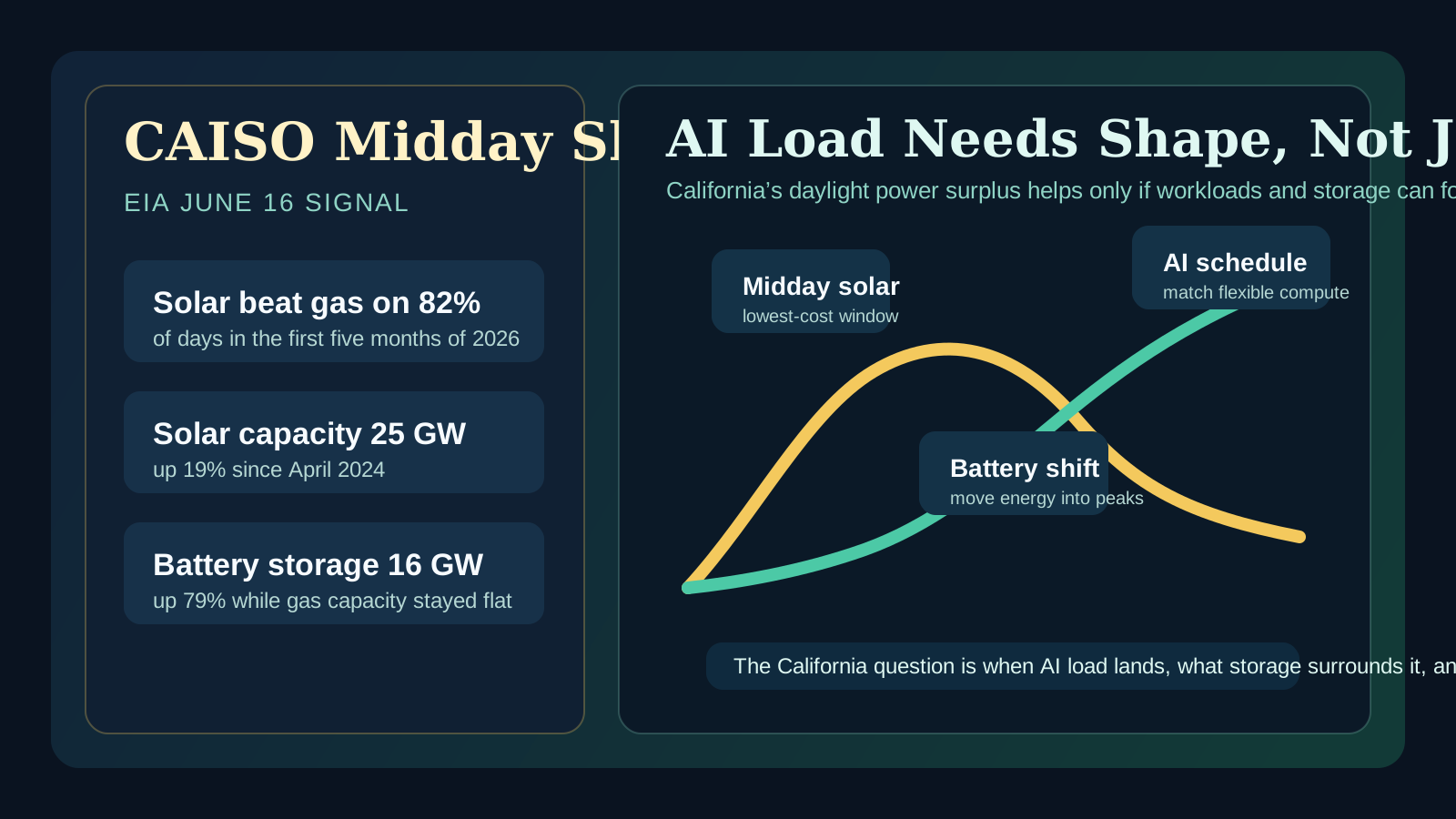
EIA’s June 16 CAISO update clears the publish bar because it shows a real operating shift, not a symbolic one. The agency says utility-scale solar generation in CAISO surpassed natural gas generation in the first five months of 2026. Solar output was up 21% from the same period in 2024, natural gas generation was down 60%, and solar beat gas on 82% of days in that January-to-May window. EIA also says utility-scale solar capacity rose 19% to 25 gigawatts from April 2024 to April 2026, while battery storage capacity jumped 79% to 16 gigawatts and gas capacity stayed nearly flat at 29 gigawatts.
The Grid Report reason to publish this is that California is making a different part of the AI electricity problem visible. In Texas and PJM, the dominant framing is still how to get enough firm capacity and transmission built. In CAISO, daytime energy is increasingly abundant relative to recent history. The harder question is what happens to large flexible loads when the solar window closes, heat spikes, or wildfire conditions change operating margins.
California’s AI power constraint is shifting from pure energy volume toward timing, storage, and how intelligently large loads follow the curve.
That matters because California is already planning for data-center growth. CAISO says the California Energy Commission forecasts data-center load on the ISO grid to rise by 1.8 gigawatts by 2030 and 4.9 gigawatts by 2040, and the ISO says utilities are receiving a growing number of large-load service applications. If that demand lands in a system where midday solar and batteries are doing more of the work, the most useful operator question is not simply how many megawatts a project needs. It is how schedulable the load is, what storage sits around it, and how much firm backup still has to be carried for the edges of the curve.
This is why the story is stronger than a generic renewables milestone. A solar-heavy daylight grid changes the economics of inference, training support tasks, and other workloads that can move around inside the day. If a developer can align flexible compute with lower-cost solar-rich hours and let storage or firm capacity cover the harder periods, California becomes more legible as an AI load-management system. If the workload is rigid and 24/7, the system still has to solve a much tougher evening and extreme-weather problem.
CAISO’s own summer assessment reinforces the distinction. The ISO says the 2026 system has sufficient energy across a wide range of conditions because of continued resource additions, while still warning that extreme heat and wildfires can stress reliability. That is exactly the kind of operating environment where load-shaping discipline starts to matter more than headline capacity totals. Storage is growing quickly, but storage does not remove the need to decide which loads can flex and which cannot.
The policy and infrastructure relevance is immediate. Rate design, interconnection requirements, co-located storage, and utility planning all start looking different when midday supply is less scarce than the evening ramp. AI campuses in California may end up competing less on pure annual energy access and more on whether they can behave like well-timed grid citizens.
There are limits. CAISO is not saying solar has replaced gas in all hours or all conditions, and the EIA figures cover only the first five months of 2026. But the directional signal is strong enough to matter. California’s AI power question is increasingly about timing, storage, and operational flexibility, not only about building more generation.
Sources
EIA, “Solar generation in CAISO surpassed natural gas in the first five months of 2026,” published June 16, 2026: https://www.eia.gov/todayinenergy/detail.php?id=67784
California ISO, “Large loads,” accessed June 20, 2026: https://www.caiso.com/generation-transmission/load/large-loads
California ISO, “2026 Summer Loads and Resources Assessment,” accessed June 20, 2026: https://www.caiso.com/generation-transmission/resource-adequacy/2026-summer-loads-and-resources-assessment
California ISO, “Revised Draft 2025-2026 Transmission Plan,” published May 12, 2026: https://www.caiso.com/documents/revised-draft-2025-2026-transmission-plan-may-2026.pdf
By Nawaz Lalani
The Grid Report is written by Nawaz Lalani and focuses on source-backed coverage of AI infrastructure, grid power demand, automation systems, and market signals.
Follow the signal, not just the headline.
Get the daily Grid brief for source-backed coverage on AI power demand, infrastructure timing, automation, and market signals.