- BBVA’s June 11 OpenAI case study is worth publishing because the useful signal is not merely that a large bank is enthusiastic about AI.
- The official details are concrete.
- The stronger Grid Report angle is that this is less a software-procurement story than a controlled operating-model story.
- Section
- AI Automation
- Read time
- 5 min read
BBVA’s June 11 OpenAI case study is worth publishing because the useful signal is not merely that a large bank is enthusiastic about AI. The stronger signal is that one of the world’s more regulated operating environments is showing what a serious rollout now looks like: secure enterprise access, cross-functional governance, leadership participation, internal capability networks, and workflow-specific tools that push adoption beyond novelty.
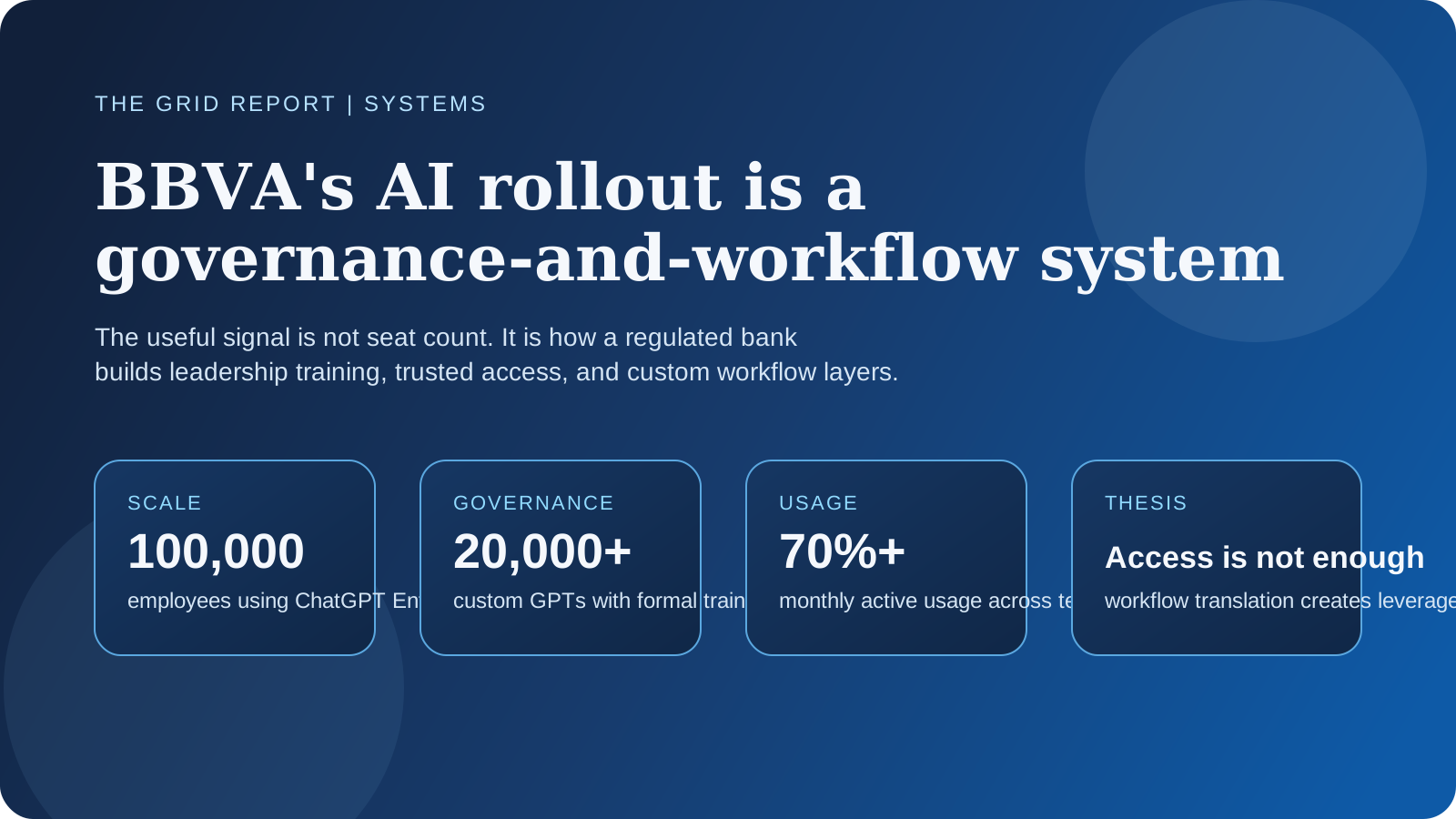
The official details are concrete. OpenAI said roughly 100,000 BBVA employees globally now use ChatGPT Enterprise, monthly active usage is above 70%, and the bank estimates about three hours saved per employee per week. OpenAI also said BBVA has created more than 20,000 GPTs, with around 4,000 used frequently, while selected workflows have delivered efficiency gains as high as 80%. Leadership training also appears central: 250 senior leaders, including the CEO and chairman, were trained early in the process.
The bank-scale AI story is no longer “who bought seats?” It is “who built the governance, training, and workflow translation layer that turns access into repeatable operating leverage?”
The stronger Grid Report angle is that this is less a software-procurement story than a controlled operating-model story. BBVA is not describing AI as one more productivity add-on. It is describing AI as a bank redesign program spanning customer experience, risk, operations, software development, and employee workflows. That matters because the hard part of enterprise AI is increasingly not access. It is governance plus translation: how a company takes general-purpose models and turns them into trusted, repeated, department-level execution.
This clears the duplicate block against the site’s recent systems stories because the thesis is different. LSEG’s OpenAI rollout was about trusted financial data becoming a workflow control layer. Travelers’ claims article was about catastrophe-throughput in one function. Microsoft’s Work IQ APIs story was about context and spending controls for enterprise agents. BBVA is different because it shows a regulated institution trying to operationalize AI as a bank-wide program with governance, training, domain-specific assistants, and executive sponsorship all working together.
For operators, the useful lesson is that real adoption seems to require an internal distribution model. OpenAI’s write-up describes AI champions, AI “wizards,” formal training, secure access, and department-specific GPTs for legal, credit analysis, customer experience, and service workflows. That pattern matters more than the seat count. It suggests that broad usage only compounds when the company builds internal translators who can move from generic tool availability to specific workflow value.
For investors and enterprise buyers, the stronger implication is that regulated-industry AI winners may be the firms that can govern adoption at scale, not just experiment loudly. A bank that can align security, legal, compliance, executives, and frontline teams around repeatable usage has a better shot at turning AI into operating leverage than one that treats deployment as a loose pilot culture.
The search case is strong because the article answers a live and specific question better than a generic enterprise-AI celebration: what is BBVA actually doing with OpenAI, and why does it matter? Readers searching for BBVA OpenAI, BBVA ChatGPT Enterprise, AI in banking workflows, or regulated enterprise AI adoption get concrete deployment details and a stronger operator thesis instead of a brand-marketing recap.
Sources
OpenAI, “BBVA puts AI at the core of banking with OpenAI,” published June 11, 2026: https://openai.com/index/bbva/
OpenAI, “How BBVA is scaling AI from pilot to practice across the org,” published November 5, 2025: https://openai.com/index/bbva-2025/
BBVA Chair Carlos Torres Vila quote and workflow details as presented in OpenAI’s June 11, 2026 case study: https://openai.com/index/bbva/
By Nawaz Lalani
The Grid Report is written by Nawaz Lalani and focuses on source-backed coverage of AI infrastructure, grid power demand, automation systems, and market signals.
Follow the signal, not just the headline.
Get the daily Grid brief for source-backed coverage on AI power demand, infrastructure timing, automation, and market signals.