- Anthropic’s June 2 Project Glasswing expansion is worth publishing because the useful signal is not simply that a frontier model can find more vulnerabilities.
- The official facts are strong enough to matter.
- Anthropic’s May 22 initial update makes the angle sharper.
- Section
- AI Automation
- Read time
- 5 min read
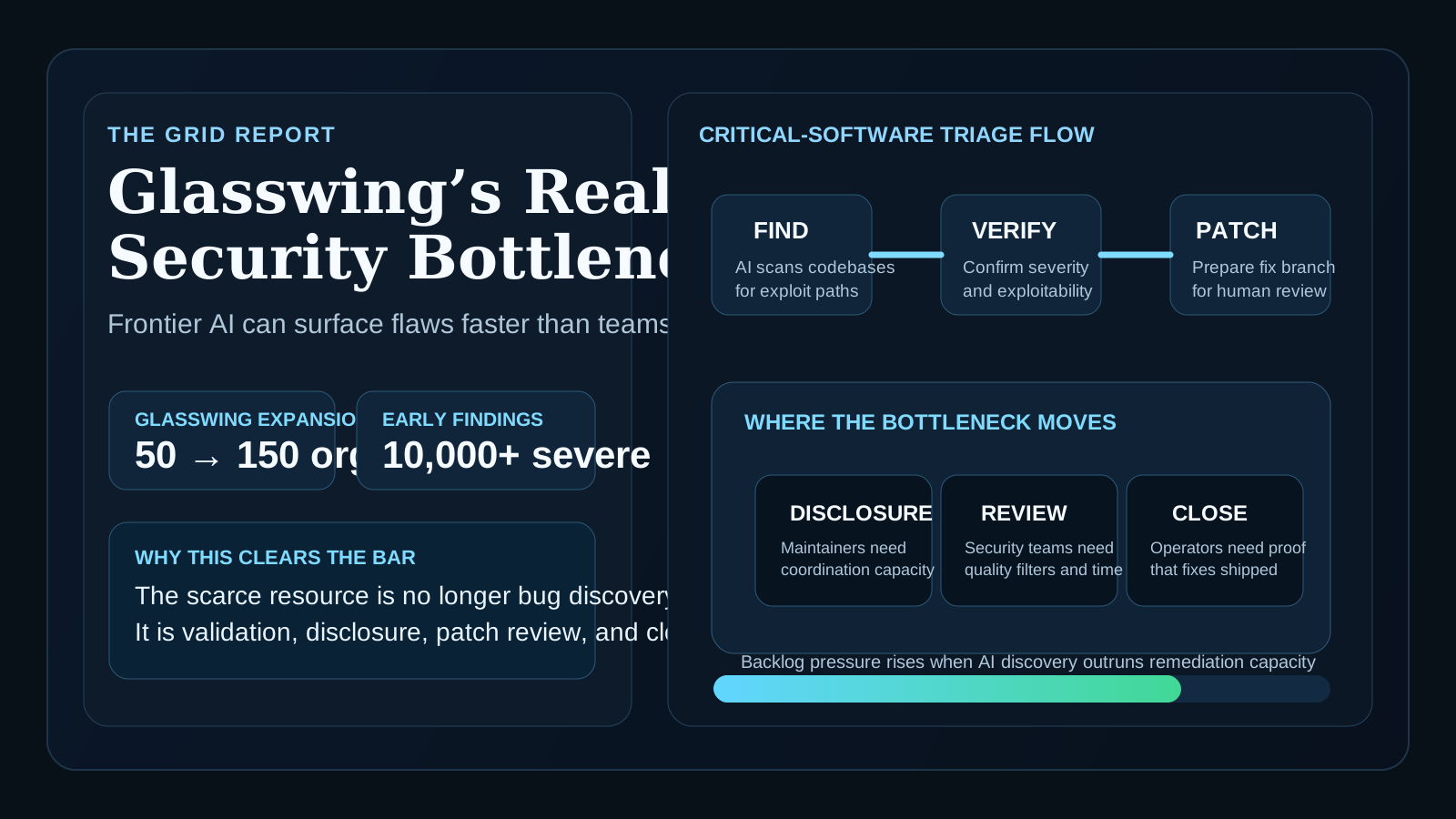
Anthropic’s June 2 Project Glasswing expansion is worth publishing because the useful signal is not simply that a frontier model can find more vulnerabilities. The stronger signal is that AI-driven security work is starting to invert the old bottleneck. The hard part is moving away from vulnerability discovery and toward validation, coordinated disclosure, patch generation, and operational cleanup across software that power grids, hospitals, payment rails, and other critical systems rely on.
The official facts are strong enough to matter. Anthropic says Glasswing is expanding from roughly 50 initial partners to about 150 organizations across more than 15 countries, most of them tied to critical infrastructure. The same announcement says the first wave of partners has already used Claude Mythos Preview to find more than 10,000 high- or critical-severity security flaws. That is not generic “AI for security” marketing. It is a claim that the pipeline of serious findings is already outrunning the old human-scale review rhythm.
Project Glasswing matters because frontier AI is turning security from a bug-finding problem into a validation, disclosure, and patch-throughput problem.
Anthropic’s May 22 initial update makes the angle sharper. The company said Mythos Preview had scanned more than 1,000 open-source projects and found an estimated 6,202 high- or critical-severity vulnerabilities in those projects alone. More importantly, Anthropic said progress in software security used to be constrained by how quickly defenders could find new flaws, and is now constrained by how quickly they can verify, disclose, and patch the large numbers of issues AI is surfacing. That is the real story. Security work is becoming a throughput problem.
That matters because the software under review is not a toy layer. Anthropic’s product materials for Claude Security explicitly frame the target as code running critical infrastructure: power grids, hospitals, payment networks, and supply chains. Once the model can reason across large codebases, validate exploitable issues, and propose targeted patches, the useful operator question changes. It stops being “can AI help with AppSec?” and becomes “how do we build a triage and remediation system that does not collapse under a sudden abundance of findings?”
Anthropic’s own product design points in that direction. Claude Security says it can generate targeted fixes, create a branch ready for pull-request review, run scheduled scans, and push findings into existing team workflows through webhooks. In other words, Anthropic is not only trying to sell a smarter scanner. It is trying to turn security into a continuous queue with model-assisted verification and patch preparation attached. That is what makes the story more useful than a generic model-capability recap.
This also gives the site a materially different Anthropic angle. The recent containment piece was about blast-radius design once agents already touch real systems. The Stainless piece was about control over SDKs, CLIs, and MCP servers. This one is about defensive throughput in the software supply chain. The thesis is that frontier AI is changing not just what agents can access, but the operating tempo at which security teams have to decide what is real, what gets disclosed, and what gets fixed first.
For operators, the practical implication is uncomfortable but clear: AI-assisted vulnerability hunting can create backlog shocks. Teams defending important systems may need stronger severity filters, better disclosure workflows, tighter maintainer coordination, and patch-review capacity before they need another model benchmark. For infrastructure owners, the takeaway is that software resilience is becoming a capacity-planning issue, not only a tooling issue.
For investors and policymakers, the signal is that cybersecurity leverage is moving from detection abundance to remediation control. The winners may be the platforms and internal teams that can verify findings, route them into the right owners, ship fixes with governance, and measure closure rates against rising AI-assisted discovery volume. If that layer fails, more powerful models may surface risk faster than institutions can absorb it.
The Grid Report view is that this clears the search bar because it answers a specific and timely question better than a generic Anthropic summary: what changed when Glasswing expanded? The useful answer is that frontier AI is beginning to turn critical-software defense into a triage system, where the scarce resource is no longer bug discovery alone but the organizational capacity to validate, disclose, and patch fast enough to matter.
Sources
Anthropic, “Expanding Project Glasswing,” published June 2, 2026: https://www.anthropic.com/news/expanding-project-glasswing
Anthropic Research, “Project Glasswing: An initial update,” published May 22, 2026: https://www.anthropic.com/research/glasswing-initial-update
Anthropic, “Claude Security,” accessed June 7, 2026: https://www.anthropic.com/product/security
Anthropic, “Project Glasswing,” published April 7, 2026: https://www.anthropic.com/project/glasswing
By Nawaz Lalani
The Grid Report is written by Nawaz Lalani and focuses on source-backed coverage of AI infrastructure, grid power demand, automation systems, and market signals.
Follow the signal, not just the headline.
Get the daily Grid brief for source-backed coverage on AI power demand, infrastructure timing, automation, and market signals.