- Microsoft's June 2 Work IQ announcement is worth publishing because the useful signal is not that another company exposed enterprise data to agents.
- The official facts are concrete.
- That matters because the practical enterprise bottleneck for agents is no longer just model quality.
- Section
- AI Automation
- Read time
- 5 min read
- Why this page exists
- The Grid Report publishes operator-grade coverage on AI, power, infrastructure, automation, and markets.
Microsoft's June 2 Work IQ announcement is worth publishing because the useful signal is not that another company exposed enterprise data to agents. The stronger signal is that Microsoft is trying to turn agent deployment into a controlled operating system inside the tenant: context retrieval, tool calling, intermediate state, human approval, and cost management are being bundled together instead of left for customers to stitch across separate products.
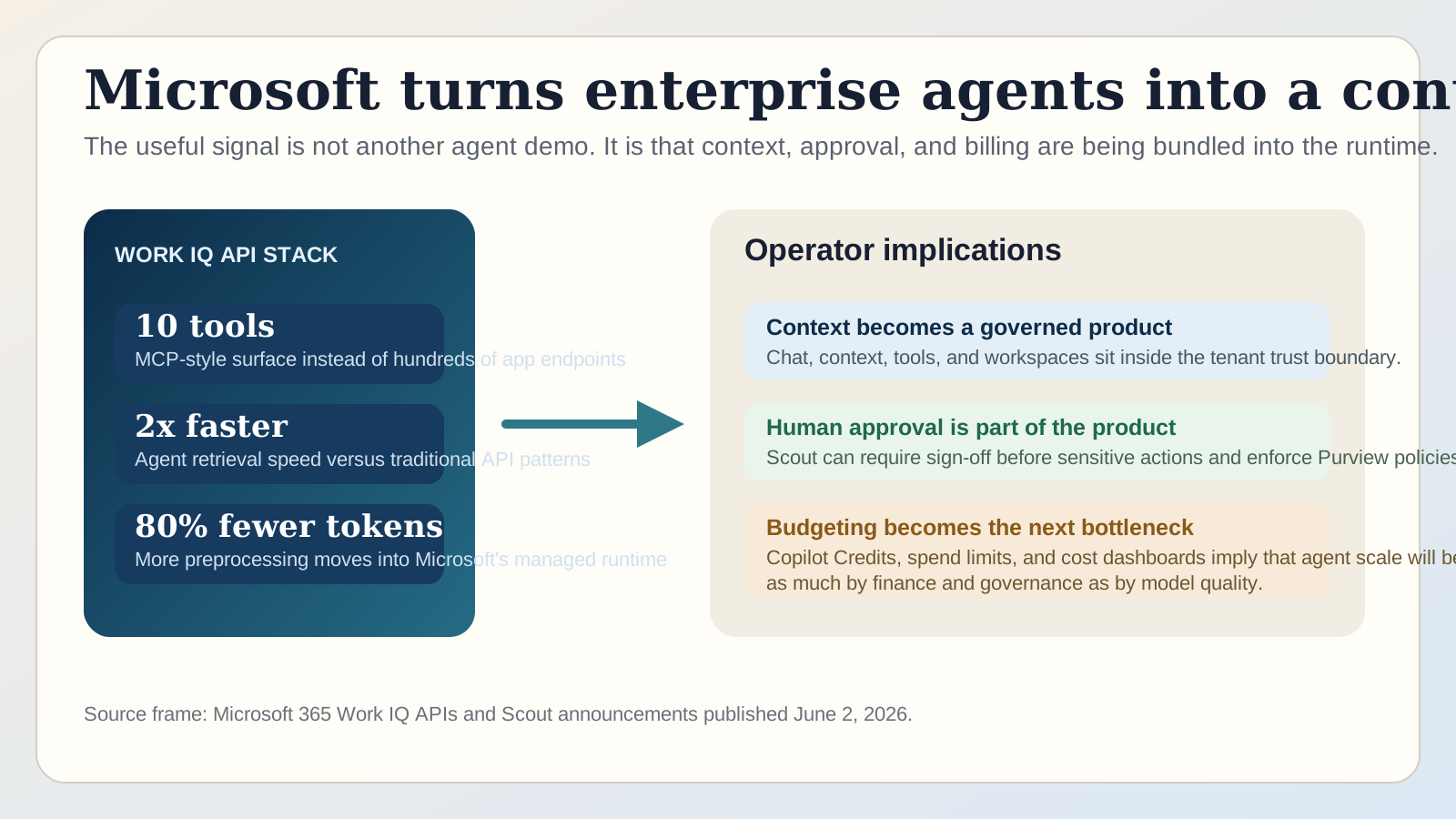
The official facts are concrete. Microsoft said the Work IQ APIs will be generally available on June 16, 2026. It broke the surface into four domains: Chat, Context, Tools, and Workspaces. It also said the tool layer collapses operations into 10 generic tools with progressive disclosure through model context protocol, and that its internal testing showed 2x faster runtime and 80% fewer tokens than traditional API patterns in coding harnesses.
The useful Microsoft signal is that enterprise agents are becoming a governed runtime with context packaging, approval rails, and credit budgets, not just another chat surface.
That matters because the practical enterprise bottleneck for agents is no longer just model quality. It is how expensive, governable, and interruptible an agent becomes once it touches real work. Work IQ is aimed directly at that bottleneck. The Context API packages source material into an agent-ready structure instead of forcing the orchestration layer to read raw records, while Workspaces give long-running agents a tenant-bound place to store progress, memory, and intermediate outputs.
The more important operator signal sits in pricing and controls. Microsoft said Work IQ uses consumption-based pricing denominated in Copilot Credits and is launching a new admin-center dashboard so IT teams can review AI credit usage, switch billing modes, set spending limits for tenants, groups, and users, and monitor credit requests. That is the buried story. Microsoft is telling enterprises that agent scale is going to be managed as a budgeted utility, not just as a feature toggle.
The companion Scout announcement makes the governance layer even clearer. Microsoft said Scout agents run under their own governed Entra identities rather than shared service accounts, can be limited to approved resources and destinations, and can require human sign-off before sensitive actions proceed. It also said Purview sensitivity and loss-prevention policies are enforced in the moment before anything is sent or written. In other words, human approval is not an afterthought. It is part of the product contract.
This clears the duplicate block against the site's recent systems coverage because the thesis is different. The Microsoft 300,000-seat story was about services firms becoming delivery test beds. The Cisco Cloud Control piece was about IT operations orchestration. This story is about the runtime economics and governance architecture underneath enterprise agents: who controls context, how actions get approved, and where spending limits are enforced before agent estates sprawl.
For operators, the implication is that the next wave of agent adoption may be won less by who has the flashiest demo and more by who can package context cheaply, keep actions attributable, and give finance and security teams a credible control plane. For investors, it suggests the enterprise agent market is hardening into infrastructure: context layers, policy rails, and billing systems may matter as much as the underlying models.
The Grid Report view is that this clears the search bar because it answers a specific and timely question: what has to exist before enterprise agents can move from pilots into governed production use? Microsoft's answer is increasingly explicit: a runtime that merges context, tools, workspaces, approval, and spending control into one system. That is a more durable signal than another assistant launch.
Sources
Microsoft 365 Blog, “Announcing the new Work IQ APIs,” published June 2, 2026: https://www.microsoft.com/en-us/microsoft-365/blog/2026/06/02/announcing-the-new-work-iq-apis/
Microsoft 365 Blog, “Introducing Microsoft Scout: Your always-on personal agent,” published June 2, 2026: https://www.microsoft.com/en-us/microsoft-365/blog/2026/06/02/introducing-microsoft-scout-your-always-on-personal-agent/
Official Microsoft Blog, “AI alone won’t change your business. The system running it will,” published June 2, 2026: https://blogs.microsoft.com/blog/2026/06/02/ai-alone-wont-change-your-business-the-system-running-it-will/
Nawaz Lalani
Nawaz Lalani is the creator of The Grid Report and writes about AI infrastructure, grid power demand, automation systems, and the market signals shaping the physical AI economy. His focus is translating technical and industrial shifts into practical coverage for operators, investors, builders, and teams making real deployment decisions.
B.S. in Geology from UT Arlington. Covers AI infrastructure, energy systems, grid constraints, automation workflows, and market signals.
Stories are built from primary sources, utility and infrastructure signals, company disclosures, filings, and operator-grade context. The goal is to explain what changed, why it matters now, and what it means for builders, investors, utilities, and teams making real deployment decisions.
Follow the lane, not just the headline.
The strongest value in The Grid Report comes from following how AI, infrastructure, power, automation, and markets connect over time.