- Foxconn’s June 1 smart-hospital push is worth publishing because the useful signal is not that another company wants to sell AI into healthcare.
- The official facts are specific.
- NVIDIA’s parallel May 31 announcement adds the higher-level frame.
- Section
- AI Automation
- Read time
- 5 min read
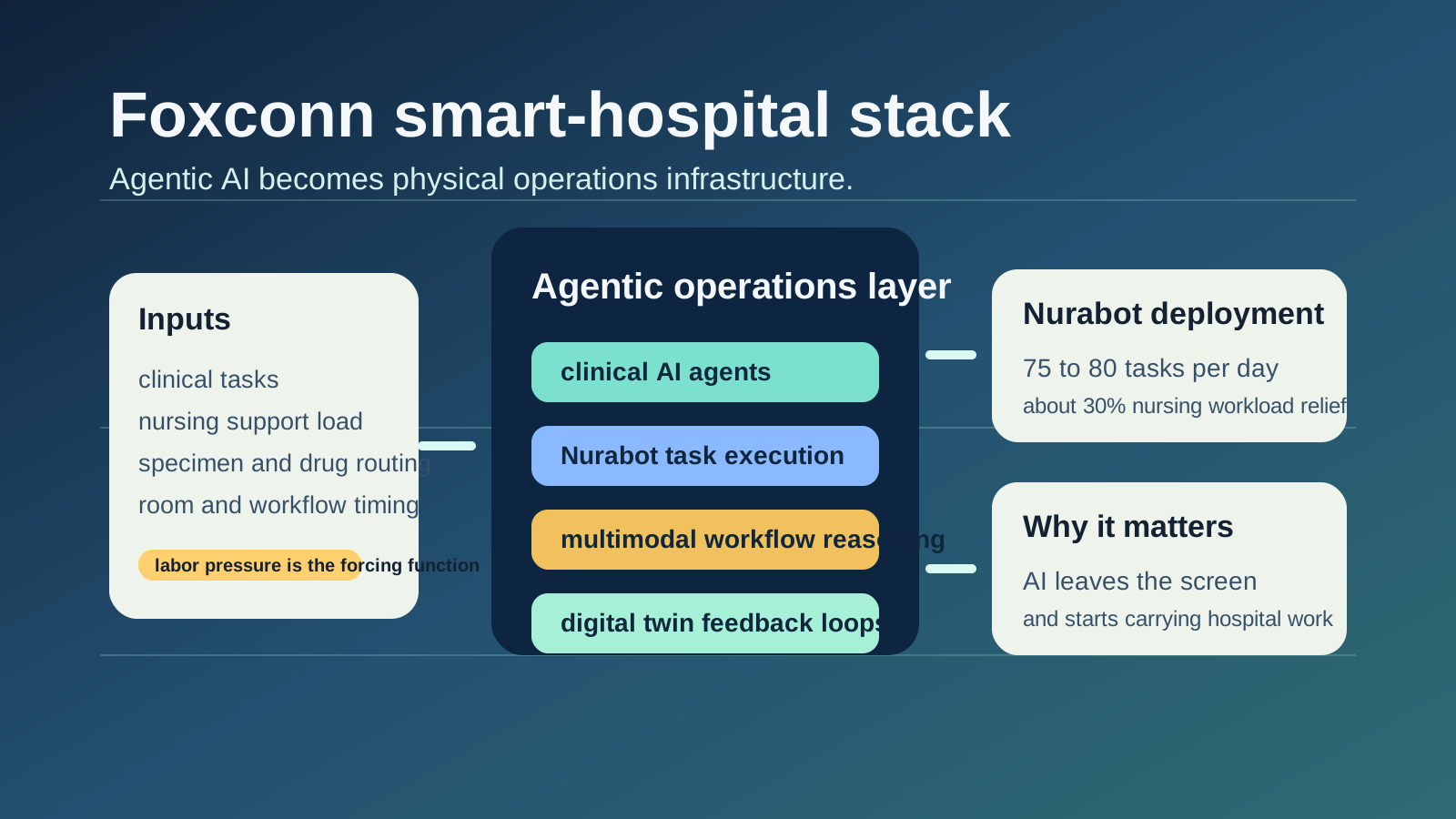
Foxconn’s June 1 smart-hospital push is worth publishing because the useful signal is not that another company wants to sell AI into healthcare. The stronger signal is that agentic AI is being packaged as operations infrastructure. When AI agents, collaborative robots, multimodal clinical models, and digital-twin workflows start getting integrated into the same environment, the story shifts from point-product experimentation to whether a hospital can run more work through the same labor base.
The official facts are specific. Foxconn said it used COMPUTEX 2026 and NVIDIA GTC Taipei to showcase healthcare systems built around CoDoClaw, a clinical AI agent system on NVIDIA NemoClaw, plus Nurabot deployments in hospitals and long-term-care settings. Foxconn said Nurabot has completed field validation, is being deployed across multiple sites, can perform 75 to 80 tasks per day, and can reduce nursing workload by about 30% on clinical support tasks such as drug delivery and specimen transport.
The useful Foxconn signal is that agentic AI gets much more real once it is tied to robots, task routing, and measurable hospital throughput instead of a stand-alone screen experience.
NVIDIA’s parallel May 31 announcement adds the higher-level frame. It said Foxconn is moving from individual AI tools to coordinated AI agent workforces across leading Taiwanese medical centers, and that CoDoctor AI and Nurabot have moved from pilot programs into clinical operations. NVIDIA also tied the broader Healthy Taiwan initiative to a $1.5 billion regional investment and said the majority of Taiwan’s medical centers are already using AI to transform care across more than 14 million patient encounters annually.
What makes this story stronger than generic healthcare AI coverage is the convergence of software and physical execution. Foxconn is not only talking about a clinical chatbot or a narrow documentation assistant. It is combining multi-agent workflow logic, collaborative nursing robotics, multimodal treatment systems, and digital-twin reasoning into the same operating environment. That is much closer to a hospital control system than to a stand-alone AI feature.
This clears the duplicate block against the site’s recent systems coverage because the thesis is different. The Microsoft, Cisco, Travelers, and Broadridge pieces were about information-heavy enterprise workflows. Foxconn is pushing agentic AI into a labor-constrained physical environment where tasks have to move through real buildings, nurses, carts, specimens, rooms, and clinical timing. That makes the operational test much harder and more interesting.
For operators, the read-through is that agentic AI becomes much more defensible once it is attached to measurable throughput. If a system can cut nursing support burden, orchestrate task routing, and turn fragmented support work into coordinated execution, then the adoption case becomes operational rather than aspirational. Buyers can ask whether the stack removes queue time, labor pressure, and handoff waste instead of simply asking whether it sounds intelligent in a demo.
For investors and builders, the stronger implication is that physical AI may scale first in environments where workflow friction is already expensive and labor is already scarce. Hospitals fit that pattern unusually well. They are dense, regulated, always-on operating environments with repetitive support tasks, heavy documentation, and limited staffing slack. That makes them one of the clearest places to test whether agentic AI can cross from interface novelty into operational leverage.
The Grid Report view is that this clears the publish bar because it answers a search-worthy question people are starting to ask in earnest: what does agentic AI look like once it leaves the screen? In Foxconn’s case, it looks like a hospital stack where agents, robots, and digital twins are being treated as one execution layer for clinical operations.
Sources
Hon Hai Technology Group, “Hon Hai Technology Group (Foxconn) Demonstrates AI-driven Platform Capabilities Across Robotics, Space, Healthcare At COMPUTEX 2026,” published June 1, 2026: https://www.foxconn.com/en-us/press-center/events/foxconn-events/2044
NVIDIA Newsroom, “NVIDIA, Foxconn and Taiwan Medical Centers Bring Agentic and Physical AI to ‘Healthy Taiwan’,” published May 31, 2026: https://nvidianews.nvidia.com/news/nvidia-foxconn-and-taiwan-medical-centers-bring-agentic-and-physical-ai-to-healthy-taiwan
By Nawaz Lalani
The Grid Report is written by Nawaz Lalani and focuses on source-backed coverage of AI infrastructure, grid power demand, automation systems, and market signals.
Follow the signal, not just the headline.
Get the daily Grid brief for source-backed coverage on AI power demand, infrastructure timing, automation, and market signals.