- Travelers’ June 2 OpenAI case study is worth publishing because the useful signal is not that another enterprise bought AI.
- The disclosed facts are specific enough to matter.
- That is what makes this a stronger Grid Report story than a generic insurer-automation headline.
- Section
- AI Automation
- Read time
- 6 min read
- Why this page exists
- The Grid Report publishes operator-grade coverage on AI, power, infrastructure, automation, and markets.
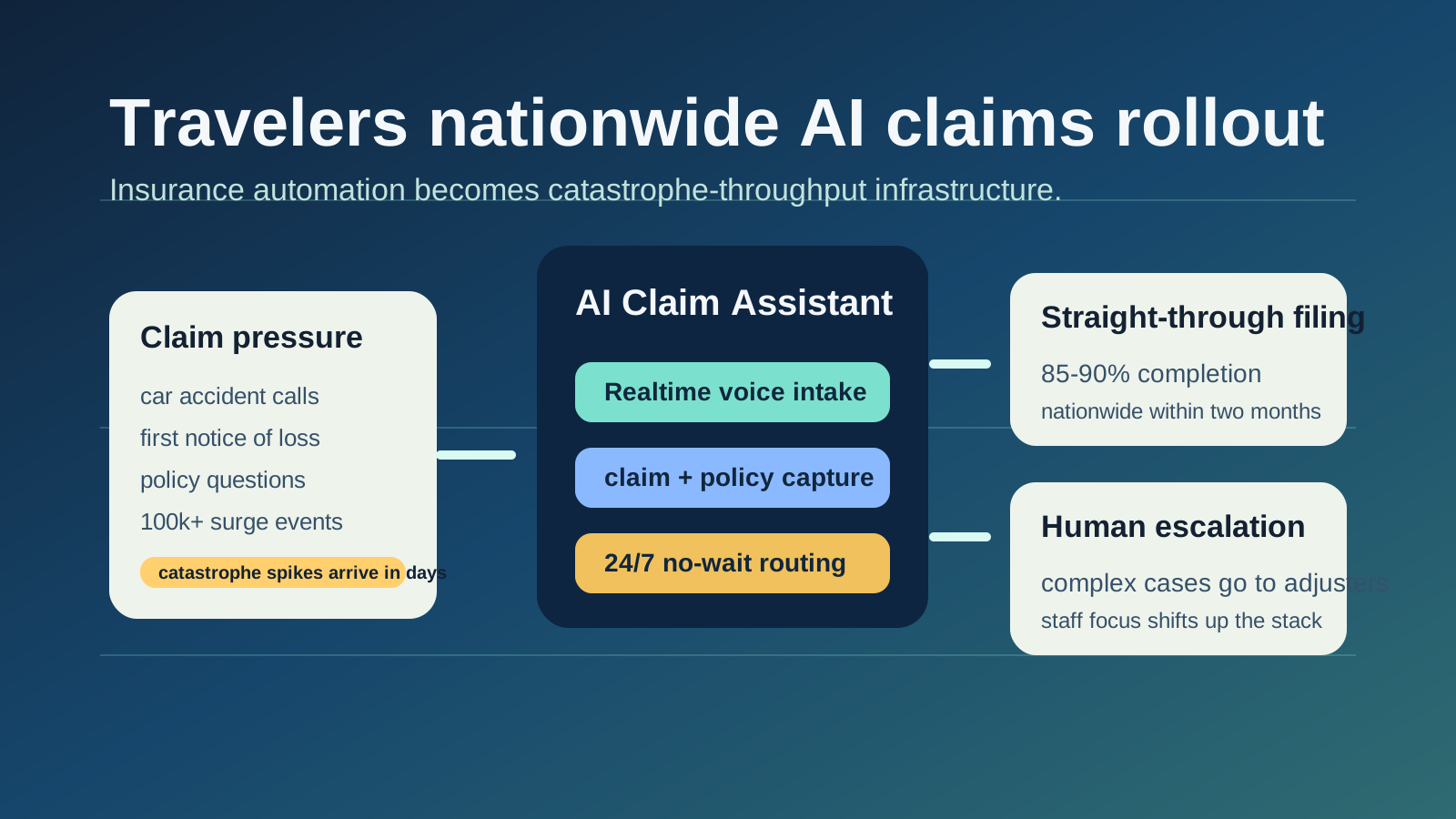
The useful Travelers signals are operational, not conceptual
The case study is publishable because it includes deployment speed, workflow scope, and enough usage detail to show this is a live intake system rather than a pilot.
What the June 2 and February 18 disclosures show
| Signal | Disclosed fact | Why it matters |
|---|---|---|
| Workflow type | Voice-based first notice of loss for auto property damage claims | This is a customer-facing operating workflow, not a back-office pilot. |
| Deployment speed | Eight-state launch expanded nationwide within two months | The rollout suggests enough confidence in reliability and workflow fit to scale fast. |
| Straight-through usage | 85-90% of assistant users complete filing through AI | The tool is handling a meaningful share of repetitive intake work instead of acting as a novelty layer. |
| Economic context | Travelers handled more than 1.5 million claims and paid over $23 billion in losses last year | The claims stack is large enough that throughput and staffing changes can matter financially. |
Sources: OpenAI case study published June 2, 2026 and Travelers press release published February 18, 2026.
Travelers’ June 2 OpenAI case study is worth publishing because the useful signal is not that another enterprise bought AI. The stronger signal is that a large regulated insurer has now moved a customer-facing voice agent into nationwide production for a core workflow that breaks under surge conditions: first notice of loss after an auto accident or catastrophe event.
The disclosed facts are specific enough to matter. OpenAI says Travelers built its AI Claim Assistant on the Realtime API and frontier models, first launched it in eight states, then expanded it countrywide within two months. OpenAI also says 85% to 90% of customers using the assistant now complete their claim filing through AI. Travelers adds the scale context that makes this more than a demo: the company handled more than 1.5 million claims last year, paid more than $23 billion in losses, and says catastrophe events can generate more than 100,000 claims in just days.
The strongest signal is not that Travelers uses AI. It is that first-notice-of-loss intake is being turned into nationwide catastrophe-throughput infrastructure.
That is what makes this a stronger Grid Report story than a generic insurer-automation headline. The original angle is that claims intake is becoming throughput infrastructure. When a carrier faces a spike in calls after storms, crashes, or other events, the first bottleneck is not advanced reasoning in the abstract. It is whether the business can absorb a flood of repetitive but emotionally sensitive claim conversations without leaving customers on hold or forcing the whole system into triage mode.
Travelers is explicitly positioning the assistant as that front-door pressure valve. According to OpenAI, the system handles natural voice conversations, answers policy questions, gathers loss details, and submits claims. Travelers says customers can still reach a live specialist at any point, but the straight-through path now covers a large enough share of inbound demand that human claim professionals can spend more time on complicated cases instead of basic intake.
That shift matters because it turns AI from a convenience layer into queue management for a regulated service business. The strongest enterprise AI deployments increasingly sit in workflows where demand arrives unpredictably, response time matters, and the business already has a clear escalation path. Insurance claims fit that pattern well. The work has structure, the handoff to humans is legible, and the economic value of faster intake is easy to understand during catastrophe surges.
This clears the site’s duplicate block against recent systems coverage. OpenAI’s Deployment Company article was about frontier vendors selling workflow redesign as a service. Braintrust’s Codex article was about collapsing software feedback loops. Broadridge’s rollout was about ontology-driven automation inside capital-markets operations. Travelers is different. It is a customer-facing voice workflow in a regulated claims stack, with nationwide deployment speed and disclosed completion rates attached.
There is still a caveat worth stating plainly. Both of the core sources are company accounts, so the article should be read as a product and customer case study rather than independent benchmark research. The reported completion rates also describe customers who used the AI assistant, not every claimant across Travelers. But even with those limits, the operating signal is strong enough to matter because the deployment moved from limited launch to national coverage quickly and is tied to a live production workflow.
For operators in insurance, healthcare, utilities, and other surge-prone service businesses, the practical takeaway is that the best voice-agent use cases may start where queue pressure is most expensive and escalation logic is already mature. For investors, the read-through is that defensible AI value may show up first in throughput-heavy workflows with measurable completion, staffing, and wait-time economics rather than in broad “AI transformation” claims.
For search performance, the article is strong because it answers a live, specific question: what did Travelers actually launch with OpenAI, how widely is it deployed, and why does the rollout matter beyond marketing language? Readers searching for Travelers AI Claim Assistant, OpenAI insurance claims, or Realtime API claims automation get a direct operating thesis instead of a generic enterprise-AI rewrite.
Sources
OpenAI, “Travelers deploys AI-powered claims countrywide with OpenAI,” published June 2, 2026: https://openai.com/index/travelers/
Travelers, “Travelers Launches Industry-Leading Agentic AI Claim Assistant Developed with OpenAI,” published February 18, 2026: https://investor.travelers.com/newsroom/press-releases/news-details/2026/Travelers-Launches-Industry-Leading-Agentic-AI-Claim-Assistant-Developed-with-OpenAI/default.aspx
Nawaz Lalani
Nawaz Lalani is the creator of The Grid Report and writes about AI infrastructure, grid power demand, automation systems, and the market signals shaping the physical AI economy. His focus is translating technical and industrial shifts into practical coverage for operators, investors, builders, and teams making real deployment decisions.
B.S. in Geology from UT Arlington. Covers AI infrastructure, energy systems, grid constraints, automation workflows, and market signals.
Stories are built from primary sources, utility and infrastructure signals, company disclosures, filings, and operator-grade context. The goal is to explain what changed, why it matters now, and what it means for builders, investors, utilities, and teams making real deployment decisions.
Follow the lane, not just the headline.
The strongest value in The Grid Report comes from following how AI, infrastructure, power, automation, and markets connect over time.