- Amazon’s reported talks to sell Trainium chips to outside data center operators clear the publish bar because they point to a real shift in AI infrastructure strategy.
- That changes the competitive question.
- Amazon’s own disclosures make the story more than a speculative chip-sales rumor.
- Section
- Infrastructure
- Read time
- 5 min read
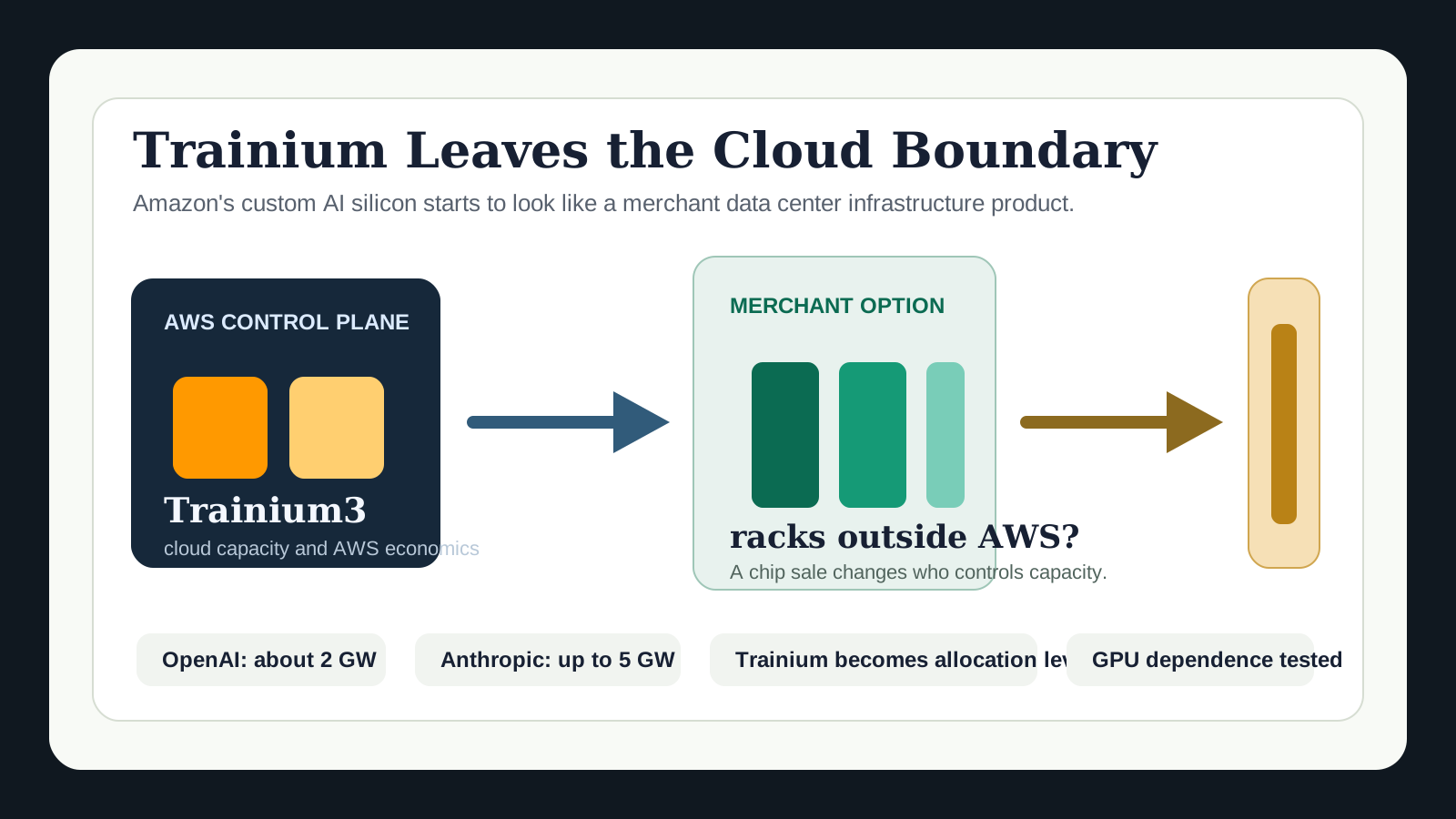
Amazon’s reported talks to sell Trainium chips to outside data center operators clear the publish bar because they point to a real shift in AI infrastructure strategy. Data Center Dynamics, citing Bloomberg, reported on June 19 that AWS AI chief Peter DeSantis said Amazon is in discussions with potential customers about getting Trainium to more customers. The important part is not that Amazon has another accelerator. It is that custom AI silicon may be moving from an internal cloud advantage into a merchant infrastructure product.
That changes the competitive question. If Trainium stays only inside AWS, Amazon uses the chip to improve cloud margins, lower customer costs, and ration scarce AI capacity through its own platform. If Trainium racks can be sold or placed with outside operators, the chip becomes part of a broader capacity market. Customers would not only choose between AWS instances and Nvidia GPU clouds. They could start choosing who controls the racks, where the power sits, and how much of the stack is tied to Amazon’s software and networking layer.
A merchant Trainium path would turn custom AI silicon into a question of rack control, power-backed capacity, and who owns the operating layer around the chip.
Amazon’s own disclosures make the story more than a speculative chip-sales rumor. In its first-quarter 2026 results, Amazon said OpenAI had committed to consume about 2 gigawatts of Trainium capacity through AWS infrastructure beginning in 2027, and that Anthropic would secure up to 5 gigawatts of current and future Trainium generations. Those are power-scale commitments, not ordinary chip mentions. They show Trainium already being sold as a capacity allocation system for frontier AI customers.
The Grid-native angle is that AI chips are becoming inseparable from power, data center control, and financing. A Trainium rack is not just a substitute for a GPU. It is a claim on memory bandwidth, networking, cooling, electrical capacity, software support, and deployment timing. Selling that stack outside AWS would make Amazon more like a supplier of AI factory components while still preserving leverage through chip design, Neuron software, and customer commitments.
The Nvidia read-through is obvious but incomplete. Yes, any external Trainium sales program would challenge Nvidia’s dominance in AI data centers. But the more interesting pressure lands on cloud business models. Google has already started opening TPU access beyond ordinary cloud consumption through selective chip access and dedicated TPU-backed capacity deals. If Amazon follows, custom silicon becomes a way for cloud companies to sell infrastructure control, not just rent compute by the hour.
There are limits. Amazon has not announced a general merchant Trainium product, named outside buyers, or explained how support, networking, warranties, and lifecycle management would work for non-AWS data center deployments. That matters because chips alone do not make an AI infrastructure business. The operational wrapper around them may be the harder product.
Still, the direction is meaningful. The AI infrastructure market is moving from a simple shortage story into a control story: who owns the silicon, who owns the rack, who controls the software layer, and who has enough power-backed capacity to make long-term commitments credible. Amazon’s reported Trainium talks matter because they put that control question directly into the chip market.
Sources
Data Center Dynamics, “Amazon could sell Trainium AI chips to data centers - report,” published June 19, 2026: https://www.datacenterdynamics.com/en/news/amazon-could-sell-trainium-ai-chips-to-data-centers-report/
Amazon, “Amazon.com Announces First Quarter Results,” published May 2026: https://ir.aboutamazon.com/news-release/news-release-details/2026/Amazon-com-Announces-First-Quarter-Results/default.aspx
OpenAI, “OpenAI and Amazon announce strategic partnership,” published February 27, 2026: https://openai.com/index/amazon-partnership/
AWS, “Amazon EC2 Trn3 UltraServers,” accessed June 20, 2026: https://aws.amazon.com/ec2/instance-types/trn3/
By Nawaz Lalani
The Grid Report is written by Nawaz Lalani and focuses on source-backed coverage of AI infrastructure, grid power demand, automation systems, and market signals.
Follow the signal, not just the headline.
Get the daily Grid brief for source-backed coverage on AI power demand, infrastructure timing, automation, and market signals.