- Visa’s OpenAI partnership and Mastercard’s Agent Pay for Machines launch are worth publishing together because the useful signal is not that another set of incumbents wants an AI headline.
- Visa’s June 10 release makes that shift explicit.
- The OpenAI angle is what makes the story more search-worthy than a generic fintech-AI tie-up.
- Section
- AI Automation
- Read time
- 4 min read
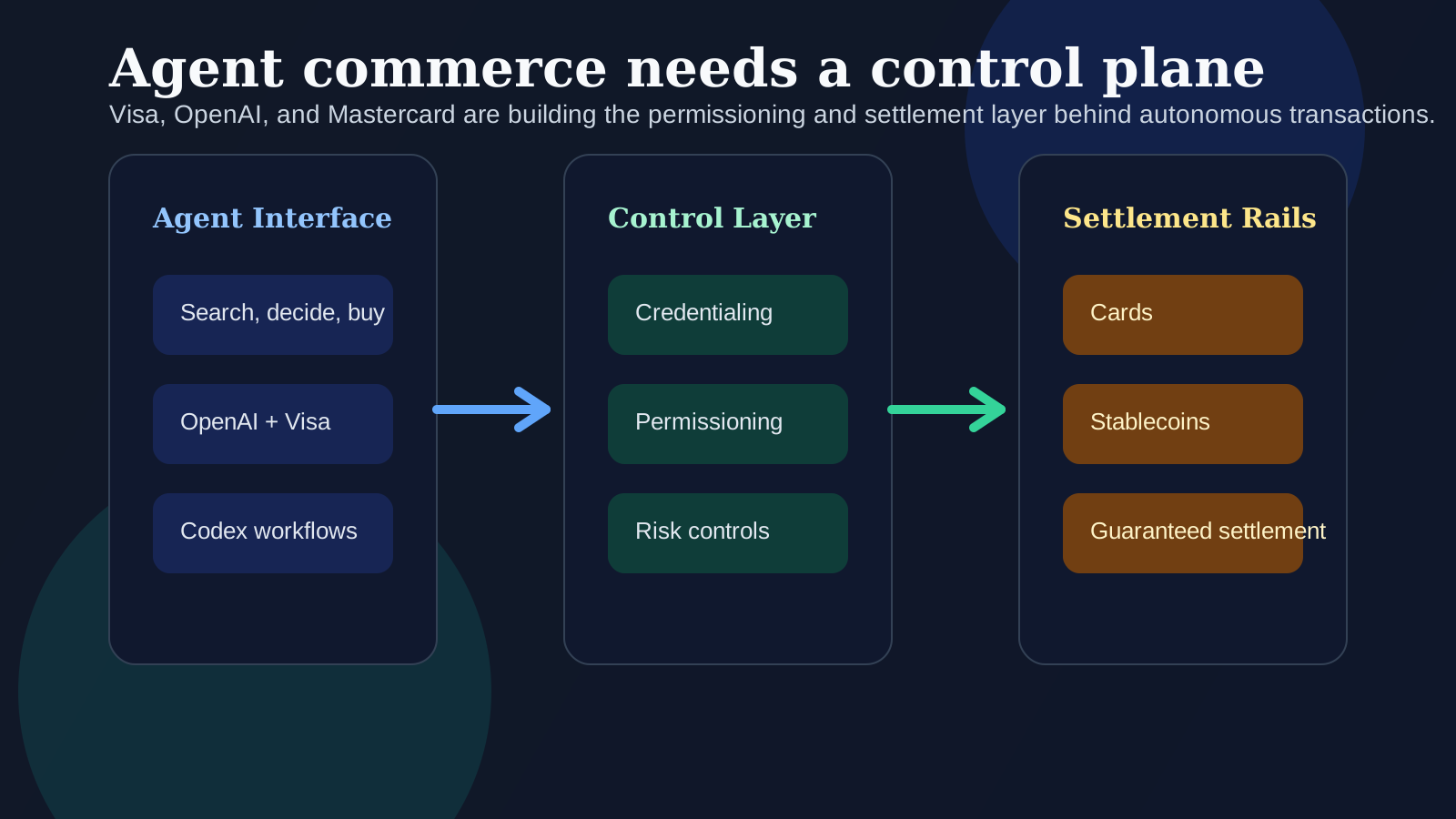
Visa’s OpenAI partnership and Mastercard’s Agent Pay for Machines launch are worth publishing together because the useful signal is not that another set of incumbents wants an AI headline. The stronger signal is that agent commerce is starting to acquire real operating infrastructure. Once software can make or complete transactions, the hard part stops being the chat interface and becomes the control stack underneath it: who the agent is, what it is allowed to buy, how risk is monitored, and how settlement actually clears.
Visa’s June 10 release makes that shift explicit. Visa said it is partnering with OpenAI to enable secure Visa payments within agentic commerce and to integrate Visa payment capabilities into OpenAI experiences. Just as important, Visa said the infrastructure layer includes credentialing, tokenization, real-time authorization, fraud monitoring, and user-defined controls such as spending limits, merchant categories, and required approvals. That is not a superficial feature add. It is a governance model for software that can spend.
The important shift is not that payments companies want an AI headline. It is that autonomous agents now need a real control layer for identity, permissions, risk, and settlement.
The OpenAI angle is what makes the story more search-worthy than a generic fintech-AI tie-up. Visa said the partnership also opens the door to developer-focused experiences powered by Codex along with more automated and conversational workflows. That matters because it connects agent payments to the same tool-driven software environments where users are already asking agents to research, write, compare vendors, and execute work. If those environments start handling checkout, procurement, API purchases, or service renewals, payment controls become part of the product architecture.
Mastercard’s June 10 announcement broadens the same thesis from another direction. Mastercard said Agent Pay for Machines supports credentialing, controls, and guaranteed settlement across multiple payment types, from cards to stablecoins. It also said more than 30 partners are involved across the stack, including Cloudflare, Stripe, Checkout.com, Coinbase, and Global Payments. The operational read-through is that agent commerce is not being framed as one closed demo. It is being framed as an interoperable payment environment that has to work across different runtimes, gateways, and asset types.
That is the stronger original angle for Grid Report readers. The market is not just building smarter agents. It is building a control plane for agents that touch money. Visa emphasizes tokenized credentials, merchant-level rules, and fraud monitoring. Mastercard emphasizes credentialing, permissioning, interoperability, and guaranteed settlement. Those are all signs that agent execution is moving from recommendation into action, and action requires infrastructure.
For operators, the practical question is no longer whether an agent can find the cheapest option or fill out a form. The practical question is whether that agent can be trusted to transact inside policy. If an internal buying agent is allowed to purchase compute, software seats, logistics capacity, ad inventory, or cloud services, companies need machine-readable rules around who can authorize what, at what dollar threshold, on which rails, and with what audit trail. That is where this story crosses from AI novelty into enterprise systems design.
This clears the duplicate block against the site’s recent OpenAI, Microsoft, BBVA, and LSEG coverage because the thesis is materially different. BBVA was about governance inside a bank-wide rollout. Microsoft Work IQ was about agent context and spending visibility. LSEG was about trusted data inside workflows. This story sits one layer lower: the transaction infrastructure that lets agents move money or commit spend once those workflows become executable.
The search case is strong because readers searching for the Visa OpenAI partnership or Mastercard Agent Pay want to know what these launches actually mean. The useful answer is not merely that payments and AI are converging. The better answer is that agent commerce now needs the same kind of identity, policy, and settlement stack that human commerce spent decades building.
Sources
Visa, “Visa Partners with OpenAI to Power the Next Generation of AI Commerce,” published June 10, 2026: https://investor.visa.com/news/news-details/2026/Visa-Partners-with-OpenAI-to-Power-the-Next-Generation-of-AI-Commerce/default.aspx
Visa, “Visa and OpenAI: Building the future of AI commerce,” accessed June 12, 2026: https://corporate.visa.com/en/sites/visa-perspectives/innovation/visa-openai-partnership.html
Mastercard, “Mastercard launches Agent Pay for Machines to unlock super-fast, always-on payments,” published June 10, 2026: https://www.mastercard.com/us/en/news-and-trends/press/2026/june/mastercard-launches-agent-pay-for-machines.html
Mastercard Investor Relations, “Mastercard Launches Agent Pay for Machines to Unlock Super-Fast, Always-On Payments,” published June 10, 2026: https://investor.mastercard.com/investor-news/investor-news-details/2026/Mastercard-Launches-Agent-Pay-for-Machines-to-Unlock-Super-Fast-Always-On-Payments/default.aspx
By Nawaz Lalani
The Grid Report is written by Nawaz Lalani and focuses on source-backed coverage of AI infrastructure, grid power demand, automation systems, and market signals.
Follow the signal, not just the headline.
Get the daily Grid brief for source-backed coverage on AI power demand, infrastructure timing, automation, and market signals.