- Marvell’s June 1 Teralynx T100 launch is worth publishing because the useful signal is not simply that switch bandwidth keeps climbing.
- The disclosed facts are concrete enough to clear the bar.
- That is the sharper Grid Report angle.
- Section
- Infrastructure
- Read time
- 4 min read
- Why this page exists
- The Grid Report publishes operator-grade coverage on AI, power, infrastructure, automation, and markets.
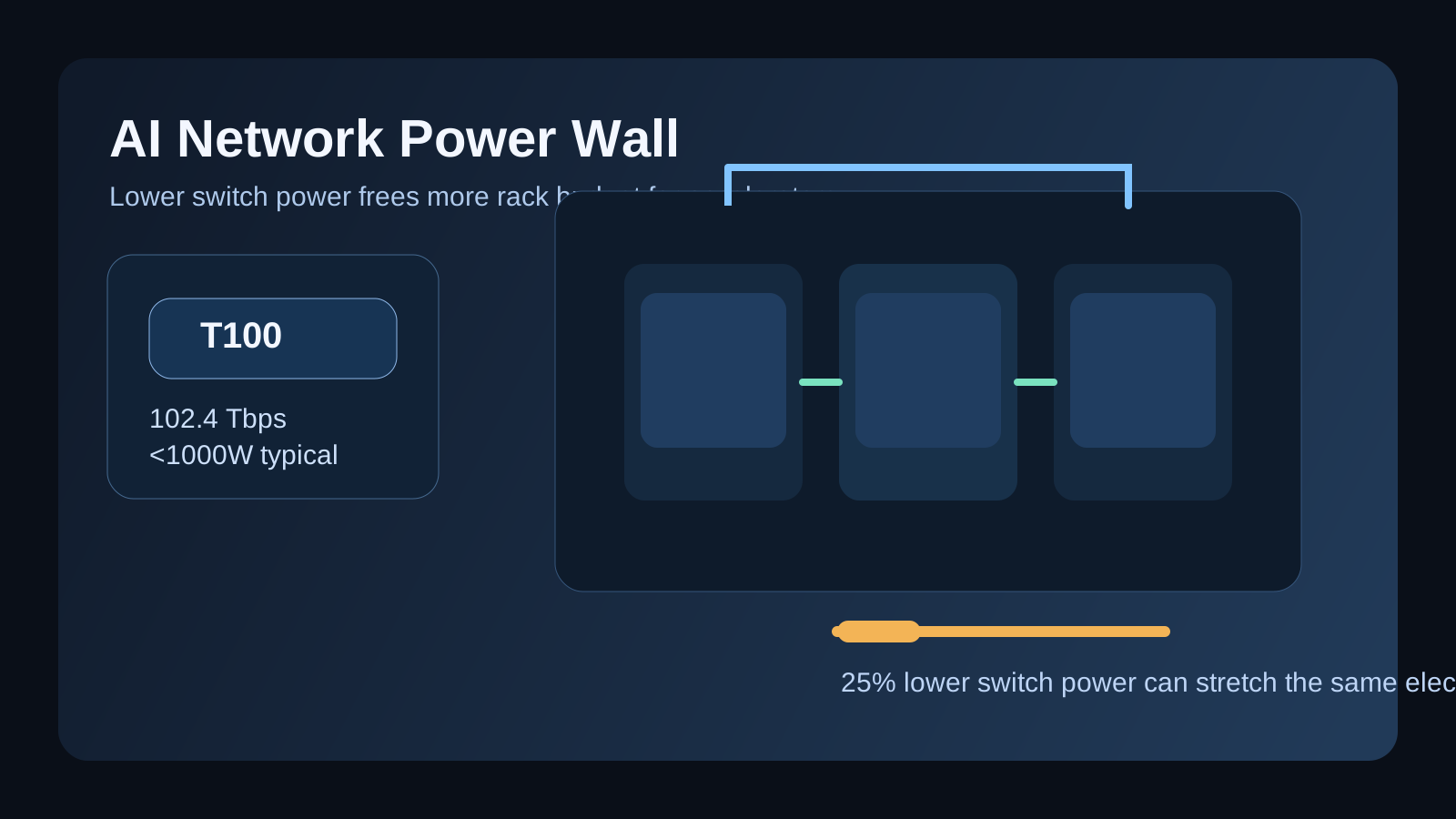
Why the T100 matters beyond switch bandwidth
The release is useful because it ties network design directly to rack density, power budgets, and cluster economics.
| Signal | What Marvell said | Why it matters | Grid Report read-through |
|---|---|---|---|
| Lower typical power | T100 runs at under 1000W typical power and up to 25% lower power than alternatives. | Network watts can be reallocated inside dense AI racks. | Switch efficiency becomes a compute-capacity lever. |
| Rack density pressure | Marvell says GPU and XPU systems are approaching 120 kW per rack. | Electrical headroom is now a first-order infrastructure constraint. | The fabric has to compete for power with accelerators and cooling. |
| Flatter fabrics | Up to 512-port radix can reduce tiers and optical links. | Simpler fabrics can lower latency, power use, and TCO together. | Networking design is increasingly an infrastructure-efficiency problem. |
| Open deployment support | Support includes multiple package options, UEC requirements, SAI, and SONiC. | Operators want lower-power silicon without locking themselves into one deployment path. | The winning network layer will combine efficiency with integration flexibility. |
Source context: Marvell Teralynx T100 launch published June 1, 2026.
Marvell’s June 1 Teralynx T100 launch is worth publishing because the useful signal is not simply that switch bandwidth keeps climbing. The stronger signal is that AI networking has become part of the rack-power budget. Once dense GPU systems are pushing toward 120 kilowatts per rack, every networking watt starts competing with accelerator, cooling, and power-delivery headroom.
The disclosed facts are concrete enough to clear the bar. Marvell says the Teralynx T100 is the industry’s first 102.4 terabit-per-second switch silicon built specifically for AI and cloud data-center infrastructure. The company says it delivers up to 25% lower power than competitive solutions, consumes under 1000 watts at typical power, supports up to 512-port scale-out radix, and is designed to reduce network tiers and optical links in large AI clusters.
In a 120-kilowatt rack world, network power is no longer background noise. It is part of the compute budget.
That is the sharper Grid Report angle. The market still often discusses AI networking as a throughput and latency race. Marvell is making a more infrastructure-relevant claim. Lower-power switch silicon can let operators deploy more accelerators within the same electrical envelope without requiring additional power infrastructure. In other words, networking efficiency can change how many monetizable GPUs fit inside a fixed rack or campus power plan.
This clears the duplicate block against the site’s recent infrastructure coverage because the thesis is different. The MRC open-spec story was about endpoint control in AI networking. STMicro’s target raise was about power silicon demand. AMD’s Taiwan article was about packaging throughput. Marvell sits in a different slot. It is about the network fabric itself becoming a power-efficiency lever in the AI buildout.
The 15% to 25% network-power-share detail matters in particular. Marvell cites that range for switching and networking components inside AI racks, which means the fabric is no longer a sidecar cost. At this density, network architecture affects the useful compute you can actually energize. A flatter fabric with fewer tiers and fewer optical links can improve cluster economics not only through latency, but through electrical efficiency.
That gives the launch a stronger operator angle than a normal chip release. If hyperscalers can reduce power burned by the network and maintain performance across scale-out and scale-up fabrics, the benefit is not abstract engineering elegance. It is more room inside the same megawatt budget to deploy revenue-producing accelerators or avoid another round of facility expansion.
For investors, the read-through is that the AI power wall is moving deeper into the component stack. It is not enough to ask who has the fastest accelerators or the biggest campuses. The more useful question is which suppliers help operators squeeze more cluster output from the same constrained electrical footprint.
The search case is strong because readers looking for the Teralynx T100 need more than a new-switch recap. The more useful answer is that AI networking is now part of the power-allocation problem inside dense clusters, and that makes low-power switch silicon strategically important.
Sources
Marvell Technology, “Marvell Announces Availability of Industry’s First 102.4 Tbps Switch Purpose-Built for AI and Cloud Data Center Infrastructure,” published June 1, 2026: https://investor.marvell.com/news-events/press-releases/detail/1024/marvell-announces-availability-of-industrys-first-102-4-tbps-switch-purpose-built-for-ai-and-cloud-data-center-infrastructure
Business Wire version of the Marvell Teralynx T100 announcement, published June 1, 2026: https://www.businesswire.com/news/home/20260601564526/en/
Nawaz Lalani
Nawaz Lalani is the creator of The Grid Report and writes about AI infrastructure, grid power demand, automation systems, and the market signals shaping the physical AI economy. His focus is translating technical and industrial shifts into practical coverage for operators, investors, builders, and teams making real deployment decisions.
B.S. in Geology from UT Arlington. Covers AI infrastructure, energy systems, grid constraints, automation workflows, and market signals.
Stories are built from primary sources, utility and infrastructure signals, company disclosures, filings, and operator-grade context. The goal is to explain what changed, why it matters now, and what it means for builders, investors, utilities, and teams making real deployment decisions.
Follow the lane, not just the headline.
The strongest value in The Grid Report comes from following how AI, infrastructure, power, automation, and markets connect over time.