- EIA’s June 18 Permian update clears the bar because it makes the West Texas AI-power story more concrete.
- That makes this more than a generic upstream story.
- EIA explains the mechanism clearly.
- Section
- Energy
- Read time
- 4 min read
- Data included
- What EIA reported
What EIA reported
The publishable signal is not just a bigger basin. It is faster gas growth in the same region where AI campuses want on-site power.
Permian fuel-base signals
| Signal | What EIA said | Why it matters |
|---|---|---|
| Gas growth | Marketed gas output rose 60% from 2021 to 2025 | The basin is becoming a larger fuel source for any gas-based campus power strategy. |
| Oil growth | Crude output rose 39% over the same period | Gas is growing faster than oil, which changes how the basin should be read. |
| GOR shift | Average gas-oil ratio reached nearly 4,200 cf/b in 2025 | Reservoir behavior is contributing to more gas supply per barrel produced. |
| Incremental volume | A higher GOR added about 3.8 Bcf/d of 2025 gas output | That is meaningful extra fuel in a region discussing prime-power AI campuses. |
| Grid angle | Production data does not remove midstream or permitting constraints | Fuel growth helps the story, but on-site power still depends on infrastructure and regulation. |
Source: U.S. Energy Information Administration, Today in Energy, June 18, 2026.
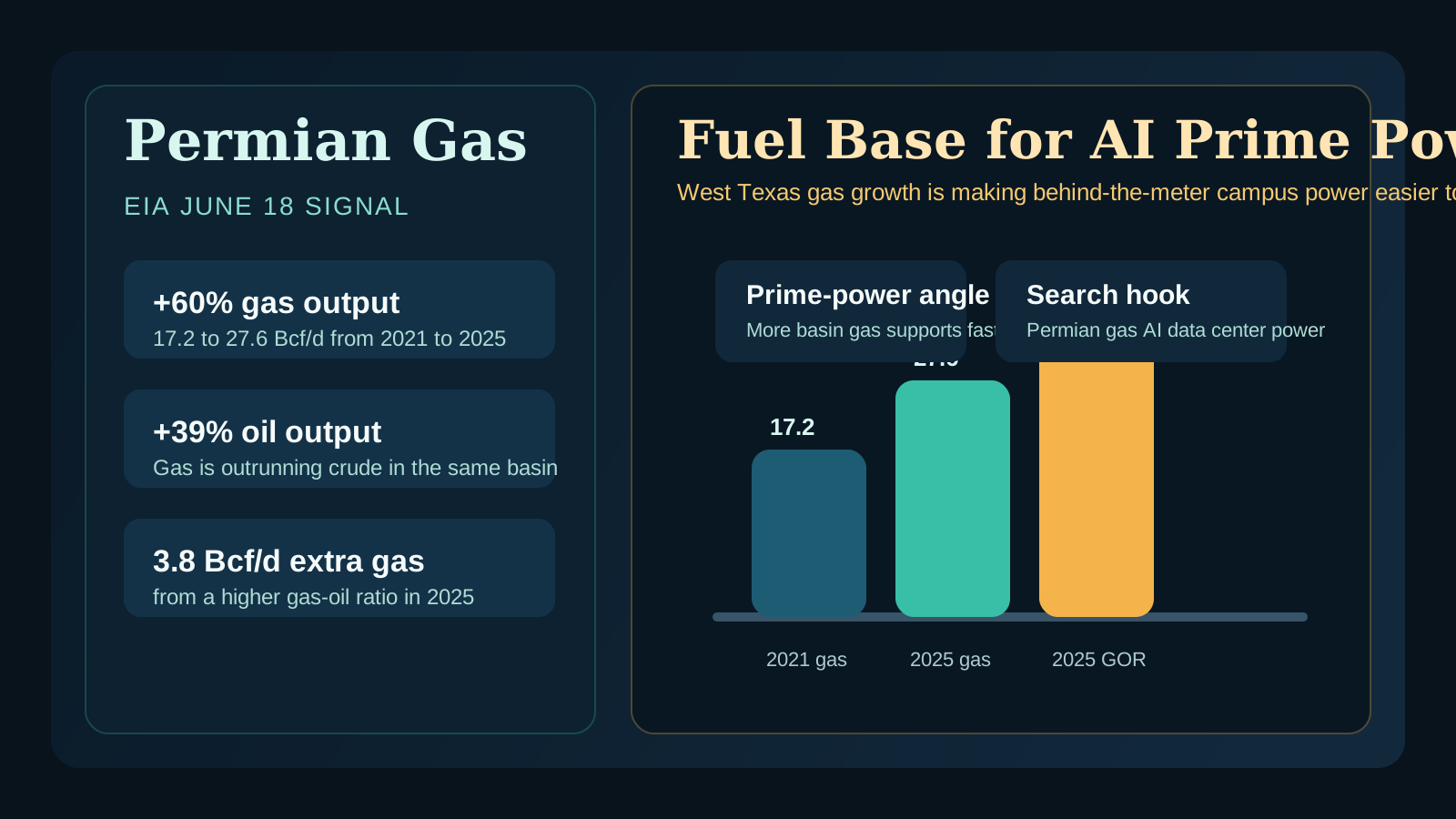
EIA’s June 18 Permian update clears the bar because it makes the West Texas AI-power story more concrete. The agency said the Permian region’s marketed natural-gas production grew from 17.2 billion cubic feet per day in 2021 to 27.6 billion cubic feet per day in 2025, a 60% increase. Over the same period, crude oil production grew 39%, from 4.7 million barrels per day to 6.6 million barrels per day. The key point is not just that the basin is larger. It is that gas supply is expanding faster than oil in the same region where developers are already pitching prime-power AI campuses.
That makes this more than a generic upstream story. Two days ago, Cummins said it would supply natural-gas generation and controls for Circe Energy’s behind-the-meter AI campuses in West Texas. EIA’s new data does not validate every AI-campus plan on its own, but it does make the local fuel backdrop easier to take seriously. If the basin is yielding more gas per barrel of oil, then the West Texas power story is not only about interconnection delay or generator procurement. It is also about the depth and trajectory of nearby fuel availability.
West Texas AI power is no longer only an interconnection story. EIA’s new Permian data makes it a fuel-supply story too.
EIA explains the mechanism clearly. As more oil and gas are produced from a reservoir, pressure declines, natural gas becomes easier to produce at lower pressures, and the gas-oil ratio rises. In the Permian, EIA said the ratio averaged nearly 4,200 cubic feet of gas per barrel of oil in 2025, up 16% from 2021. That shift alone mattered. EIA estimates that if the 2021 ratio had held constant, the region would have produced only 23.8 billion cubic feet per day of natural gas in 2025 instead of 27.6 billion. In other words, the higher ratio produced an extra 3.8 billion cubic feet per day of gas.
That extra gas is the most useful Grid Report angle. West Texas AI infrastructure is increasingly being discussed as a speed-to-power market where operators may accept a heavier on-site generation footprint in exchange for faster energization. If that model spreads, then basin-level gas growth becomes part of the infrastructure stack behind compute deployment. The relevant question is no longer only whether a campus can buy turbines or reciprocating engines. It is whether the regional fuel system can support a larger population of campuses trying to run prime power before the grid is ready.
This does not mean every cubic foot of additional Permian gas turns neatly into AI-campus fuel. Midstream constraints, pipeline routing, local generation permitting, emissions scrutiny, and power-market economics still matter. EIA’s piece is about production, not a dedicated AI supply contract map. But the signal is still publishable because it tightens the link between an upstream basin trend and a downstream AI infrastructure strategy that already exists in the same geography.
There is also a strategic reading here for investors and operators. If AI-capacity announcements in West Texas increasingly depend on behind-the-meter gas, then the winners are not only data-center landlords or chip suppliers. They may also include the companies that can package basin gas access, on-site generation equipment, controls, interconnection workarounds, and phased campus buildouts into a credible time-to-power offer.
The stronger conclusion is that West Texas is becoming easier to read as a two-layer AI story: first a grid bottleneck story, then a fuel-conversion story. EIA’s June 18 update does not finish that case, but it gives the prime-power camp a much firmer physical basis than a generic “there is plenty of gas in Texas” claim.
Sources
U.S. Energy Information Administration, “Permian natural gas production increased faster than crude oil,” published June 18, 2026: https://www.eia.gov/todayinenergy/detail.php?id=67785
Cummins, “Cummins natural gas generators to power large scale data centers in West Texas,” published June 16, 2026: https://www.cummins.com/en-na/news/releases/2026/06/16/cummins-natural-gas-generators-power-large-scale-data-centers-west-texas
By Nawaz Lalani
The Grid Report is written by Nawaz Lalani and focuses on source-backed coverage of AI infrastructure, grid power demand, automation systems, and market signals.
Follow the signal, not just the headline.
Get the daily Grid brief for source-backed coverage on AI power demand, infrastructure timing, automation, and market signals.