- PJM’s June 16 update clears the bar because it offers a specific, timely answer to a question the AI-power conversation keeps circling without fully resolving: how do you bring enough supply online fast enough when load growth is starting to outrun the old planning rhythm?
- That is the signal worth publishing.
- The PJM post includes enough operating detail to matter.
- Section
- Energy
- Read time
- 4 min read
- Why this page exists
- The Grid Report publishes operator-grade coverage on AI, power, infrastructure, automation, and markets.
What PJM reported
The useful change is not only that queue costs fell. It is that broader transmission work changed the economics of getting new supply connected.
PJM transition-cycle signals
| Signal | What PJM said | Why it matters |
|---|---|---|
| Cost change | $8.7 billion reduction in required network upgrades | Lower upgrade burdens can improve project economics and queue survivability. |
| Study scope | 270 projects in Phase II | This is a broad sample of supply trying to connect, not a one-off project anecdote. |
| Supply potential | About 30 GW at full output | Enough capacity to matter for regions trying to serve fast-rising power demand. |
| Transmission driver | February RTEP approvals across eastern, southern, and western PJM | Shows broader backbone planning can remove costly scattered fixes later. |
| Near-term gating | Decision Point II opened June 8 and 13 projects can accelerate | Queue economics improved, but developer follow-through still determines what gets built. |
Source: PJM Inside Lines, June 16, 2026, plus FERC Order 1920 explainer context.
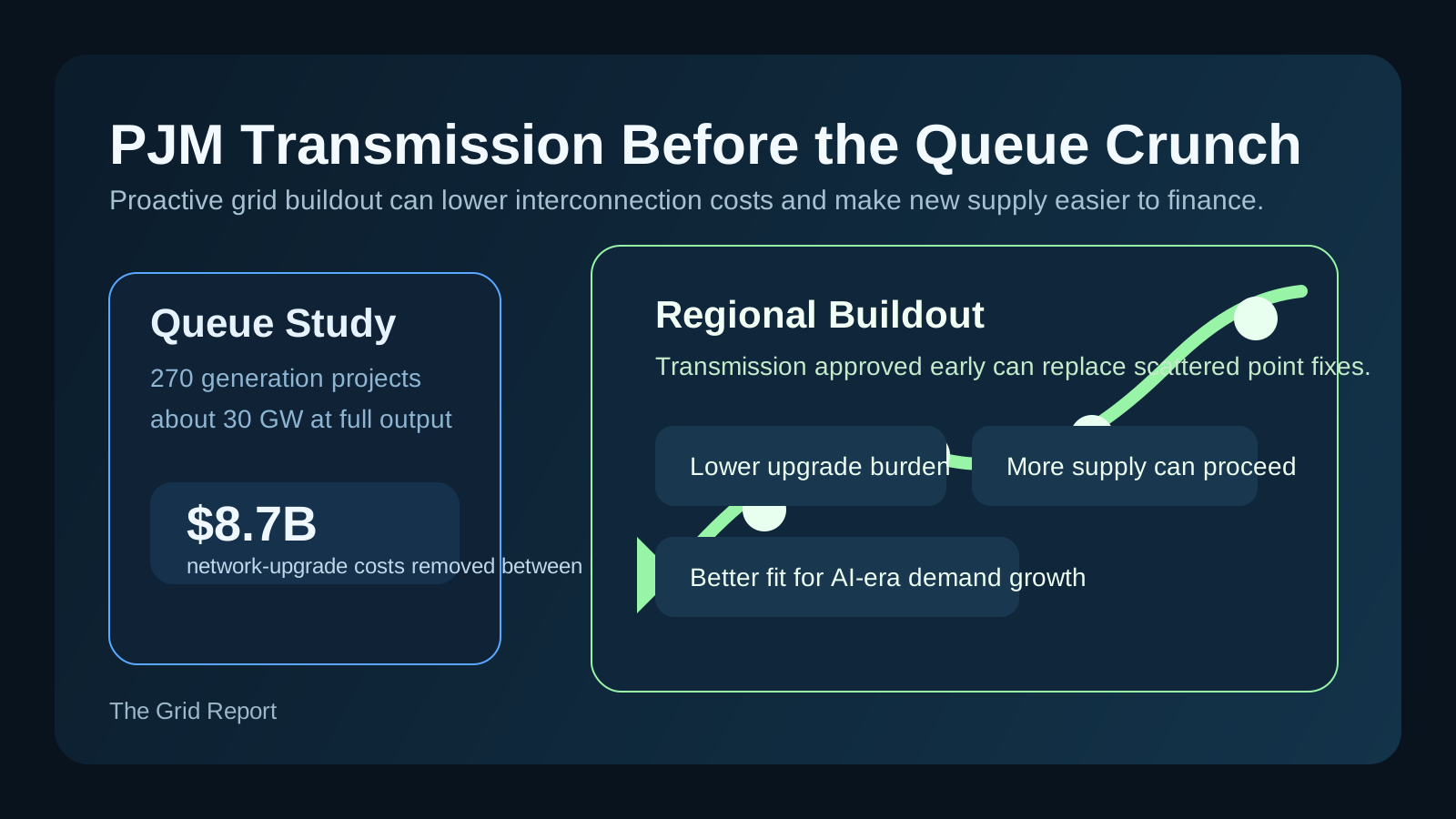
PJM’s June 16 update clears the bar because it offers a specific, timely answer to a question the AI-power conversation keeps circling without fully resolving: how do you bring enough supply online fast enough when load growth is starting to outrun the old planning rhythm? PJM said that between Phase I and Phase II of its latest transition-cycle interconnection studies, the cost of network upgrades needed to connect 270 generation projects fell by $8.7 billion. The region attributed most of that drop to broader transmission projects already approved through its Regional Transmission Expansion Plan.
That is the signal worth publishing. The AI infrastructure debate often focuses on load side problems such as where data centers connect, who pays for upgrades, and how utilities protect ordinary ratepayers. PJM’s numbers point to the other half of the equation. If the grid builds better backbone transmission earlier, it can reduce the amount of expensive, scattered point upgrades individual generators need to shoulder later. That can make more generation projects financeable and help supply catch up with rising demand.
AI demand is not only a load-side story. The supply side now depends on whether transmission gets built early enough to make new generation connectable at sane cost.
The PJM post includes enough operating detail to matter. Phase II covered 270 projects representing roughly 30 gigawatts of new generation at full output. PJM says some of the cost decline came from 180 projects withdrawing after Phase I, but that the bulk of the reduction reflected February board approval of transmission projects across eastern, southern, and western parts of the footprint. PJM’s framing is straightforward: proactive planning can replace multiple isolated fixes with larger, more efficient solutions that better use existing rights of way and prepare the system for demand growth.
This is where the AI angle becomes more useful than a generic transmission piece. AI demand does not only require more substations for load. It also requires enough generation and transfer capability to serve that load without every new supply project being crushed by queue-era upgrade bills. In that sense, proactive transmission is becoming an AI supply story. It is part of the hidden machinery that determines whether announced data-center demand can be matched by actual energizable generation on a realistic timeline.
There is also a policy layer underneath the headline. PJM says this work is happening ahead of its compliance with FERC Order 1920, the commission’s long-term transmission planning and cost-allocation rule. FERC’s own explainer says Order 1920 requires planners to use a forward-looking approach, identify long-term transmission needs, and evaluate facilities that address those needs efficiently and cost-effectively. PJM’s June 16 result looks like an early, practical example of why that planning logic matters before every project becomes a queue fight.
The caveat is that lower upgrade estimates do not automatically mean every project gets built or that consumers instantly pay less. Developers still have to decide whether to proceed, commit more capital, and survive later queue stages. PJM itself says Decision Point II is the next 30-day review window and only 13 projects are currently eligible to accelerate to final agreement. So the better reading is not guaranteed outcome. It is improved probability and lower friction.
The publishable conclusion is simple: proactive transmission planning is no longer a background policy topic. In an AI-era grid, it is part of the supply stack that determines how quickly new generation can show up and at what cost.
Sources
PJM Inside Lines, “Proactive Planning Lowers Connection Costs by $8.7 Billion, Paves Way for More Generation,” published June 16, 2026: https://insidelines.pjm.com/proactive-planning-lowers-connection-costs-by-8-7-billion-paves-way-for-more-generation/
Federal Energy Regulatory Commission, “Explainer on the Transmission Planning and Cost Allocation Final Rule”: https://www.ferc.gov/explainer-transmission-planning-and-cost-allocation-final-rule
Nawaz Lalani
Nawaz Lalani is the creator of The Grid Report and writes about AI infrastructure, grid power demand, automation systems, and the market signals shaping the physical AI economy. His focus is translating technical and industrial shifts into practical coverage for operators, investors, builders, and teams making real deployment decisions.
B.S. in Geology from UT Arlington. Covers AI infrastructure, energy systems, grid constraints, automation workflows, and market signals.
Stories are built from primary sources, utility and infrastructure signals, company disclosures, filings, and operator-grade context. The goal is to explain what changed, why it matters now, and what it means for builders, investors, utilities, and teams making real deployment decisions.
Follow the lane, not just the headline.
The strongest value in The Grid Report comes from following how AI, infrastructure, power, automation, and markets connect over time.