- NVIDIA and Corning’s new partnership is worth publishing because it shifts the AI infrastructure story deeper into the stack.
- The disclosed expansion is material.
- The original Grid Report angle is that AI infrastructure bottlenecks are moving beyond chips and power into manufacturing throughput for networking materials.
- Section
- Infrastructure
- Read time
- 6 min read
- Why this page exists
- The Grid Report publishes operator-grade coverage on AI, power, infrastructure, automation, and markets.
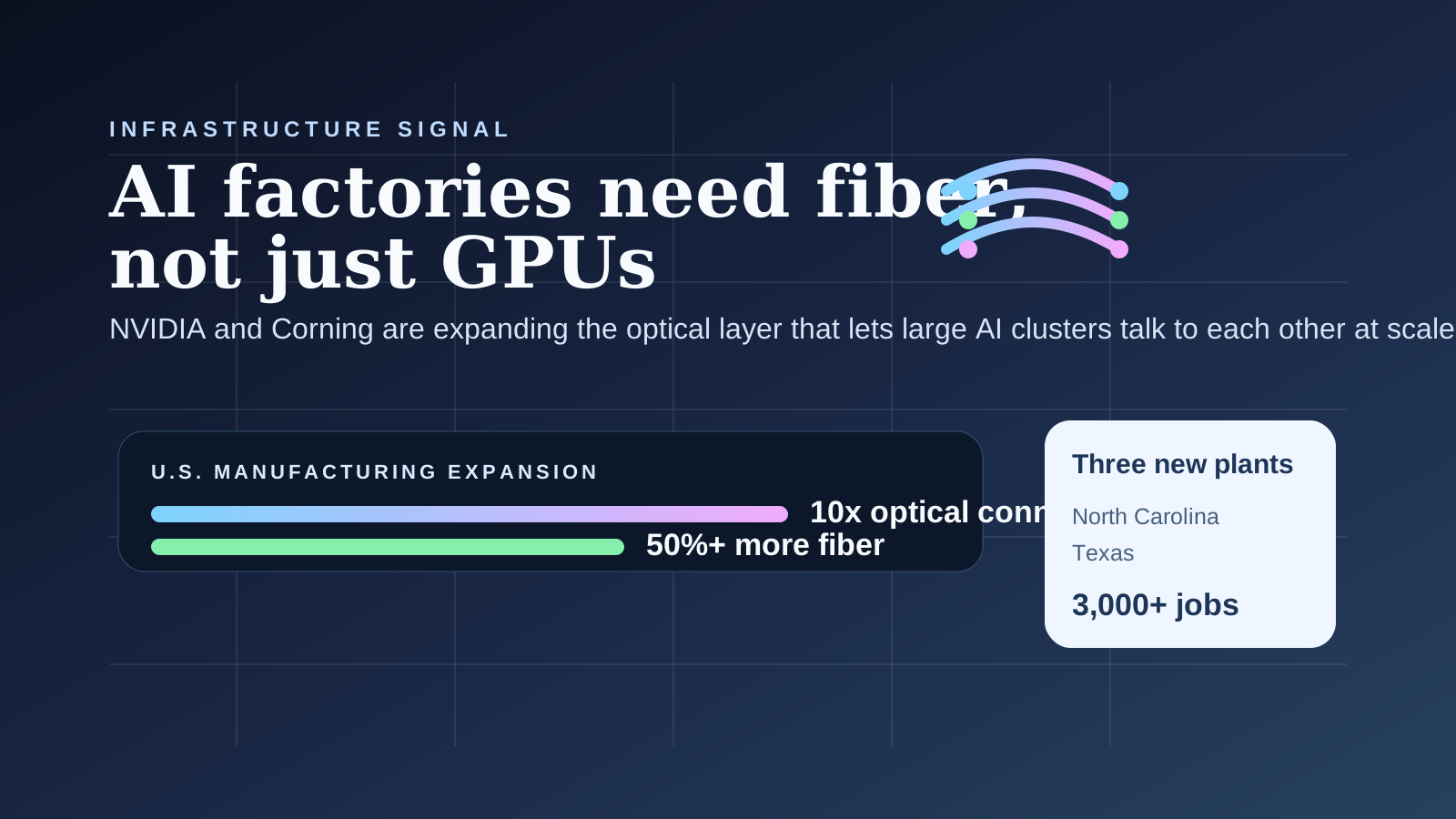
Where Corning fits in the AI infrastructure stack
The deal matters because it makes networking materials and optical manufacturing visible as one more scaling constraint in the AI factory buildout.
Optical-layer signals
| Constraint layer | What this deal changes | Why it matters |
|---|---|---|
| GPU-to-GPU communication | More optical connectivity capacity | Large AI clusters only scale when networking throughput keeps up with compute density. |
| Supply-chain geography | More U.S.-based manufacturing | Domestic production reduces some concentration risk in a fast-scaling infrastructure stack. |
| Industrial exposure | Corning becomes a clearer AI infrastructure name | The AI capex story is extending beyond chips and data-center landlords into materials and optics. |
Sources: Corning and NVIDIA press releases cited in this article.
NVIDIA and Corning’s new partnership is worth publishing because it shifts the AI infrastructure story deeper into the stack. Most of the market still talks about GPUs, megawatts, and campuses. Corning’s announcement makes a different constraint visible: the optical layer that lets large clusters move data at the speed and scale AI factories require.
The disclosed expansion is material. Corning says it will increase its U.S.-based optical connectivity manufacturing capacity by 10x and its U.S. fiber production capacity by more than 50 percent. The company also says the buildout includes three new advanced manufacturing facilities in North Carolina and Texas and more than 3,000 high-paying jobs. NVIDIA’s framing is direct: modern AI workloads require unprecedented volumes of high-performance optical fiber, connectivity, and photonics to connect large numbers of GPUs at scale.
The AI factory buildout is no longer just a GPU and power story. NVIDIA and Corning are showing that the optical layer is now a strategic manufacturing bottleneck too.
The original Grid Report angle is that AI infrastructure bottlenecks are moving beyond chips and power into manufacturing throughput for networking materials. GPU availability still matters, but once AI clusters get larger, the quality and quantity of the interconnect layer becomes a first-order deployment issue. If the optical layer cannot scale, then more compute does not automatically turn into usable system capacity.
That is what makes this different from the AMD packaging article, the Modine cooling piece, and the SoftBank prefab-power story. Those were all about separate choke points in the physical AI stack. Corning adds another one: fiber, photonics, and optical connectivity manufacturing are now important enough that NVIDIA is explicitly helping scale domestic supply.
For operators and developers, this matters because the AI factory is a systems problem. Compute density only works if power, cooling, networking, and rack-to-rack communication all scale together. A campus can secure GPUs and still miss schedule or underperform if the optical infrastructure is delayed, constrained, or too dependent on a thin manufacturing base.
For investors, the signal broadens the list of AI infrastructure beneficiaries. The most obvious trade has been semiconductors. Corning suggests the market should also watch materials science, optical components, and U.S.-based advanced manufacturing names that sit behind high-performance networking and cluster deployment. The AI capex story keeps pulling in more of the industrial base.
For industrial policy and regional development, the domestic footprint matters too. Three new plants and a large capacity expansion say AI infrastructure is no longer only about software leadership or cloud capex. It is also about whether the United States can physically manufacture the less glamorous but essential components that keep large AI systems operating.
The reason to publish this now is that it is specific, search-worthy, and clearly more useful than a generic rewrite of another NVIDIA partnership. The real story is not “NVIDIA teams up with Corning.” It is that the optical layer has now become visible enough to earn its own manufacturing surge inside the AI buildout.
Sources
Corning, “NVIDIA and Corning Announce Long-Term Partnership To Strengthen U.S. Manufacturing for AI Infrastructure,” published May 6, 2026: https://investor.corning.com/news-and-events/news/news-details/2026/NVIDIA-and-Corning-Announce-Long-Term-Partnership-To-Strengthen-U-S--Manufacturing-for-AI-Infrastructure/default.aspx
NVIDIA Newsroom, “NVIDIA and Corning Announce Long-Term Partnership to Strengthen US Manufacturing for AI Infrastructure,” published May 6, 2026: https://nvidianews.nvidia.com/news/nvidia-and-corning-announce-long-term-partnership-to-strengthen-us-manufacturing-for-ai-infrastructure
Nawaz Lalani
Nawaz Lalani is the creator of The Grid Report and writes about AI infrastructure, grid power demand, automation systems, and the market signals shaping the physical AI economy. His focus is translating technical and industrial shifts into practical coverage for operators, investors, builders, and teams making real deployment decisions.
B.S. in Geology from UT Arlington. Covers AI infrastructure, energy systems, grid constraints, automation workflows, and market signals.
Stories are built from primary sources, utility and infrastructure signals, company disclosures, filings, and operator-grade context. The goal is to explain what changed, why it matters now, and what it means for builders, investors, utilities, and teams making real deployment decisions.
Follow the lane, not just the headline.
The strongest value in The Grid Report comes from following how AI, infrastructure, power, automation, and markets connect over time.