- Google’s June 15 Alabama expansion clears the bar because it makes a fuzzy national debate more concrete.
- The original angle is not that Google is adding another campus.
- That matters because the real political risk around AI campuses is usually not the server hall.
- Section
- Policy
- Read time
- 4 min read
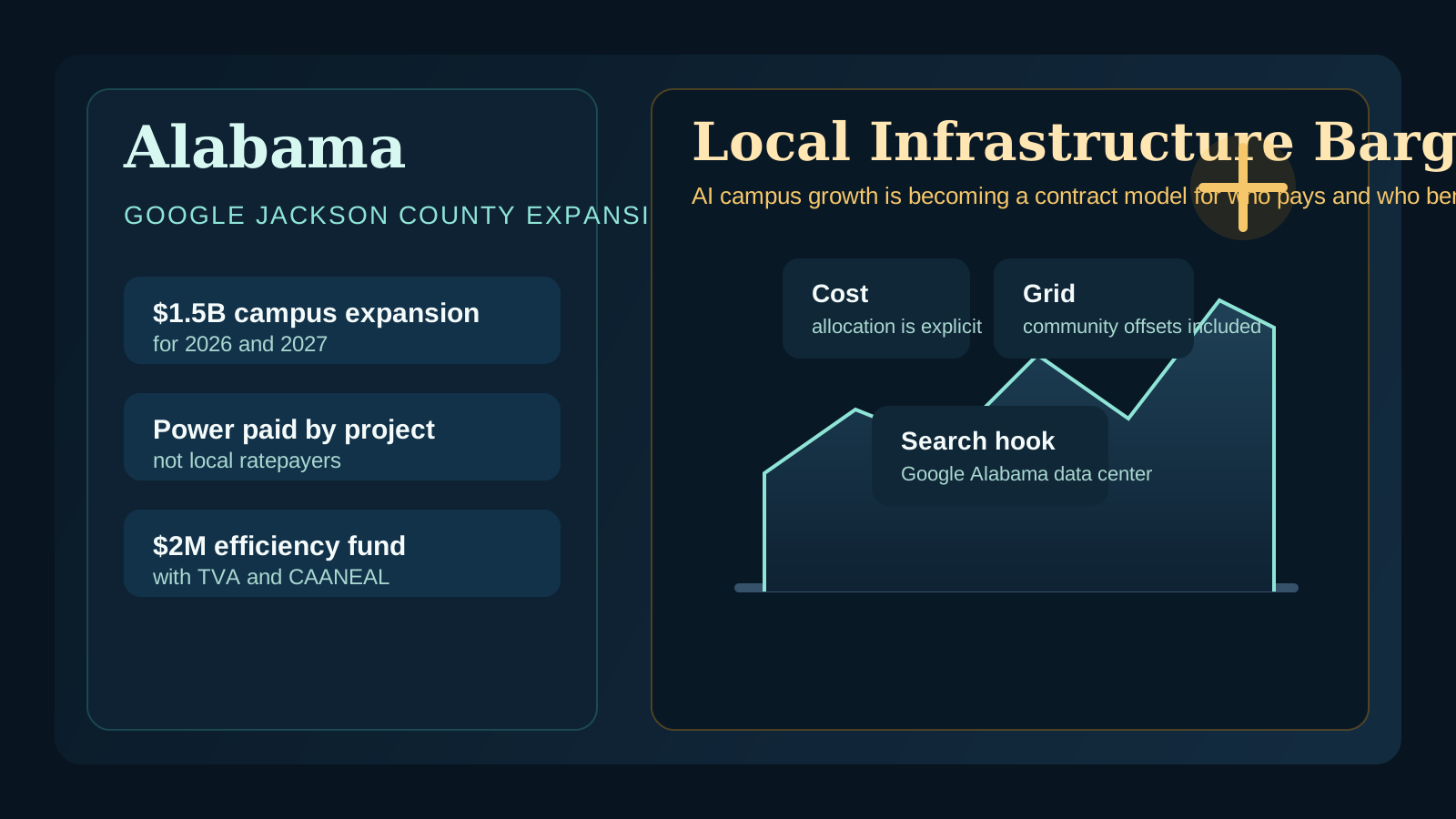
Google’s June 15 Alabama expansion clears the bar because it makes a fuzzy national debate more concrete. The company says it will invest $1.5 billion in 2026 and 2027 to expand its Jackson County data-center campus, fund 100% of its own power and infrastructure costs, and pair the expansion with a $2 million Energy Impact Fund for local efficiency and weatherization work. That is more useful than a generic “AI needs power” headline because it shows what a local political bargain can actually look like when a hyperscaler wants more electricity.
The original angle is not that Google is adding another campus. It is that the White House ratepayer-protection language is starting to turn into a site-level operating template. In March, Google said it supported the pledge and committed to paying for 100% of the power its data centers use and any new infrastructure costs directly driven by its growth. The Alabama announcement is one of the clearest local examples yet of that promise being translated into a public expansion narrative with named dollars, explicit cost responsibility, and a small but visible community offset.
The next AI-campus fights are not only about megawatts. They are about whether developers can make the local cost-and-benefit bargain legible before the rate case begins.
That matters because the real political risk around AI campuses is usually not the server hall. It is the fear that a large new load will show up first as a quiet utility obligation and later as a household or small-business rate fight. Google is trying to pre-answer that objection. By saying the company will fund its own power and infrastructure costs, it is attempting to separate project economics from the general rate base before the expansion becomes a broader public argument.
The Jackson County details also matter symbolically. Google says the campus has operated since 2019 on a repurposed former coal-plant site. That turns the story into more than another hyperscale land grab. The company is framing the expansion as industrial reuse tied to a local energy-and-jobs package: direct campus spending, project-paid infrastructure, efficiency funding with TVA and CAANEAL, and additional STEM support for area schools.
For operators and policymakers, the useful takeaway is that large-load growth may become easier to defend when the contract logic is explicit. The emerging model is not simply “bring jobs and trust us.” It is closer to: pay for the incremental infrastructure, show the local system benefit, add measurable community offsets, and make the cost-causation story legible early. If that formula holds, it could reduce friction for the next wave of AI-campus permitting fights.
The limitation is obvious. This is still Google describing its own arrangement, not a full regulatory docket showing exactly how every future asset and contingency would be treated under stress. A pledge is not the same as a tariff, and a corporate announcement is not the same as a commission order. Even so, the Alabama update is publishable because it moves the conversation from abstract principle toward a visible local template.
The stronger reading is that AI power politics are becoming a bargain-design problem. The projects most likely to move will not only be the ones with land and capital. They will be the ones that can show, in advance, who pays, who benefits, and why nearby customers should not feel trapped into subsidizing someone else’s load growth.
Sources
Google, “We’re strengthening our presence in Alabama through new investments and community support,” published June 15, 2026: https://blog.google/innovation-and-ai/infrastructure-and-cloud/global-network/alabama-investment-june-2026/
Google, “Supporting the White House Ratepayer Protection Pledge: Google’s approach for responsible energy growth,” published March 4, 2026: https://blog.google/innovation-and-ai/infrastructure-and-cloud/global-network/affordability-pledge-responsible-energy-growth/
By Nawaz Lalani
The Grid Report is written by Nawaz Lalani and focuses on source-backed coverage of AI infrastructure, grid power demand, automation systems, and market signals.
Follow the signal, not just the headline.
Get the daily Grid brief for source-backed coverage on AI power demand, infrastructure timing, automation, and market signals.