- One of the few unpublished systems stories that still clears the bar this week is DOE and Lawrence Livermore National Laboratory launching the Mjolnir AI Testbed for the energy sector.
- DOE says the Mjolnir platform is built so utilities, grid operators, vendors, and other qualified organizations can upload models and run adversarial tests against them.
- This clears the duplicate block for the site.
- Section
- AI Automation
- Read time
- 4 min read
One of the few unpublished systems stories that still clears the bar this week is DOE and Lawrence Livermore National Laboratory launching the Mjolnir AI Testbed for the energy sector. The story is worth publishing because it is not another vague claim that utilities should use AI. The official signal is more concrete: if AI is going to touch grid operations, planning, and management, it needs to be stress-tested as an operational system with failure modes, attack surfaces, and measurable robustness.
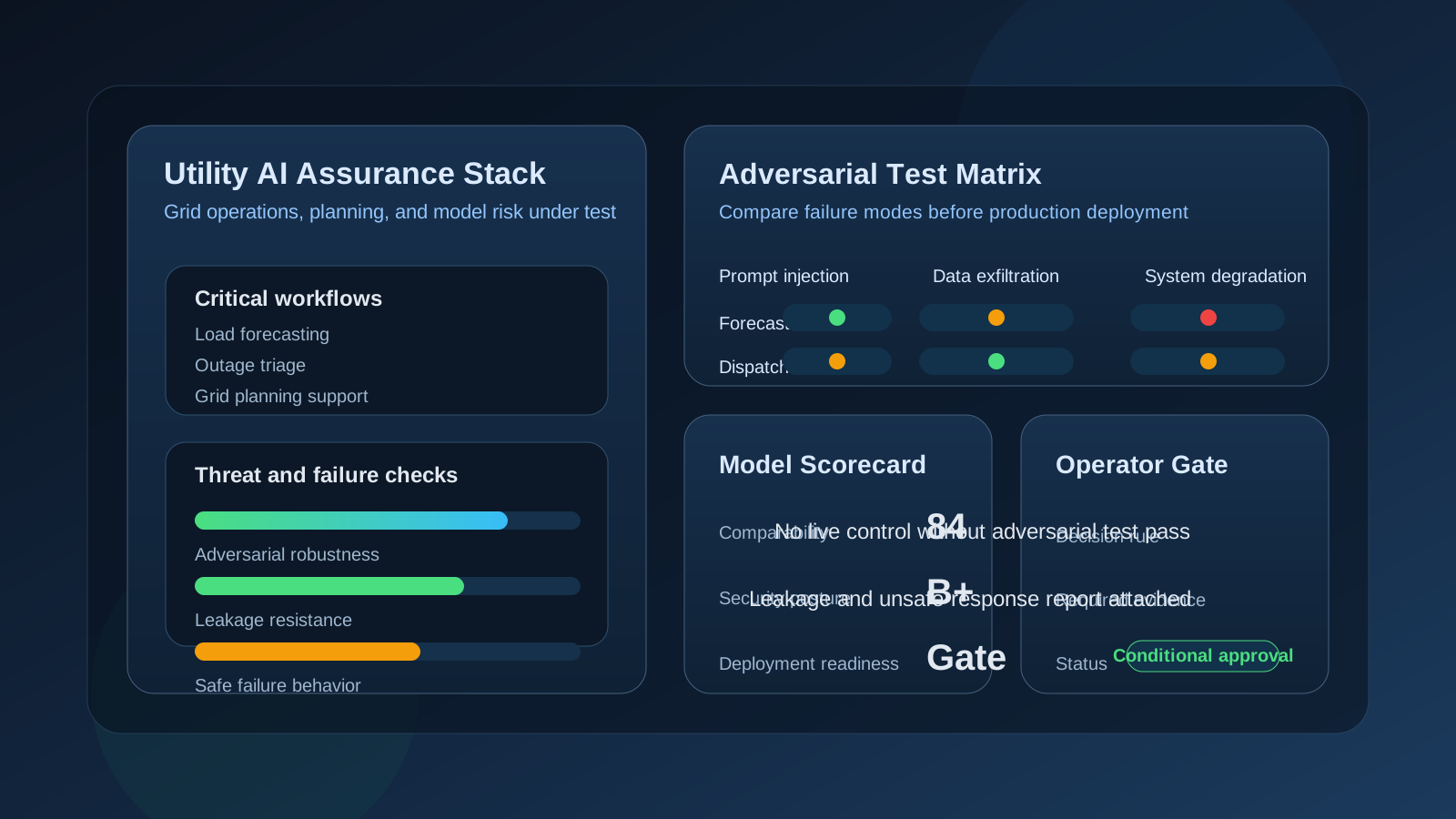
DOE says the Mjolnir platform is built so utilities, grid operators, vendors, and other qualified organizations can upload models and run adversarial tests against them. The stated purpose is to evaluate how likely a model is to behave unsafely, leak sensitive information, or degrade under failure and compromise. That matters because it shifts the adoption conversation away from demo quality and toward assurance discipline. In this framing, AI is not production-ready because it sounds useful. It becomes production-ready only when operators can compare models, quantify model risk, and understand how brittle the system is before it reaches critical workflows.
Utility AI is moving out of the demo phase and into an assurance phase where robustness, leakage risk, and adversarial resilience have to be measured before operators trust the model.
This clears the duplicate block for the site. The Grid Report has already covered enterprise deployment services, workspace agents, and user-control trends. This article is materially different because it is about energy-sector model assurance as its own operating layer. The useful question is not only whether a utility can automate a workflow. It is whether the organization has a defensible way to test, compare, and govern AI models before those models inform planning decisions or touch high-consequence systems.
For operators, the implication is practical. Utility AI programs are likely to split into two tracks: model capability and model trustworthiness. A model that improves forecasting or incident analysis still creates new failure and cybersecurity questions if no one can measure adversarial resilience, exception behavior, or data leakage risk. A shared testbed changes procurement and governance because it gives utilities and vendors a way to compare claims under a common evaluation frame instead of relying on vendor assurances alone.
For investors and infrastructure builders, the signal is that AI adoption in critical sectors may create a new market around model validation, red-teaming, assurance tooling, and compliance evidence. If the energy sector normalizes adversarial testing before operational rollout, similar assurance layers are likely to become more valuable across other regulated or safety-critical industries. That is a more durable and infrastructure-native angle than treating utility AI as a simple software upsell.
The Grid Report view is that this article is publishable because it has a hard official hook, a distinct thesis, and specific search value around the Mjolnir AI Testbed. The important shift is not that utilities want AI. It is that utility AI is starting to require its own assurance stack.
Sources
U.S. Department of Energy CESER, "CESER and Lawrence Livermore National Laboratory Launch AI Testbed to Strengthen the Energy Sector's AI Cybersecurity," April 14, 2026: https://www.energy.gov/ceser/articles/ceser-and-lawrence-livermore-national-laboratory-launch-ai-testbed-strengthen-energy
Lawrence Livermore National Laboratory, "Lab Report: April 24, 2026," including Mjolnir coverage, April 24, 2026: https://www.llnl.gov/news/lab-report/lab-report-april-24-2026
By Nawaz Lalani
The Grid Report is written by Nawaz Lalani and focuses on source-backed coverage of AI infrastructure, grid power demand, automation systems, and market signals.
Follow the signal, not just the headline.
Get the daily Grid brief for source-backed coverage on AI power demand, infrastructure timing, automation, and market signals.