- The strongest signal in Dell's May 18 PowerRack launch is not that Dell introduced another piece of AI hardware.
- Dell's main launch release frames this directly.
- That sounds like vendor packaging language until you connect it to the deployment problem.
- Section
- Infrastructure
- Read time
- 7 min read
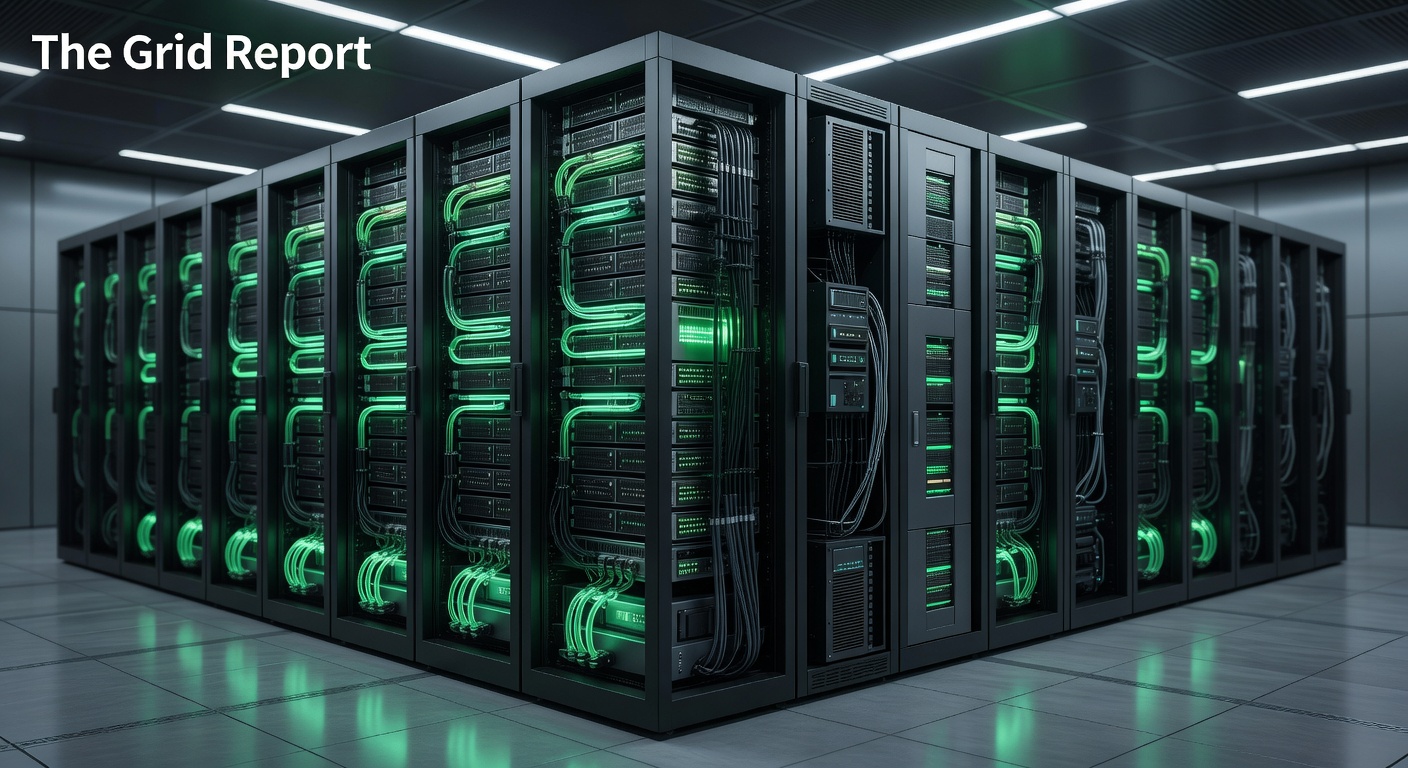
The strongest signal in Dell's May 18 PowerRack launch is not that Dell introduced another piece of AI hardware. It is that Dell is arguing the deployable product is now the rack itself. That matters because the next AI infrastructure bottleneck is increasingly not just GPU supply. It is the schedule risk, cooling complexity, and integration work that sit around the accelerators before a customer can actually turn capacity into revenue.
Dell's main launch release frames this directly. The company says the Dell AI Factory with NVIDIA now has more than 5,000 customers and is adding PowerRack as part of a push to move enterprise AI from experiment to production. The relevant detail is how Dell defines the offer: compute, networking, and storage engineered as one system, with thermal design, power management, and software optimization built together from the start rather than assembled piecemeal on-site.
Dell is trying to turn AI deployment certainty into a product by selling the rack, not just the boxes inside it.
That sounds like vendor packaging language until you connect it to the deployment problem. The PowerRack launch post says operators trying to source compute, networking, storage, and cooling separately are taking on real performance, power, and schedule risk at rack scale. Dell's answer is to shift that work upstream into factory validation. It says fully integrated racks can arrive ready to run in a little over six hours and that structured deployment services can accelerate time-to-value by 84% compared with self-assembly. Even if those claims should be read critically, the underlying market point is real: integration time is becoming part of AI capacity economics.
This is why PowerRack deserves an infrastructure slot instead of a generic product-announce treatment. The scarce asset in AI buildout is no longer only silicon. It is the ability to stand up dense capacity with predictable cooling, predictable networking behavior, and fewer surprise delays once equipment reaches the floor. Dell is effectively pitching rack-scale integration as a way to convert capex into usable capacity faster, which makes the offer more relevant to operators than another spec-sheet race.
Cooling is the other reason this is worth publishing. Dell pairs the PowerRack push with the PowerCool CDU C7000, which it says can deliver 220 kilowatts of cooling in a compact 4U form factor and support future NVIDIA Vera Rubin NVL72 systems. That matters because AI infrastructure competition is increasingly constrained by whether power and thermal systems can keep pace with denser racks. In practice, a rack that arrives with integrated cooling assumptions is a different product from a rack that still leaves thermal coordination to the customer and the facility team.
The broader Dell launch also makes clear that this is not only a hyperscaler story. The company is bundling PowerRack with data orchestration, deskside agentic AI systems, enterprise search, and on-prem partner integrations including OpenAI Codex. That combination suggests the new infrastructure sale is not just raw compute. It is a claim that enterprises want a controlled path from local data to governed agents to dense back-end capacity, all on systems they can own and operate.
For operators, the useful read is that rack integration is becoming part of procurement strategy. For investors, the more interesting question is whether OEMs that can deliver pre-validated rack systems gain leverage over vendors still selling a looser bill of materials. For the market as a whole, the PowerRack push is a reminder that AI infrastructure competition is moving up one level of abstraction. The fight is no longer only over the best chip. It is increasingly over who can ship the cleanest path from power, cooling, and networking design to live workloads.
The Grid Report view is that Dell is trying to productize deployment certainty. If that framing holds, rack-scale integration becomes more than an operational convenience. It becomes a real competitive layer in the AI infrastructure stack, especially for enterprises and neo-cloud operators that cannot afford to discover integration problems after the equipment shows up.
Sources
Dell Technologies, “Dell Technologies Closes the Gap Between AI Ambition and AI Outcomes,” May 18, 2026: https://www.dell.com/en-us/dt/corporate/newsroom/announcements/detailpage.press-releases~usa~2026~05~dell-technologies-closes-the-gap-between-ai-ambition-and-ai-outcomes.htm
Dell, “Dell PowerRack Transforms AI Infrastructure with Scalable Compute, Networking and Storage,” May 18, 2026: https://www.dell.com/en-us/blog/dell-powerrack-transforms-ai-infrastructure-with-scalable-compute-networking-storage/
Dell, “Dell Technologies World: A Bright and Beautiful Road Ahead,” May 18, 2026: https://www.dell.com/en-us/blog/dell-technologies-world-a-bright-and-beautiful-road-ahead/
By Nawaz Lalani
The Grid Report is written by Nawaz Lalani and focuses on source-backed coverage of AI infrastructure, grid power demand, automation systems, and market signals.
Follow the signal, not just the headline.
Get the daily Grid brief for source-backed coverage on AI power demand, infrastructure timing, automation, and market signals.