- AMD’s latest infrastructure announcement matters because it names the bottleneck more clearly than most chip-company press releases do.
- The release is explicit about that constraint.
- That is why the company’s mention of Helios is so useful.
- Section
- Infrastructure
- Read time
- 7 min read
- Why this page exists
- The Grid Report publishes operator-grade coverage on AI, power, infrastructure, automation, and markets.
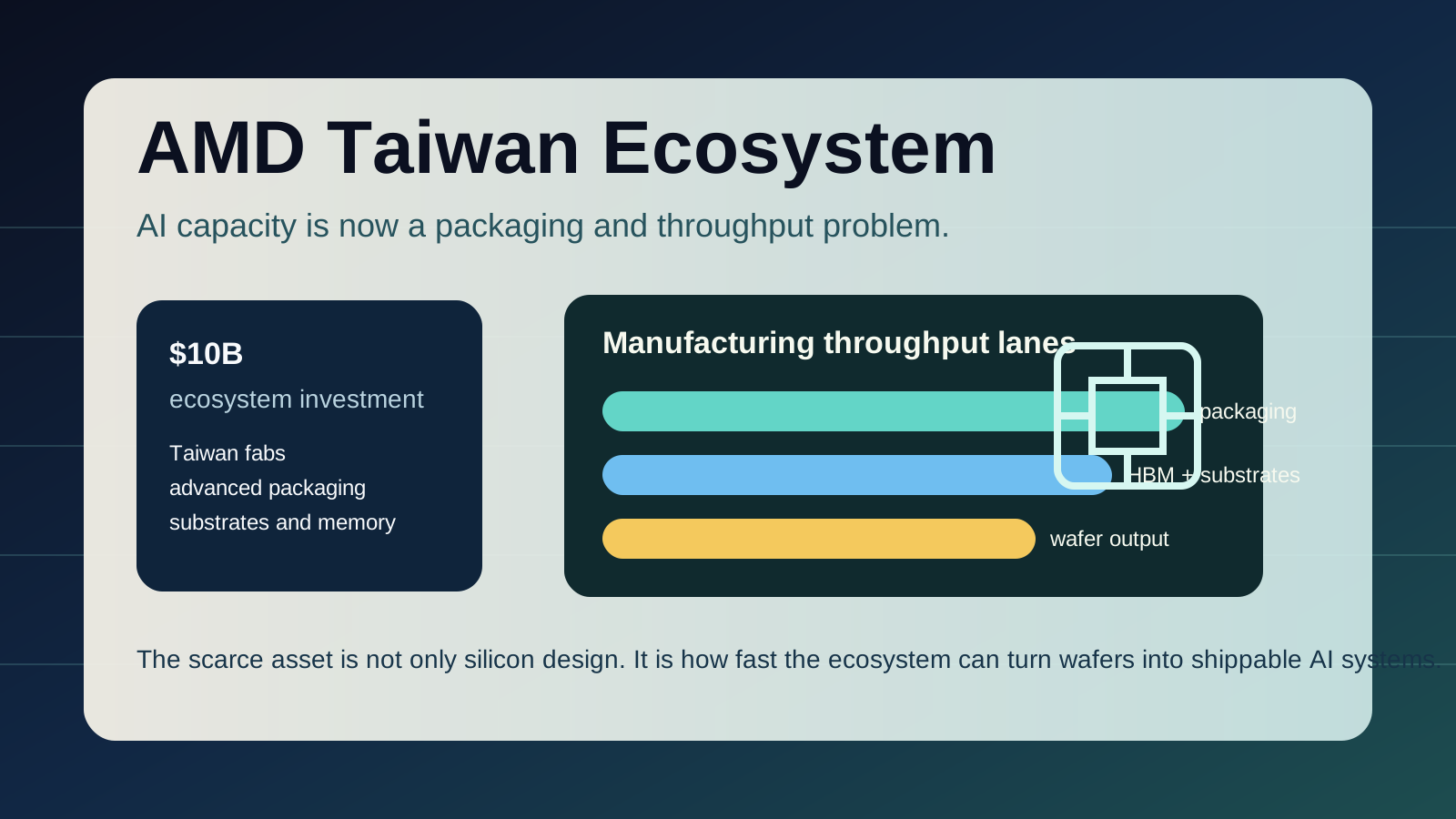
AMD’s latest infrastructure announcement matters because it names the bottleneck more clearly than most chip-company press releases do. On May 21, 2026, AMD said it would invest more than $10 billion across the Taiwan ecosystem to expand strategic partnerships and scale advanced packaging manufacturing for next-generation AI infrastructure. The easy reading is that this is another big AI-capex number. The better reading is that AMD is telling the market where capacity is really constrained.
The release is explicit about that constraint. AMD says the program is meant to advance silicon, packaging, and manufacturing technologies needed to ship AI systems at scale, including Elevated Fanout Bridge, or EFB, based 2.5D packaging, panel-based interconnect work with PTI, and ecosystem support from ASE and SPIL. Those details matter because the scarce asset is no longer just wafer starts or headline GPU demand. It is the ecosystem throughput required to package, connect, and deliver high-performance systems quickly enough for customers that want to deploy at hyperscale speed.
The real AI capacity bottleneck is increasingly not a roadmap slide. It is whether the packaging and manufacturing stack can turn chips into shippable systems fast enough.
That is why the company’s mention of Helios is so useful. AMD says its Helios rack-scale platform, combining 6th Gen EPYC “Venice” CPUs, Instinct MI450X GPUs, advanced networking, and ROCm software, remains on track for multi-gigawatt deployments beginning in the second half of 2026. Multi-gigawatt AI deployment is not something chip design alone can unlock. It depends on whether packaging, memory integration, substrates, thermal constraints, and manufacturing handoffs can all move fast enough together.
For operators and investors, the implication is that “compute capacity” is increasingly an ecosystem product. The market often talks as if capacity arrives when a chip roadmap arrives. In practice, capacity arrives when advanced packaging lines, HBM integration, interconnect yield, and ODM manufacturing all line up on time. AMD’s Taiwan push is a reminder that the next competitive edge in AI infrastructure may come from manufacturing choreography as much as from model performance or silicon specs.
There is also a geographic signal here. Taiwan already sits at the center of advanced semiconductor manufacturing, but AMD is making the relationship more explicit by tying AI-system deployment to local packaging and manufacturing partnerships. That means geopolitical concentration risk does not disappear just because more companies enter the AI accelerator race. If anything, it becomes more visible at the packaging layer.
This is also why the announcement is more relevant than a standard supplier update. AMD is effectively arguing that the packaging stack deserves to be treated as strategic infrastructure. If AI customers are planning around rack-scale deployments measured in gigawatts, then the upstream question is not simply how many chips exist. It is whether the ecosystem can turn those chips into installed systems with acceptable power, thermal, and economic characteristics.
The Grid Report view is that AMD’s Taiwan announcement should be read as a supply-chain truth serum for the AI buildout. The scarce thing is not abstract “AI demand.” It is the real industrial throughput needed to convert designs into operating compute clusters.
Sources
AMD, “AMD Announces More Than $10 Billion in Taiwan Ecosystem Investments to Accelerate AI Infrastructure,” published May 21, 2026: https://ir.amd.com/news-events/press-releases/detail/1286/amd-announces-more-than-10-billion-in-taiwan-ecosystem-investments-to-accelerate-ai-infrastructure
AMD, “AMD Announces More Than $10 Billion in Taiwan Ecosystem Investments to Accelerate AI Infrastructure,” published May 21, 2026: https://www.amd.com/en/newsroom/press-releases/2026-5-20-amd-announces-more-than-10-billion-in-taiwan-ecos.html
Nawaz Lalani
Nawaz Lalani is the creator of The Grid Report and writes about AI infrastructure, grid power demand, automation systems, and the market signals shaping the physical AI economy. His focus is translating technical and industrial shifts into practical coverage for operators, investors, builders, and teams making real deployment decisions.
B.S. in Geology from UT Arlington. Covers AI infrastructure, energy systems, grid constraints, automation workflows, and market signals.
Stories are built from primary sources, utility and infrastructure signals, company disclosures, filings, and operator-grade context. The goal is to explain what changed, why it matters now, and what it means for builders, investors, utilities, and teams making real deployment decisions.
Follow the lane, not just the headline.
The strongest value in The Grid Report comes from following how AI, infrastructure, power, automation, and markets connect over time.