- Workday and Google Cloud’s expanded partnership is worth publishing because it puts agent interoperability inside a part of enterprise software that actually matters: HR and finance systems where approvals, policy checks, payroll inputs, and employee actions already live.
- The announced package is specific.
- The original Grid Report angle is that agent standards are moving into operational software, not just developer tooling.
- Section
- AI Automation
- Read time
- 6 min read
- Why this page exists
- The Grid Report publishes operator-grade coverage on AI, power, infrastructure, automation, and markets.
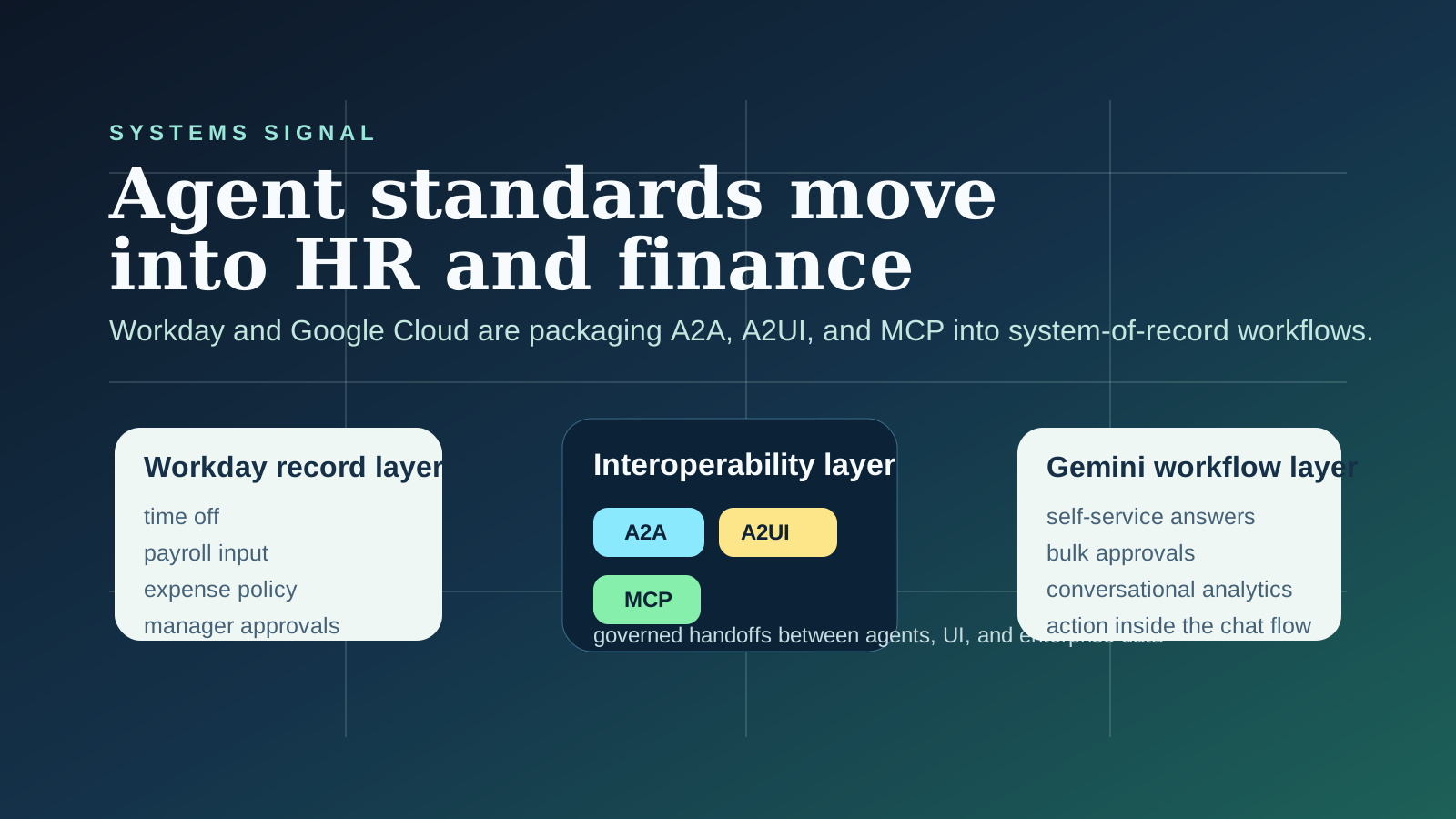
Why this Workday-Google move matters more than a generic enterprise AI integration
The important change is where interoperability lands: inside system-of-record software with built-in policy, identity, approvals, and workflow ownership.
Enterprise control points
| Layer | What Workday and Google are adding | Why it matters |
|---|---|---|
| Conversational surface | Sana Self-Service Agent inside Gemini Enterprise | Keeps the user in one interface while the agent calls the workflow behind it. |
| Model layer | Gemini as the default model for Sana for Workday | Improves reasoning and multimodal support without changing the core business workflow system. |
| Data layer | Zero-copy connection between Workday Data Cloud and Google Cloud Lakehouse | Reduces data-movement friction while preserving permissions and policy boundaries. |
| Action layer | A2A, A2UI, and MCP support | Turns agent usefulness into a governed handoff problem, not only a chat problem. |
Source: Workday press release and linked product materials cited in this article.
Workday and Google Cloud’s expanded partnership is worth publishing because it puts agent interoperability inside a part of enterprise software that actually matters: HR and finance systems where approvals, policy checks, payroll inputs, and employee actions already live. This is a more important signal than another generic AI-agent partnership because it moves the conversation from demo environments into system-of-record workflows.
The announced package is specific. Workday says its Sana Self-Service Agent is now available in Gemini Enterprise, Gemini becomes the default AI model for Sana for Workday, and the two companies will work on a next generation of Workday agents for HR and finance. The release also says the partnership supports Agent-to-Agent, Agent-to-UI, and Model Context Protocol approaches so agents can share information and hand off work inside a single workflow.
The important signal is not that Workday added another AI assistant. It is that agent interoperability is moving into software that already owns approvals, policies, and real business actions.
The original Grid Report angle is that agent standards are moving into operational software, not just developer tooling. There is already plenty of coverage about MCP in coding and tool-use contexts. What matters here is that Workday is pairing those interoperability methods with a system that already owns permissions, approval chains, policy logic, and sensitive people-and-money data. That is where agent handoffs begin to look less like experimentation and more like governed execution.
That is also why this differs from the Braintrust Codex rollout article and the OpenAI Deployment Company piece. Those stories were about feedback loops and workflow redesign around software delivery or frontier deployment services. Workday and Google Cloud are showing a different layer of the market: enterprise suites want agents to operate where employees already work, with governance and records attached from the start.
The most useful operator detail is the zero-copy data posture. Workday says the connection between Workday Data Cloud and Google Cloud Lakehouse lets customers combine Workday data with other business data without moving or duplicating it, while keeping permissions and business rules intact. For enterprises, that matters because a large share of agent projects fail not at model quality, but at data movement, access control, and approval design.
For software buyers, the practical question is no longer whether an agent can answer a policy question. It is whether the agent can answer it inside the right workflow, under the right permissions, and then take the next approved action without forcing the employee to jump across five different tools. That is the real enterprise product problem. Workday and Google Cloud are trying to solve it by combining the conversational surface, the workflow engine, and the record layer.
For the broader AI software market, this is a competitive signal. If agent orchestration, UI handoff, and tool/context standards become native inside large enterprise suites, then point solutions that only provide a chat layer or a narrow agent shell will face more pressure. The higher-value control point shifts toward whoever owns the approval chain, the data boundary, and the workflow handoff logic.
The reason to publish this now is that it is timely, specific, and useful for operators evaluating how agent software is maturing. The key signal is not “AI for HR.” It is that interoperability standards are moving into production business systems, where real leverage depends on policy-aware action rather than one more clever response box.
Sources
Workday, “Workday and Google Cloud Expand Strategic Partnership to Bring AI Agents for HR and Finance Into Employees’ Daily Workflows,” published May 28, 2026: https://newsroom.workday.com/2026-05-28-Workday-and-Google-Cloud-Expand-Strategic-Partnership-to-Bring-AI-Agents-for-HR-and-Finance-Into-Employees-Daily-Workflows
Google Cloud, “Agent Marketplace,” accessed May 31, 2026: https://console.cloud.google.com/agent-marketplace
Nawaz Lalani
Nawaz Lalani is the creator of The Grid Report and writes about AI infrastructure, grid power demand, automation systems, and the market signals shaping the physical AI economy. His focus is translating technical and industrial shifts into practical coverage for operators, investors, builders, and teams making real deployment decisions.
B.S. in Geology from UT Arlington. Covers AI infrastructure, energy systems, grid constraints, automation workflows, and market signals.
Stories are built from primary sources, utility and infrastructure signals, company disclosures, filings, and operator-grade context. The goal is to explain what changed, why it matters now, and what it means for builders, investors, utilities, and teams making real deployment decisions.
Follow the lane, not just the headline.
The strongest value in The Grid Report comes from following how AI, infrastructure, power, automation, and markets connect over time.