- The June 2 White House executive order is worth publishing because the useful signal is not simply that Washington wants more visibility into advanced AI.
- That matters because most AI-policy coverage still treats model release as a public-policy question after the product is already formed.
- That is the original Grid Report angle.
- Section
- AI
- Read time
- 5 min read
- Why this page exists
- The Grid Report publishes operator-grade coverage on AI, power, infrastructure, automation, and markets.
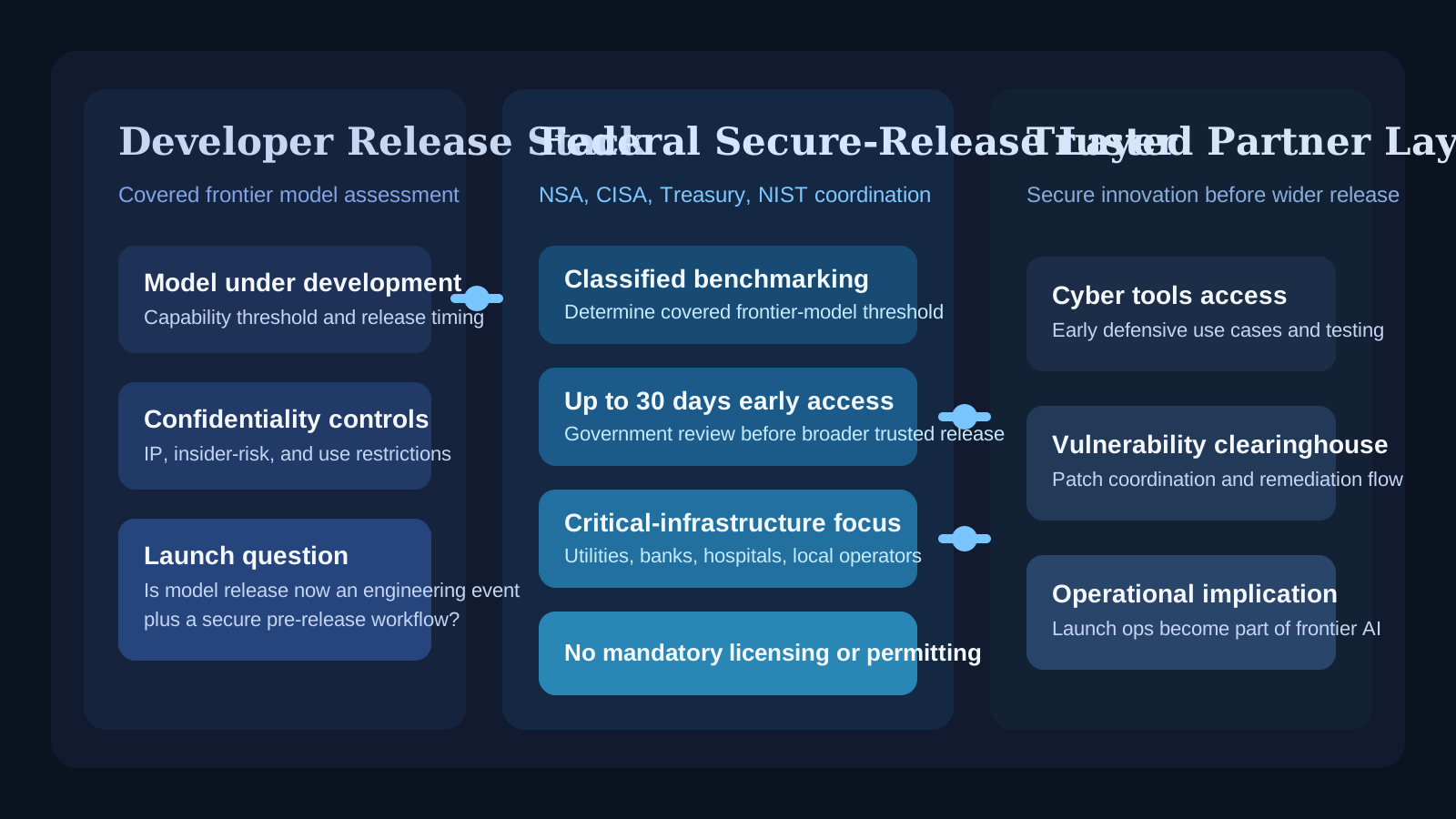
The June 2 White House executive order is worth publishing because the useful signal is not simply that Washington wants more visibility into advanced AI. The stronger signal is operational. The order tries to turn the release of the most capable models into a defined secure-launch workflow with threshold testing, confidentiality rules, early government access, and trusted-partner coordination before wider deployment.
That matters because most AI-policy coverage still treats model release as a public-policy question after the product is already formed. The order reframes it as a release-operations question upstream. In the text, the administration tells agencies to create a classified benchmarking process that determines when a model qualifies as a “covered frontier model,” then build a voluntary framework through which developers could provide the government with access to those models for up to 30 days before broader release to trusted partners.
The useful policy question is no longer only who regulates frontier AI. It is who gets early access, under what protections, and how much secure-release machinery now sits inside the launch itself.
That is the original Grid Report angle. Once early access, benchmarking, and partner selection sit inside the same release motion, frontier AI stops looking like a normal software launch. It starts looking more like a secure-deployment pipeline where product, security, policy, and critical-infrastructure readiness converge before a model reaches the wider market.
The critical-infrastructure language is what makes this more than a Beltway process story. The order says Homeland Security, through CISA, should facilitate access to AI-enabled cybersecurity tools for state and local authorities and for critical-infrastructure operators including rural hospitals, community banks, and local utilities. The accompanying fact sheet also calls for an AI cybersecurity clearinghouse that would coordinate vulnerability discovery and remediation with industry and infrastructure operators. That means the intended early users are not only federal reviewers. They are also organizations expected to defend real systems.
This clears the duplicate block against recent Grid Report coverage. The Anthropic containment story was about blast-radius engineering inside agent systems. The OpenAI AWS article was about enterprise procurement approval. The OpenAI DeployCo article was about workflow redesign services. This story is different. It is about how the launch process for top-tier models itself may become a controlled infrastructure-adjacent workflow.
For model developers, the implication is not necessarily a slower release cycle. The order explicitly says it should not be construed as mandatory licensing, preclearance, or permitting. The more practical implication is that labs may increasingly need secure staging environments, more formal model-threshold decisions, tighter confidentiality controls, and a clearer trusted-partner map before releasing their strongest systems.
For operators and enterprise buyers, the read-through is that frontier AI access may become more segmented. The first useful question may no longer be whether a model exists, but whether it has moved through a secure review path and which counterparties were trusted to handle it early. That changes how critical-infrastructure customers, cyber vendors, and regulated industries may evaluate “production-ready” AI.
For policymakers, the order suggests the federal government is trying to gain earlier visibility without taking on the legal and political baggage of explicit model licensing. That is a narrower move than a broad AI rulebook, but potentially more consequential for the top end of the market because it reaches directly into launch timing, partner selection, and secure deployment practice.
The reason to publish this now is that the order gives operators a sharper framework for what frontier-model governance may actually look like in practice. The future fight may not be over whether advanced models are regulated in the abstract. It may be over who gets early access, under what protections, and how much secure-release machinery becomes normal before the most capable systems go live.
Sources
The White House, “Promoting Advanced Artificial Intelligence Innovation and Security,” published June 2, 2026: https://www.whitehouse.gov/presidential-actions/2026/06/promoting-advanced-artificial-intelligence-innovation-and-security/
The White House, “Fact Sheet: President Donald J. Trump Promotes Advanced Artificial Intelligence Innovation and Security,” published June 2, 2026: https://www.whitehouse.gov/fact-sheets/2026/06/fact-sheet-president-donald-j-trump-promotes-advanced-artificial-intelligence-innovation-and-security/
Nawaz Lalani
Nawaz Lalani is the creator of The Grid Report and writes about AI infrastructure, grid power demand, automation systems, and the market signals shaping the physical AI economy. His focus is translating technical and industrial shifts into practical coverage for operators, investors, builders, and teams making real deployment decisions.
B.S. in Geology from UT Arlington. Covers AI infrastructure, energy systems, grid constraints, automation workflows, and market signals.
Stories are built from primary sources, utility and infrastructure signals, company disclosures, filings, and operator-grade context. The goal is to explain what changed, why it matters now, and what it means for builders, investors, utilities, and teams making real deployment decisions.
Follow the lane, not just the headline.
The strongest value in The Grid Report comes from following how AI, infrastructure, power, automation, and markets connect over time.