- OpenAI’s May 22 post about being named a Leader in Gartner’s Magic Quadrant for enterprise AI coding agents is useful only if you read past the ranking language.
- Cisco is the part that matters most for operators.
- That is why the Gartner post is more meaningful than a normal analyst-ranking item.
- Section
- AI Automation
- Read time
- 6 min read
- Why this page exists
- The Grid Report publishes operator-grade coverage on AI, power, infrastructure, automation, and markets.
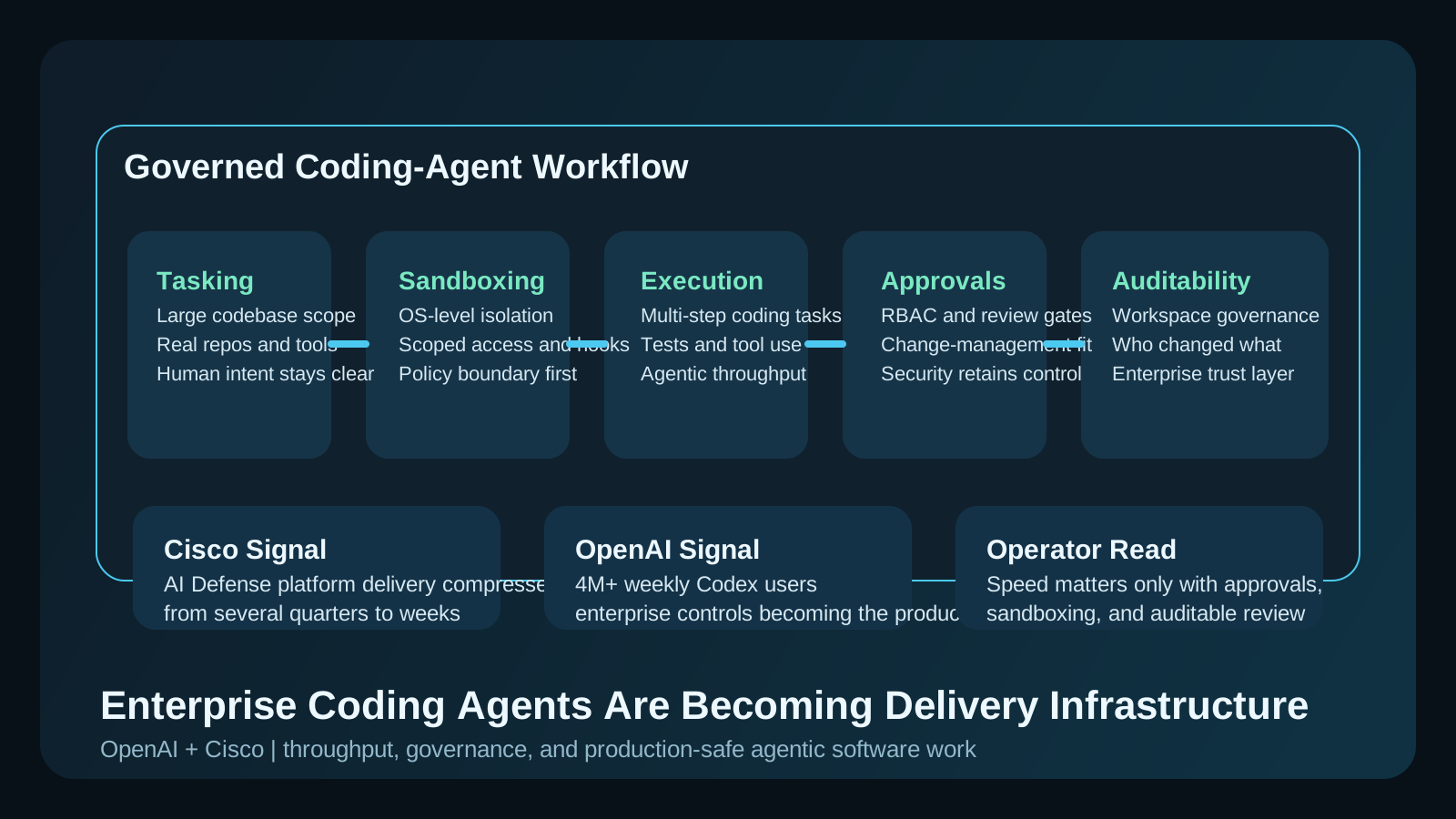
OpenAI’s May 22 post about being named a Leader in Gartner’s Magic Quadrant for enterprise AI coding agents is useful only if you read past the ranking language. The real signal is operational: OpenAI says Codex is used by more than 4 million people each week, and it points to Cisco as a case where the product helped build the majority of Cisco’s AI Defense platform while shortening delivery time from several quarters to weeks. That turns the story from software marketing into a real enterprise throughput claim.
Cisco is the part that matters most for operators. In OpenAI’s earlier January 20 write-up, Cisco was described as using Codex inside complex multi-repository and C/C++-heavy environments with enterprise security, compliance, and governance requirements. That is a harder proving ground than a greenfield demo or a startup codebase. If coding agents can hold up there, the useful question is no longer whether they can autocomplete faster. It is whether they can become a governed delivery layer for large organizations.
Coding agents become an enterprise product only when speed arrives with sandboxing, approvals, and auditability strong enough for real production work.
That is why the Gartner post is more meaningful than a normal analyst-ranking item. OpenAI emphasizes enterprise controls such as approval gates, RBAC, customizable policies, OS-level sandboxing, and auditable workspace governance. Those features are not side details. They are the commercial wrapper that lets an enterprise convert model capability into something a software organization can actually deploy without blowing up security review, compliance, or change management.
The better frame for this market is not “AI writes code now.” It is that software delivery is becoming agentic in a controlled way. Agents can take on larger tasks, operate over real repositories, use tools, run tests, and prepare work for human review. But the enterprise value only appears if management can see who approved what, what environment the agent touched, which policies applied, and how work moved through review. Speed without that control layer is just a new form of operational risk.
This also helps explain why enterprise coding agents are becoming a systems story rather than a pure model story. The buying decision is no longer only about benchmark capability. It is about product surface, workflow integration, security posture, policy controls, remote execution, and how easily the agent can fit into an organization’s existing delivery machinery. In other words, the system around the model is becoming the product.
For teams evaluating this category, Cisco’s example offers a sharper benchmark than generic productivity claims. A serious deployment should be able to operate inside large codebases, shorten cycle time on meaningful engineering work, and still preserve auditability and governance. That is a much higher standard than saving a few minutes in an IDE, but it is also where real operating leverage begins.
The Grid Report view is that enterprise coding agents are now crossing from novelty into delivery infrastructure. OpenAI’s Gartner result is not important because Gartner said so. It is important because the control stack around coding agents is maturing enough for large companies to treat them as a governed production system. If that continues, software organizations will increasingly compete on how well they orchestrate human engineers and agentic execution together.
Sources
OpenAI, “OpenAI named a Leader in enterprise coding agents by Gartner,” published May 22, 2026: https://openai.com/index/gartner-2026-agentic-coding-leader/
OpenAI, “Cisco and OpenAI redefine enterprise engineering with AI agents,” published January 20, 2026: https://openai.com/index/cisco
Nawaz Lalani
Nawaz Lalani is the creator of The Grid Report and writes about AI infrastructure, grid power demand, automation systems, and the market signals shaping the physical AI economy. His focus is translating technical and industrial shifts into practical coverage for operators, investors, builders, and teams making real deployment decisions.
B.S. in Geology from UT Arlington. Covers AI infrastructure, energy systems, grid constraints, automation workflows, and market signals.
Stories are built from primary sources, utility and infrastructure signals, company disclosures, filings, and operator-grade context. The goal is to explain what changed, why it matters now, and what it means for builders, investors, utilities, and teams making real deployment decisions.
Follow the lane, not just the headline.
The strongest value in The Grid Report comes from following how AI, infrastructure, power, automation, and markets connect over time.