- FuriosaAI’s new partnership with Broadcom deserves attention because it reframes what the next inference race is actually about.
- That matters because the workload is changing.
- Broadcom’s role is the key tell.
- Section
- Infrastructure
- Read time
- 6 min read
- Why this page exists
- The Grid Report publishes operator-grade coverage on AI, power, infrastructure, automation, and markets.
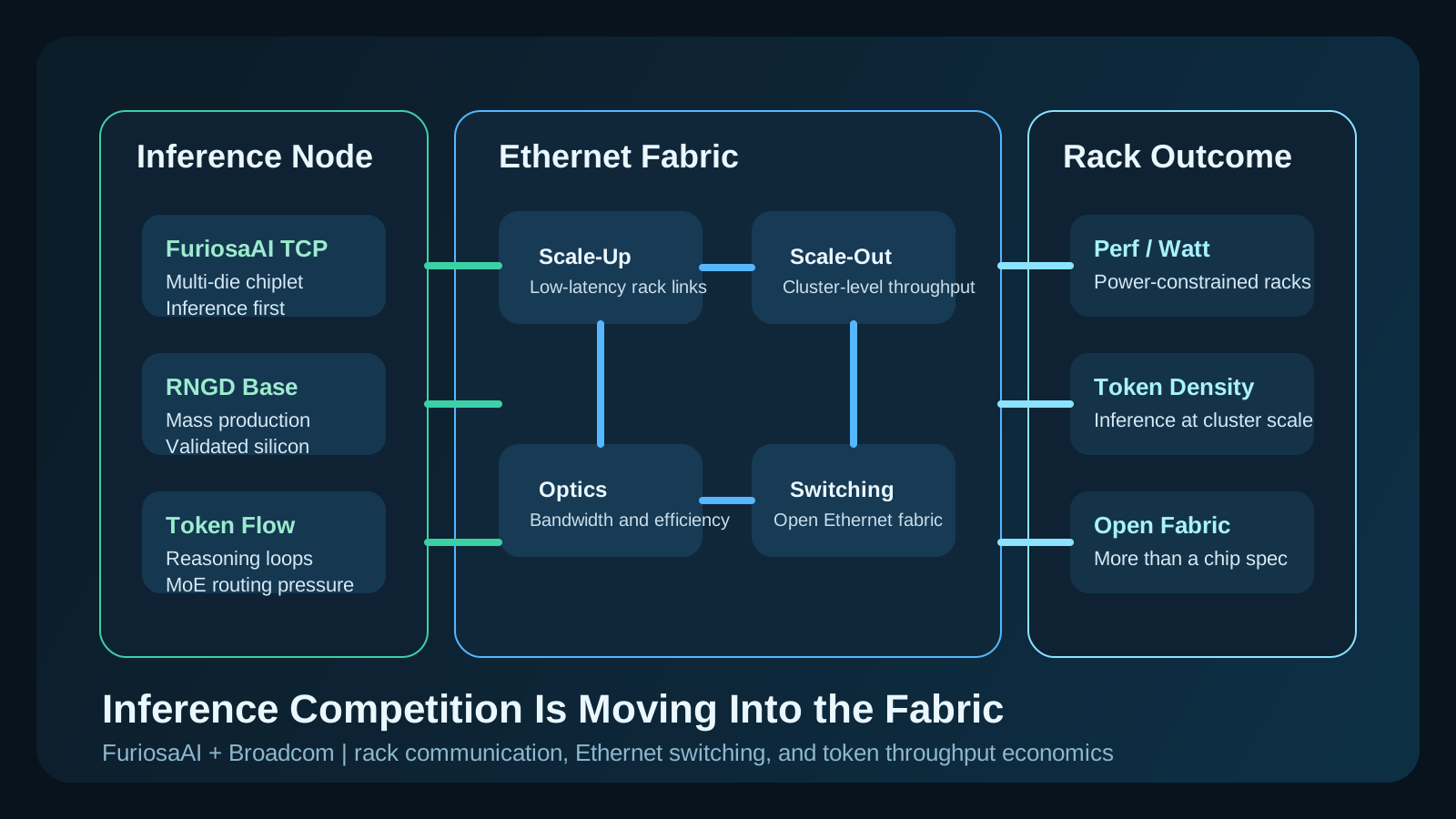
FuriosaAI’s new partnership with Broadcom deserves attention because it reframes what the next inference race is actually about. On May 27, 2026, FuriosaAI said it would work with Broadcom on a third-generation accelerator platform built around a multi-die chiplet design, high-speed inter-chip networking, and Broadcom’s Ethernet scale-up and fabric-switch stack. The easy version of the story is “another AI chip startup found a major partner.” The more useful version is that inference competition is moving beyond the chip package and into the network fabric.
That matters because the workload is changing. FuriosaAI is explicitly positioning the partnership around agentic and reasoning-heavy AI systems that generate continuous loops of inference calls rather than isolated model runs. In that environment, raw accelerator performance still matters, but it stops being sufficient. The bottleneck increasingly becomes how efficiently data moves across servers and racks, how well mixture-of-experts routing behaves under load, and how much token throughput a cluster can deliver inside real power constraints.
The real FuriosaAI-Broadcom signal is that frontier inference is becoming a rack-to-rack fabric problem, not just a single-chip benchmark contest.
Broadcom’s role is the key tell. FuriosaAI did not announce a simple licensing relationship or a generic chip manufacturing deal. It tied its next platform to Broadcom’s XPU platform, Ethernet scale-up, and fabric-switch portfolio. Broadcom has already been arguing that the AI infrastructure market needs an open, end-to-end fabric that can scale across very large clusters without blowing out bandwidth or power budgets. FuriosaAI is now aligning its product roadmap to that thesis.
This creates a more specific read-through for operators and investors. The relevant comparison is not only “can a challenger chip beat a GPU on benchmark X.” The harder question is whether a vendor can deliver a complete rack-to-rack inference system with strong performance per watt, tolerable software friction, and networking that does not collapse once real deployment scale appears. That is a much higher bar, but it is also a more commercially meaningful one.
FuriosaAI is trying to strengthen that argument by anchoring the announcement to maturity, not only aspiration. The company says its RNGD inference chip is already in mass production and positions the new Broadcom-backed platform as a third-generation step rather than a greenfield concept. Whether that roadmap ultimately works is still an execution question. But the story becomes more credible when the company can point to shipping silicon, a software stack meant to reduce CUDA dependence, and a networking partner already pushing Ethernet AI fabrics at gigawatt-scale cluster design points.
The broader infrastructure signal is that inference is starting to look like a communication problem as much as a compute problem. Once AI deployment shifts toward very high token volumes and agentic workflows, cluster economics depend on memory movement, fabric latency, and utilization efficiency across the whole system. That makes Ethernet, optics, retimers, and interconnect design much more central to the AI hardware stack than a simple “which chip wins” narrative suggests.
The Grid Report view is that this is why the announcement clears the noise filter. It is not a generic startup funding story or another benchmark claim. It is a specific sign that the next wave of AI infrastructure competition may be won by the vendors who can turn inference into an integrated rack-and-fabric product with strong energy economics. If that happens, the most important AI hardware stories will increasingly be told in network diagrams, not just chip specs.
Sources
FuriosaAI, “FuriosaAI partners with Broadcom to build next-generation inference platform for the Agentic Era,” published May 27, 2026: https://furiosa.ai/blog/furiosaai-partners-with-broadcom-to-build-next-generation-inference-platform-for-the-agentic-era
Broadcom, “Broadcom Showcases Industry-Leading Solutions for Scaling AI Infrastructure at OFC 2026,” published March 12, 2026: https://investors.broadcom.com/node/64036/pdf
Nawaz Lalani
Nawaz Lalani is the creator of The Grid Report and writes about AI infrastructure, grid power demand, automation systems, and the market signals shaping the physical AI economy. His focus is translating technical and industrial shifts into practical coverage for operators, investors, builders, and teams making real deployment decisions.
B.S. in Geology from UT Arlington. Covers AI infrastructure, energy systems, grid constraints, automation workflows, and market signals.
Stories are built from primary sources, utility and infrastructure signals, company disclosures, filings, and operator-grade context. The goal is to explain what changed, why it matters now, and what it means for builders, investors, utilities, and teams making real deployment decisions.
Follow the lane, not just the headline.
The strongest value in The Grid Report comes from following how AI, infrastructure, power, automation, and markets connect over time.