- The US Department of Energy has closed a loan of up to $1.9 billion to help NextEra Energy restart Iowa’s Duane Arnold Energy Center.
- That is not the same as a final all-in cost per megawatt.
- The attraction is obvious.
- Section
- Infrastructure
- Read time
- 7 min read
- Why this page exists
- The Grid Report publishes operator-grade coverage on AI, power, infrastructure, automation, and markets.
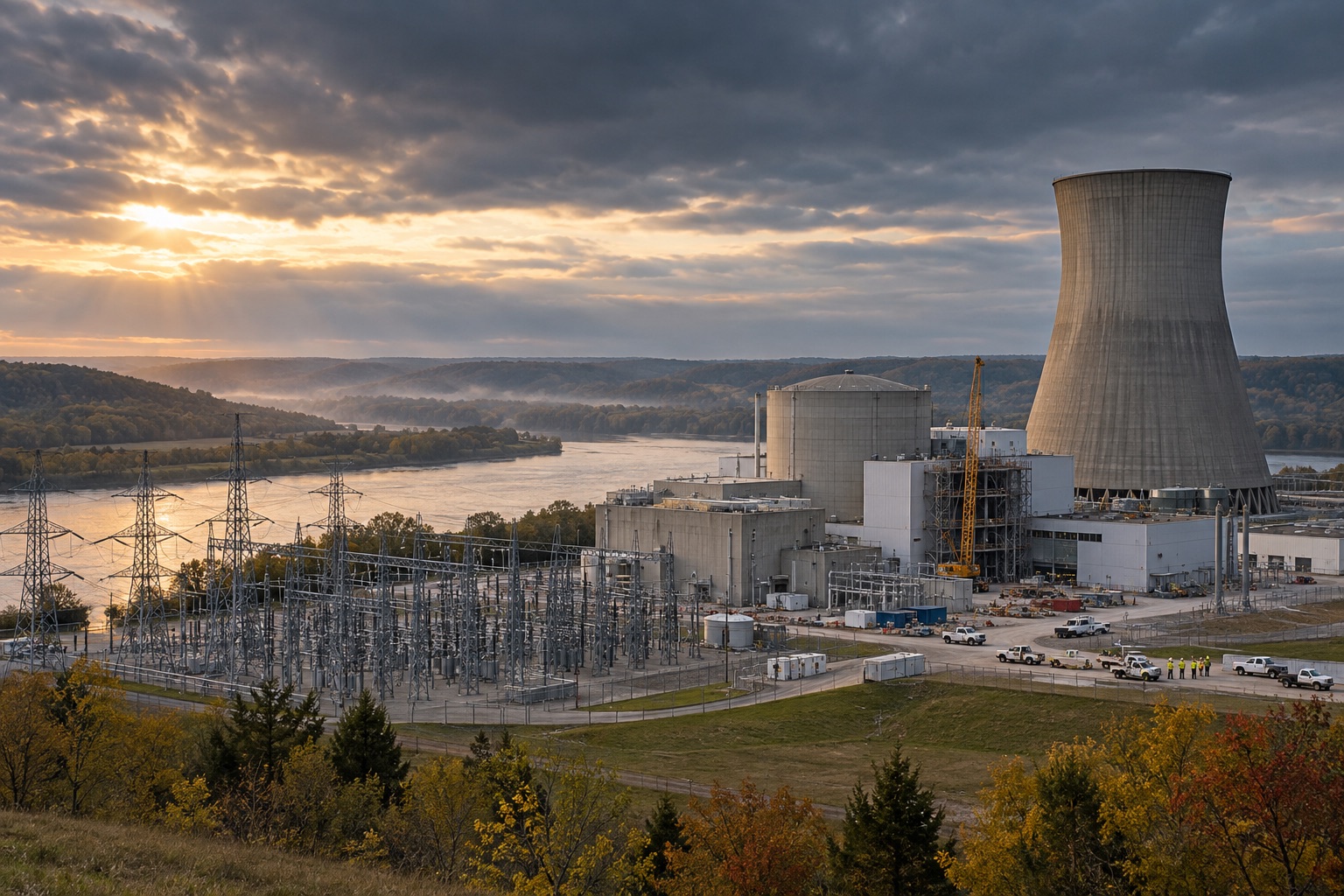
Duane Arnold restart benchmark
The loan supplies a concrete financing marker. The remaining gates determine when that capital becomes operating capacity.
| Marker | Value | What it does—and does not—prove |
|---|---|---|
| DOE loan | Up to $1.9 billion | A major financing gate is closed; it is not a final all-in project cost. |
| Plant capacity | 615 MW | Meaningful firm capacity for MISO, subject to licensing and successful restart. |
| Loan per nameplate MW | About $3.1 million | A useful restart-finance benchmark, not a cross-technology levelized-cost comparison. |
| Employment | ~1,500 construction; 450+ operations | An economic-development case that still depends on execution and commercial operation. |
Calculated and summarized from US Department of Energy project and loan-closing materials published September 2026.
The US Department of Energy has closed a loan of up to $1.9 billion to help NextEra Energy restart Iowa’s Duane Arnold Energy Center. The headline number is large, but its most useful infrastructure benchmark is more specific: the financing equals roughly $3.1 million for each of the plant’s 615 megawatts of nameplate capacity.
That is not the same as a final all-in cost per megawatt. A federal loan is financing, not a completed-project invoice, and the amount may cover only part of the ultimate capital requirement. Still, it is a rare public marker for what it now takes to return an existing reactor to service after it ceased operations in 2020.
Financial close funds the route back to the grid; licensing and execution determine whether the 615 megawatts arrive on time.
The attraction is obvious. DOE says the recommissioned plant could supply enough electricity for nearly 500,000 homes, support about 1,500 construction jobs and more than 450 operating jobs, and add firm generation to the Midcontinent Independent System Operator grid. Unlike a new reactor, the site already has a plant, transmission connection, and operating history.
The hard part is that none of those advantages makes a restart automatic. Duane Arnold still needs Nuclear Regulatory Commission approvals, refurbishment work, qualified labor, fuel and equipment planning, testing, and a commissioning schedule that survives close scrutiny. The megawatts matter only when they are licensed and synchronized to the grid.
That distinction is especially relevant to data-center and AI demand. DOE’s project page explicitly connects the restart to growing cloud and AI infrastructure needs. Large-load developers increasingly want firm power on timelines measured in a few years. A reactor restart can be strategically valuable, but its schedule cannot be treated like a signed power purchase agreement with a guaranteed delivery date.
Investors should therefore separate three milestones. Financial close shows that a lender accepted the project structure. Regulatory approval establishes whether and under what conditions the reactor can return. Commercial operation proves that the refurbishment, workforce, supply chain, and testing program delivered usable megawatts. Each milestone removes a different kind of risk.
The $3.1-million-per-megawatt financing ratio also needs context. It should not be compared casually with the overnight construction cost of a new gas, wind, solar, or nuclear plant because technologies deliver different capacity factors, fuel exposure, reliability attributes, and grid services. It is best used as a restart benchmark: how much committed federal capital is being placed behind an existing firm-power asset before completion.
For MISO planners, the restart offers scale but not a complete load-growth solution. Six hundred fifteen megawatts is meaningful regional capacity, yet a single large AI campus can request power on a comparable order of magnitude. Restarts can relieve part of the supply problem, but they do not eliminate transmission constraints, local deliverability limits, or the need to test whether announced loads actually arrive.
The broader policy signal is that Washington is willing to use its balance sheet to recover dormant nuclear capacity. DOE says this is the third nuclear restart it has financed under the current administration. That can create a repeatable capital path for a small set of viable sites, but the investable question remains site-specific: asset condition, licensing path, interconnection value, workforce, contract structure, and schedule credibility.
Duane Arnold is therefore more than a nuclear-revival headline. It is a live test of whether public finance can convert an existing but idle grid asset into dependable power faster and with less execution risk than building equivalent firm capacity from scratch.
Sources
US Department of Energy loan closing announcement, September 8, 2026: https://www.energy.gov/articles/energy-department-closes-19-billion-loan-restart-duane-arnold-nuclear-plant
US Department of Energy Duane Arnold project page: https://www.energy.gov/edf/duane-arnold
US Department of Energy environmental review completion letter: https://www.energy.gov/sites/default/files/2026-04/Duane%20Arnold%20Energy%20Center%20-%20Completion%20Letter.pdf
Nawaz Lalani
Nawaz Lalani is the creator of The Grid Report and writes about AI infrastructure, grid power demand, automation systems, and the market signals shaping the physical AI economy. His focus is translating technical and industrial shifts into practical coverage for operators, investors, builders, and teams making real deployment decisions.
B.S. in Geology from UT Arlington. Covers AI infrastructure, energy systems, grid constraints, automation workflows, and market signals.
Stories are built from primary sources, utility and infrastructure signals, company disclosures, filings, and operator-grade context. The goal is to explain what changed, why it matters now, and what it means for builders, investors, utilities, and teams making real deployment decisions.
Follow the lane, not just the headline.
The strongest value in The Grid Report comes from following how AI, infrastructure, power, automation, and markets connect over time.