- OpenAI’s new Deployment Company deserves attention because it makes the next enterprise AI bottleneck explicit.
- OpenAI’s own description is telling.
- The useful operator signal is that model quality alone is not clearing deployment friction.
- Section
- AI Automation
- Read time
- 6 min read
- Why this page exists
- The Grid Report publishes operator-grade coverage on AI, power, infrastructure, automation, and markets.
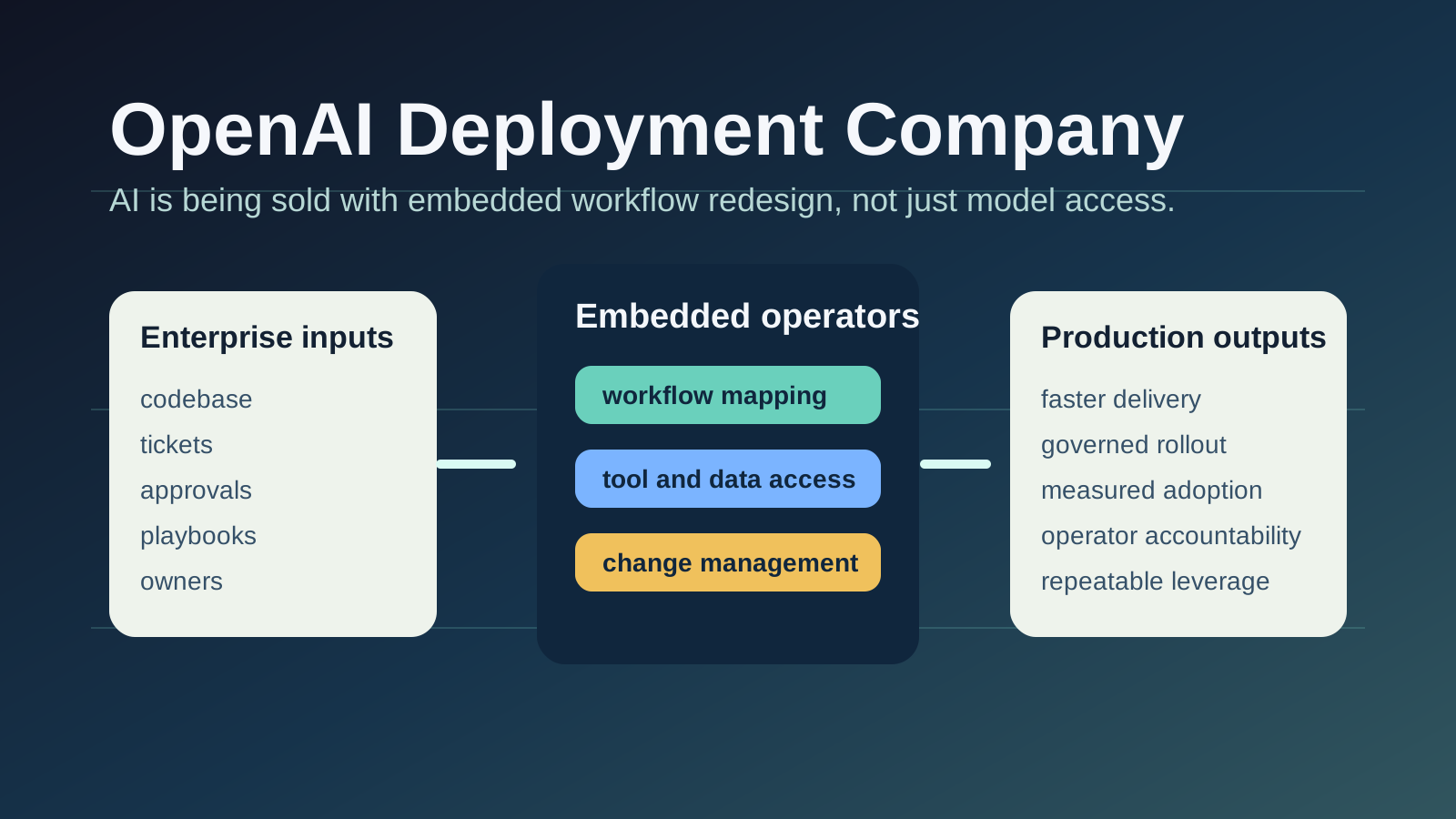
OpenAI’s new Deployment Company deserves attention because it makes the next enterprise AI bottleneck explicit. On May 11, 2026, OpenAI said it was launching a new company designed to help organizations build and deploy AI systems they can rely on in their most important work, and that it had agreed to acquire Tomoro to bring experienced Forward Deployed Engineers into the effort from day one. The surface story is services expansion. The deeper story is that enterprise AI is increasingly being sold with workflow redesign attached.
OpenAI’s own description is telling. It says these Forward Deployed Engineers will work directly with business leaders, operators, and frontline teams to identify where AI can have the biggest impact, redesign organizational infrastructure and critical workflows around it, and turn those gains into durable systems. That is materially different from the first phase of enterprise adoption, which was mostly about licenses, experimentation, and basic tool access.
The important shift is not that OpenAI launched another enterprise offering. It is that workflow redesign and embedded deployment labor are now being packaged as part of the AI product.
The useful operator signal is that model quality alone is not clearing deployment friction. Companies still need help mapping workflows, securing tool access, changing approvals, retraining teams, and measuring whether anything actually improved. By packaging those tasks inside a formal deployment arm, OpenAI is effectively admitting that the implementation layer is now strategic enough to deserve its own business line.
That also changes the competitive frame. Once AI vendors start providing embedded deployment labor, the market is no longer just models versus models. It becomes models plus organizational surgery. The vendor that can help a company redesign how work gets done may capture more durable value than the vendor that merely provides better answers in a chat window.
There is a broader systems implication here as well. OpenAI says the Deployment Company will work alongside its Alliance partner ecosystem, which suggests the frontier-model business is being paired with an execution network rather than treated as a standalone product. In practical terms, that pulls AI adoption closer to the consulting, systems-integration, and change-management stack, but with much tighter proximity to the model vendor itself.
For enterprises, this is both useful and clarifying. Useful because deployment help is real demand. Clarifying because it confirms that buying AI is increasingly a redesign decision, not a software-seat decision. If AI projects stall, the missing piece may not be another benchmark or another internal prompt guide. It may be the hard work of restructuring data flows, approvals, incentives, and ownership around the tool.
The Grid Report view is that OpenAI’s Deployment Company is one of the clearest signs yet that enterprise AI is moving from access to execution. The winners in this phase may be the firms that can combine model capability with operator-grade implementation discipline.
Sources
OpenAI, “OpenAI launches the OpenAI Deployment Company to help businesses build around intelligence,” published May 11, 2026: https://openai.com/index/openai-launches-the-deployment-company/
OpenAI, “The next phase of enterprise AI,” published April 2026 and accessed May 27, 2026: https://openai.com/index/next-phase-of-enterprise-ai/
Nawaz Lalani
Nawaz Lalani is the creator of The Grid Report and writes about AI infrastructure, grid power demand, automation systems, and the market signals shaping the physical AI economy. His focus is translating technical and industrial shifts into practical coverage for operators, investors, builders, and teams making real deployment decisions.
B.S. in Geology from UT Arlington. Covers AI infrastructure, energy systems, grid constraints, automation workflows, and market signals.
Stories are built from primary sources, utility and infrastructure signals, company disclosures, filings, and operator-grade context. The goal is to explain what changed, why it matters now, and what it means for builders, investors, utilities, and teams making real deployment decisions.
Follow the lane, not just the headline.
The strongest value in The Grid Report comes from following how AI, infrastructure, power, automation, and markets connect over time.